Key Takeaways
- Cava authorized its first share buyback ever on September 18, up to $100 million, arriving after the stock round-tripped from an April high near $95 down to roughly $52 even though second-quarter revenue grew 31.3% and same-restaurant sales rose 9%.
- Free cash flow inflected right before the announcement: after several quarters generating $1 million to $3 million, Cava produced $15.5 million and then $29.3 million in its two most recent quarters, a combined $44.8 million.
- Insider buying has replaced insider selling. Months after shareholder Artal Participations sold 3 million shares near $90 in June, Cava’s chief operating officer and chief legal officer both bought stock, at $66.52 in August and $49.96 in September.
Cava Stock’s Long Round Trip Meets a Real Cash Flow Story
On September 16, Cava’s chief legal officer, Joseph Kadow, filed a small purchase with the SEC: 1,000 shares bought through his spouse for $49,960, a rounding error next to a company with a market capitalization in the billions. Two days later, Cava did something bigger. The board authorized a $100 million share buyback, its first, running through September 2027.
The timing sits inside a longer story. Cava stock reached $95 in April, its high for the year, then slid through a guidance-driven pullback, a 3 million share sale by longtime investor Artal Participations near $90 in June, and a Cyclospora food safety scare in July that dented traffic even though Cava does not serve iceberg lettuce and was not named in the outbreak. By mid-September, shares were changing hands near $52, down roughly 13% for the year, a wide gap from a second quarter that beat estimates on every headline number: revenue up 31.3% to $365.4 million, same-restaurant sales up 9% on 5.3% traffic growth, and adjusted EBITDA up 30% to $54.7 million.
What had changed by September was the cash flow underneath the story.
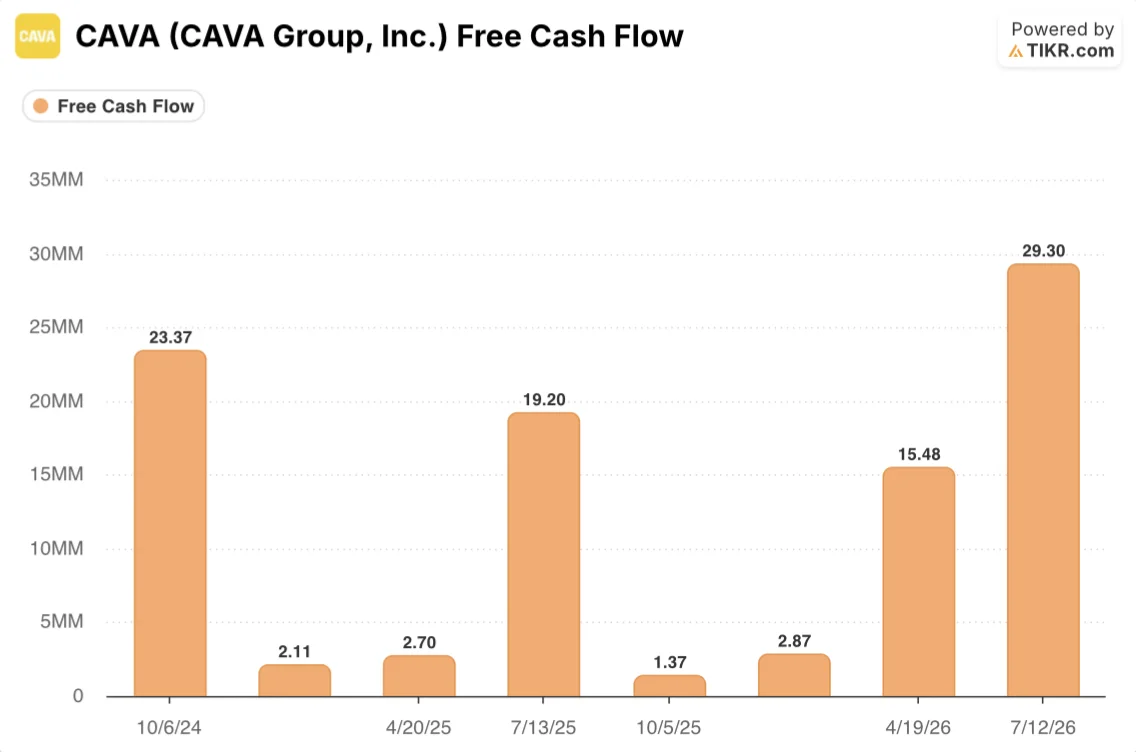
After producing free cash flow of just $2.11 million, $2.70 million, $1.37 million and $2.87 million across four uneven quarters, Cava’s free cash flow jumped to $15.48 million in the quarter ended April 19 and $29.30 million in the quarter ended July 12, a combined $44.8 million that management called out on the earnings call as its tenth straight quarter of positive year-to-date cash flow.
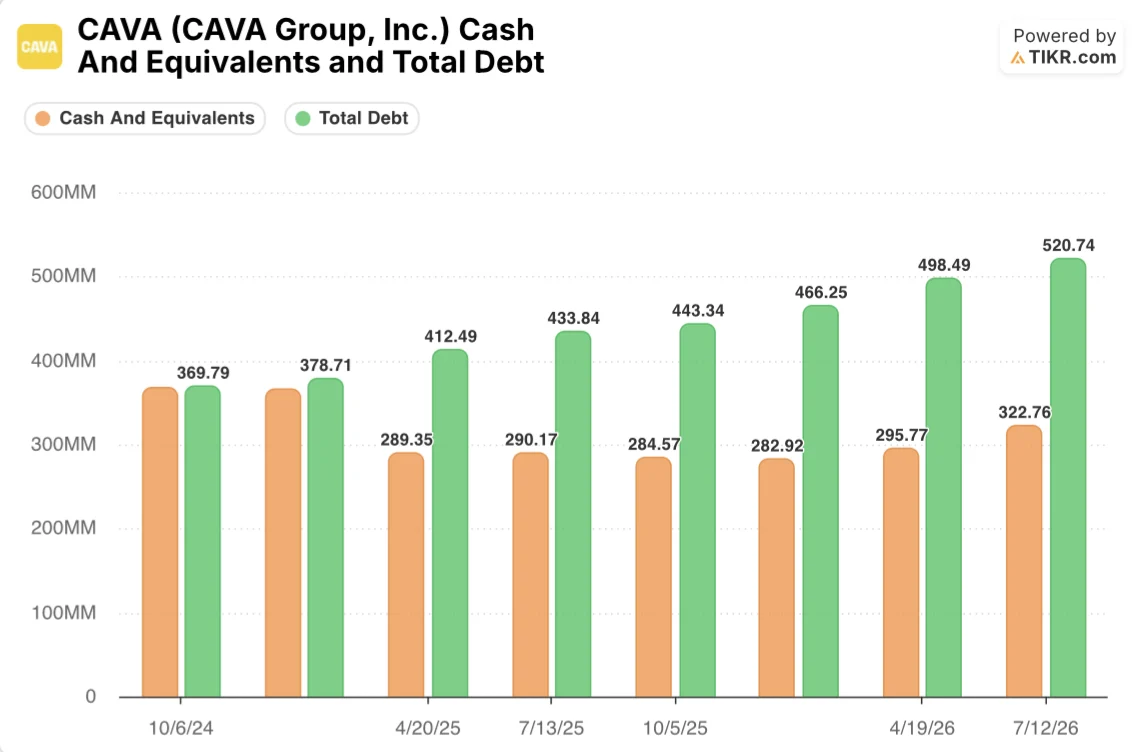
Cash and equivalents, which had drifted down from $369.8 million in late 2024 to a trough near $283 million earlier this year, rebuilt to $322.8 million by the second quarter’s close. The balance sheet’s rising total debt line, which has climbed steadily to $520.7 million alongside the buildout to 476 restaurants, tracks lease obligations from new stores rather than borrowed money; management said on the call it ended the quarter with zero debt outstanding and a fully undrawn $150 million revolver.
What the Buyback Actually Signals
A $100 million authorization against $322.8 million of cash and a run rate of roughly $30 million of quarterly free cash flow is not a company betting the balance sheet. The press release itself is written in discretionary language, no minimum purchase commitment, timing tied to market conditions and stock valuation, room to modify or suspend the program at any point. That is closer to a signal than a plan, a sign management is comfortable enough with cash generation to return some of it to shareholders without slowing the 75 to 77 net new restaurants it still plans to open this year, or the Las Vegas and Bay Area expansions on deck for 2027.
The skepticism has not gone away. Through September, analysts kept cutting targets even after the Q2 beat, JPMorgan to $80, Citi to $60, Guggenheim citing margin pressure tied to fuel surcharges and the pre-marinated chicken rollout Cava is funding into the back half of the year. Those are real costs working against restaurant-level margin just as the company tries to prove July’s traffic dip is fully behind it.
The buyback and the insider buying do not settle that argument, they reframe it. A management team that spent 2026 defending guidance through a food safety scare and a sliding stock is now putting its own capital, and modest amounts of personal capital, behind the idea that the sell-off overshot the fundamentals. The next two quarters of same-restaurant sales, and whether Cava actually executes the buyback into a still-cautious tape rather than just authorizing it, will say whether that read holds up.
Should You Invest in CAVA Group, Inc.?
The only way to really know is to look at the numbers yourself. TIKR gives you free access to the same institutional-quality financial data that professional analysts use to answer exactly that question.
Pull up CAVA stock and you’ll see years of historical financials, what Wall Street analysts expect for revenue and earnings in the quarters ahead, how valuation multiples have moved over time, and whether price targets are trending up or down.
You can build a free watchlist to track CAVA Group, Inc. alongside every other stock on your radar. No credit card required. Just the data you need to decide for yourself.
Access Professional Tools to Analyze CAVA stock on TIKR for Free →
Looking for New Opportunities?
- See what stocks billionaire investors are buying so you can follow the smart money.
- Analyze stocks in as little as 5 minutes with TIKR’s all-in-one, easy-to-use platform.
- The more rocks you overturn… the more opportunities you’ll uncover. Search 100K+ global stocks, global top investor holdings, and more with TIKR.
Disclaimer:
Please note that the articles on TIKR are not intended to serve as investment or financial advice from TIKR or our content team, nor are they recommendations to buy or sell any stocks. We create our content based on TIKR Terminal’s investment data and analysts’ estimates. Our analysis might not include recent company news or important updates. TIKR has no position in any stocks mentioned. Thank you for reading, and happy investing!