
Key Takeaways
- Four Joby Aviation insiders, CEO JoeBen Bevirt, CFO Rodrigo Brumana, Chief Policy Officer Gregory Bowles, and director Paul Sciarra, filed stock sales between August 13 and September 21, a stretch in which JOBY shares fell from near $8 to $6.30.
- TIKR’s free cash flow data shows Joby’s quarterly cash burn has widened from $118.7 million in mid-2025 to roughly $200 million in each of the last two quarters.
- Management is guiding for $385 million to $415 million in cash use in the second half of 2026, holding burn near its current elevated pace straight through September’s eIPP flights and the push toward first paying passengers.
- Joby still held $2.3 billion in cash and short term investments at the end of Q2, plus a pending $250 million Toyota investment, a real offset to the wider burn rate.
Joby Stock Slides as Four Insiders Cash Out
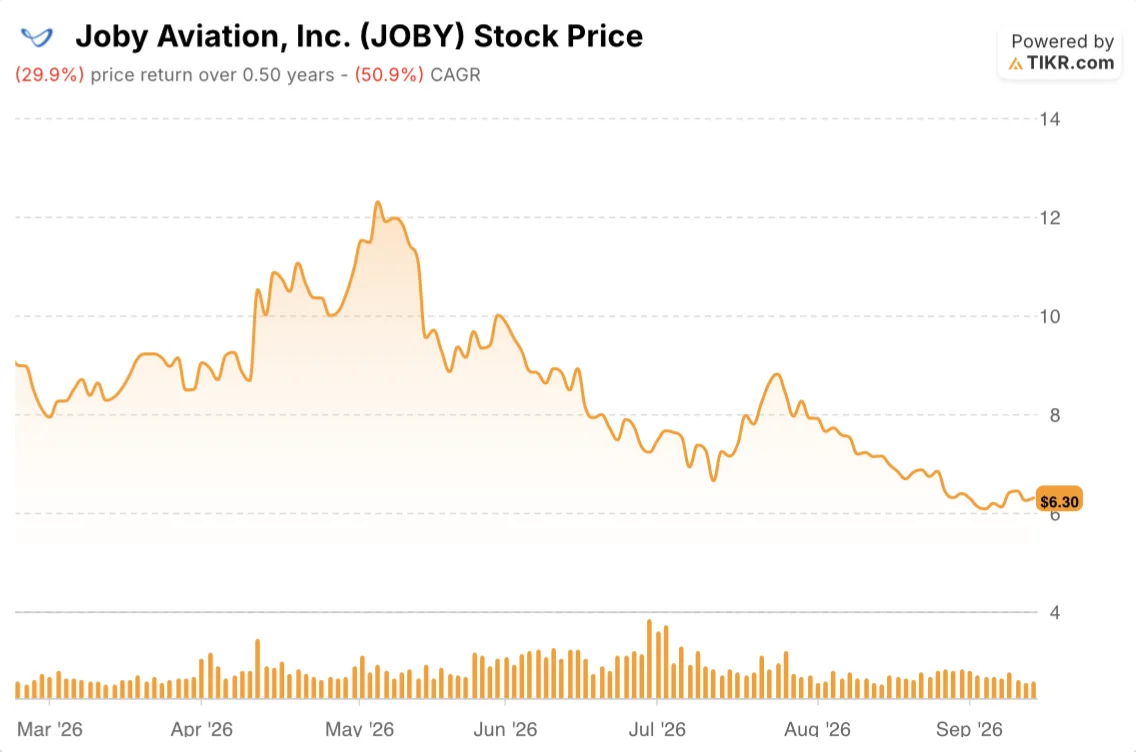
Joby Aviation’s chief policy officer, Gregory Bowles, filed a routine EDGAR disclosure on September 21: another 6,138 shares sold for $38,976, trimming his stake to 190,170 shares. Small money against a large holding. But it was the fourth insider sale filed at Joby in five weeks, and the stock changing hands that day traded around $6.35, near the bottom of a slide that had carried JOBY from close to $8 in mid-August.
Bowles wasn’t alone. Four days earlier, CEO JoeBen Bevirt disclosed the sale of 606,667 shares for $3.75 million, working out to roughly $6.18 apiece, cutting his indirect stake held through the Joby Trust to 57.2 million shares. It was Bevirt’s second sale of the summer. On August 17, he had sold 596,667 shares for $4.69 million at $7.87, back when the stock was still holding above $7.50. CFO Rodrigo Brumana filed sales of his own on September 2 and 3, 46,729 shares combined for $316,378, after an RSU settlement had briefly lifted his direct holdings. And on August 13, board director Paul Sciarra sold 62,500 shares for $497,500 at a weighted average of $7.96, just before the stock’s next leg down.
None of these sales moved the needle against the executives’ broader stakes. Bevirt’s trust still holds over 57 million shares, Sciarra’s trust nearly 56 million. But four separate insiders filing sales inside five weeks, on a stock that had already given back close to 30% over six months, from a May high near $12.50 down to $6.30, is the kind of pattern a reader notices even before asking whether it means anything.
Not all of these sales carry the same weight. Brumana’s came within two days of an RSU settlement adding 73,421 shares to his holdings, and Bowles paired his September sale with the exercise of 4,322 stock options, both patterns that look more like covering tax obligations on vesting equity than a fresh decision to reduce exposure. Bevirt’s two sales carry no such trigger in the filings; both came straight out of the Joby Trust with no vesting event attached, and none of the five disclosures name a pre-arranged trading plan, so the filings alone can’t say whether these were scheduled in advance or decided in the moment.
The Real Test Behind Joby’s Widening Burn
The insider filings are only half the story.
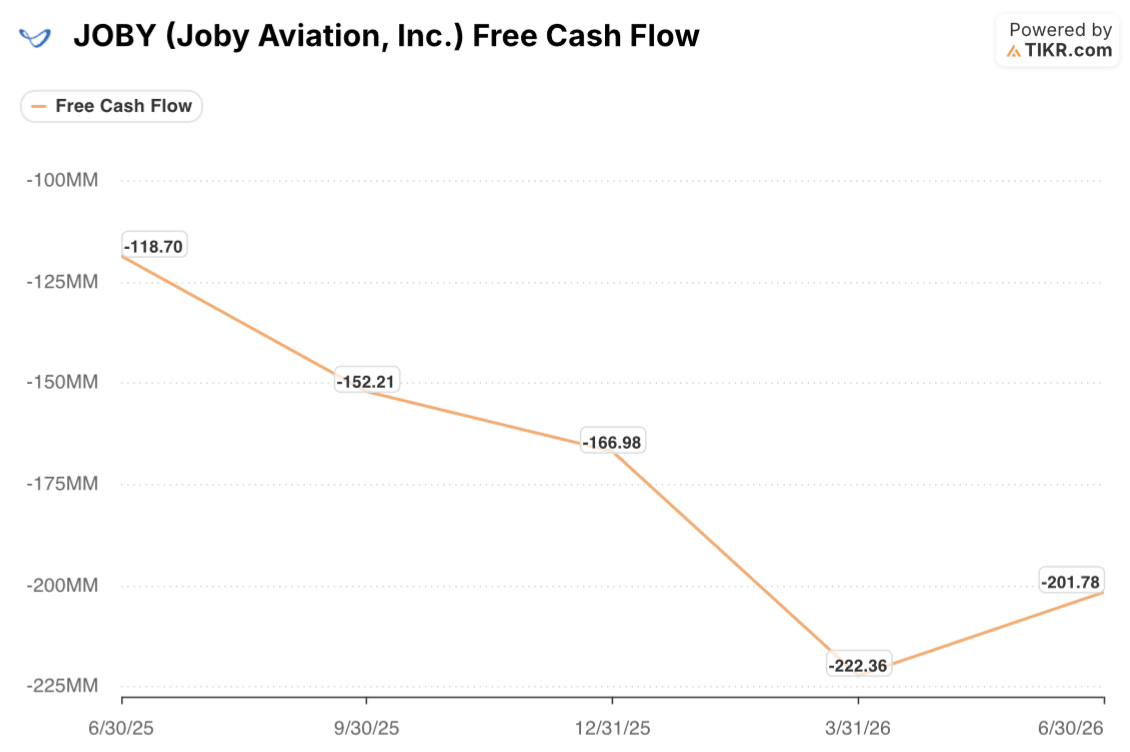
JOBY’s quarterly free cash flow data shows Joby’s cash burn has been on a steady climb: $118.7 million in the quarter ended June 2025, $152.2 million by September, $167.0 million by December, then a jump to $222.4 million in the first quarter of 2026 before easing slightly to $201.8 million in the second. That is not a one-quarter blip. It is a burn rate that has nearly doubled in a year, and management’s own second-half guidance of $385 million to $415 million implies a quarterly pace of roughly $193 million to $208 million, essentially locking in where the company already sits rather than signaling relief.
That timing matters. The elevated burn is set to run straight through Joby’s highest-stakes operating stretch yet: eIPP flights in Texas, a push toward carrying its first passengers, and a continued manufacturing ramp with Toyota. Against that, Joby still closed the second quarter with $2.3 billion in cash and short term investments, plus a pending $250 million investment from Toyota, so there is no near-term liquidity scare here.
The more useful question is what comes next. If Joby’s third-quarter free cash flow holds near $200 million rather than climbing toward the top of guidance, and if the insider filings quiet down once eIPP passenger flights actually get underway, the current selling reads as routine diversification against outsized stakes. If burn pushes higher and the sales keep coming, the pattern earns a second look.
Should You Invest in Joby Aviation, Inc.?
The only way to really know is to look at the numbers yourself. TIKR gives you free access to the same institutional-quality financial data that professional analysts use to answer exactly that question.
Pull up JOBY stock and you’ll see years of historical financials, what Wall Street analysts expect for revenue and earnings in the quarters ahead, how valuation multiples have moved over time, and whether price targets are trending up or down.
You can build a free watchlist to track Joby Aviation, Inc. alongside every other stock on your radar. No credit card required. Just the data you need to decide for yourself.
Access Professional Tools to Analyze JOBY stock on TIKR for Free →
Looking for New Opportunities?
- See what stocks billionaire investors are buying so you can follow the smart money.
- Analyze stocks in as little as 5 minutes with TIKR’s all-in-one, easy-to-use platform.
- The more rocks you overturn… the more opportunities you’ll uncover. Search 100K+ global stocks, global top investor holdings, and more with TIKR.
Disclaimer:
Please note that the articles on TIKR are not intended to serve as investment or financial advice from TIKR or our content team, nor are they recommendations to buy or sell any stocks. We create our content based on TIKR Terminal’s investment data and analysts’ estimates. Our analysis might not include recent company news or important updates. TIKR has no position in any stocks mentioned. Thank you for reading, and happy investing!