Key Stats for Verizon Stock
- Current Price: $41.65
- Target Price (Mid): ~$70
- Street Target: ~$51
- Potential Total Return: ~67%
- Annualized IRR: ~13% / year
Now Live: Discover how much upside your favorite stocks could have using TIKR’s new Valuation Model (It’s free) >>>
What Happened?
“I do not see it as a viable competitor in the medium and even longer term,” Verizon Communications (VZ) CEO Dan Schulman said of satellite on September 9. After the October 8 close, SpaceX (SPCX) agreed to buy Grain Management’s nationwide 800 MHz spectrum, a deal still pending FCC approval.
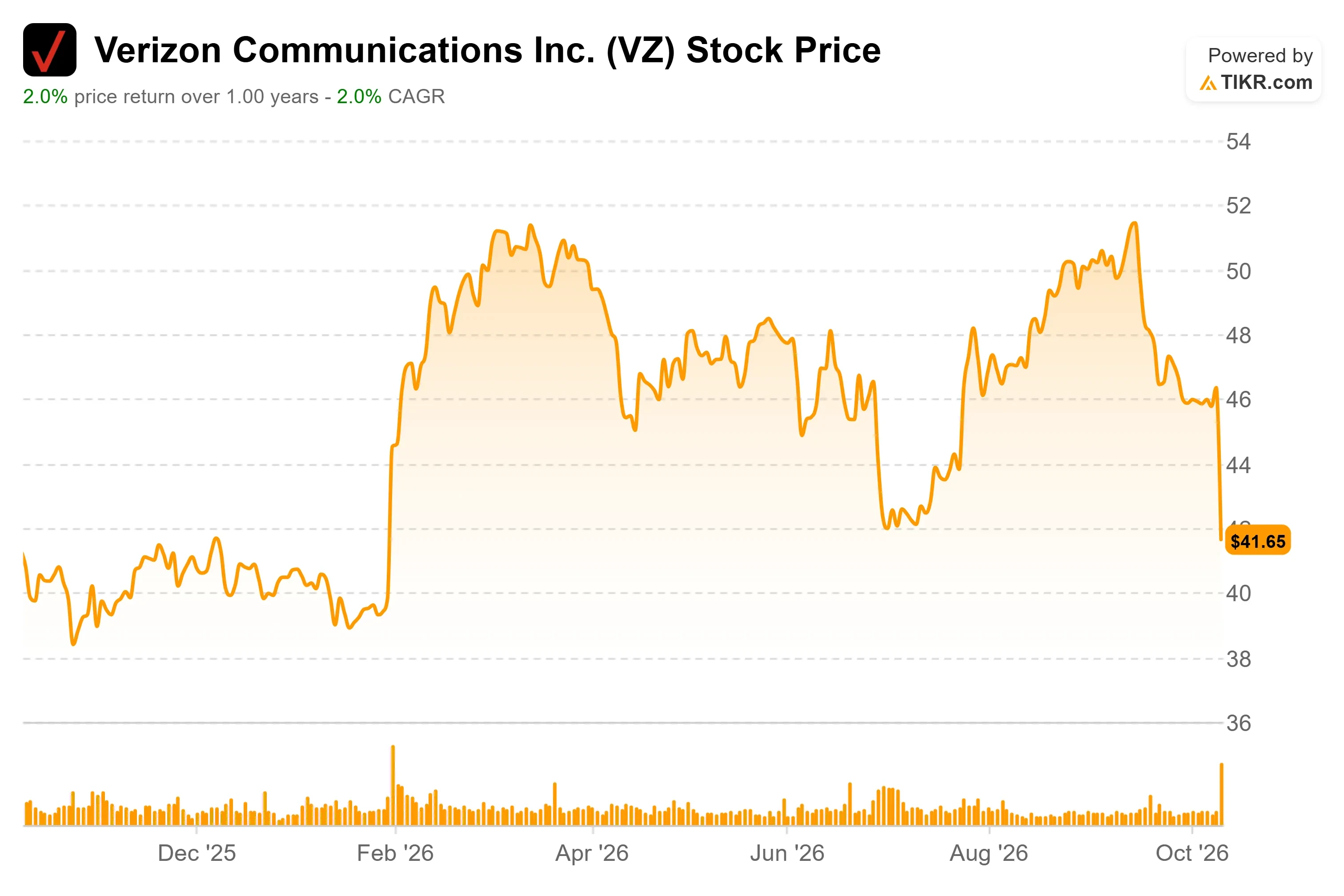
On October 9, Verizon closed at $41.65, down 10.14%. About $0.71 of the $4.70 decline reflects the 70.75-cent quarterly dividend, since October 9 was also the ex-dividend date. At about 2:30 p.m. ET, Verizon was down 10.91%, AT&T (T) 11.28%, and T-Mobile US (TMUS) 12.81%. Verizon’s investor relations materials put Schulman’s next chance to respond on October 26.
See historical and forward estimates for Verizon stock (It’s free!) >>>
Schulman Bet on Network Economics and Closed the Wholesale Door
At the Goldman Sachs Communacopia conference, Schulman said Verizon had seen “no, 0, discernible impact” on broadband growth from any low-earth-orbit provider. He argued satellite “just can’t compete without a terrestrial network in urban and suburban,” where he put roughly 95% to 98% of Verizon’s revenue. He also said “we see absolutely no advantage in extending an MVNO to any LEO provider nor are there any backdoors whatsoever to any of our existing MVNO relationships.”
SpaceX said the low-band spectrum “addresses one of the key remaining technical gaps” on Starlink Mobile’s path to becoming a major U.S. carrier. Evercore’s Kutgun Maral said “The carriers’ best argument just got weaker,” but he called the deal a coverage fix rather than a capacity solution. Evercore counts about 79 MHz at SpaceX against 280 to 380 MHz for each of the big three, and it sees full 5G-quality service as possible from the first half of 2028.
TD Cowen puts a terrestrial build at more than $80 billion. Its analyst Gregory Williams thinks SpaceX wants a wholesale deal first, renting capacity on existing networks. That is the route Schulman said Verizon sees “absolutely no advantage” in offering.
The Estimates Held and the Multiple Fell
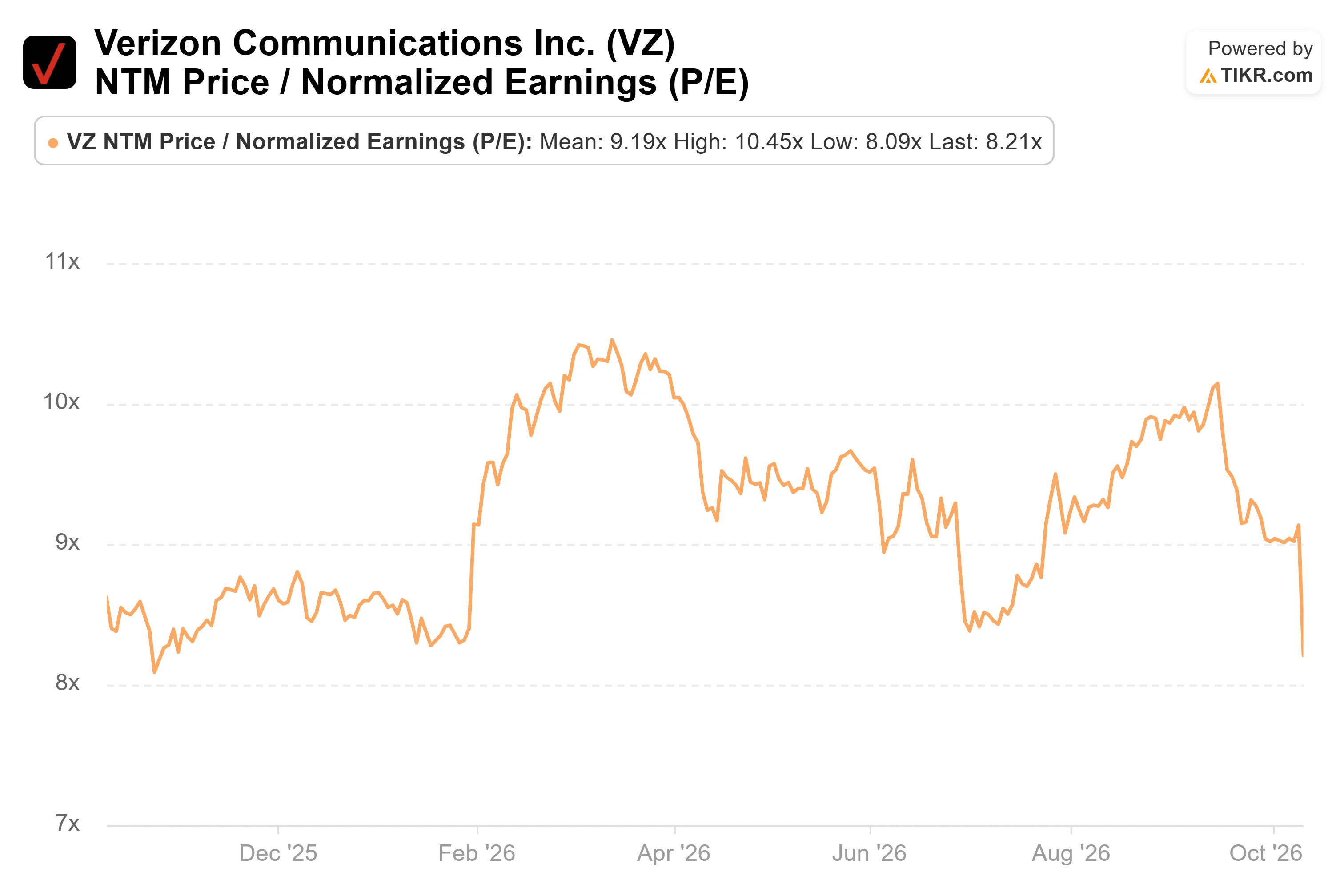
TIKR shows NTM normalized EPS at $5.07 on October 9, against $5.09 on September 30. Over the same span, the NTM P/E fell to 8.21x from 9.02x. AT&T trades at 9.21x NTM earnings and Deutsche Telekom (DTE) at 10.24x. Verizon’s NTM free cash flow yield is 13.8%, and its NTM dividend yield is 6.9%.
Between September 30 and October 9, the analyst mix moved to 8 Buy, 2 Outperform, and 16 Hold, from 8, 3, and 15. The highest target fell to $62 from $71. The lowest Street target, $44, still sits above the October 9 close.
See how Verizon performs against its peers in TIKR (It’s free!) >>>
TIKR Advanced Model Analysis
- Current Price: $41.65
- Target Price (Mid): ~$70
- Potential Total Return: ~67%
- Annualized IRR: ~13% / year

See analysts’ growth forecasts and price targets for Verizon stock (It’s free!) >>>
The TIKR mid case targets around $70 by December 31, 2030. That is roughly where it stood when TIKR covered Verizon at $47.08 on September 26. The lower entry price lifts the potential total return to about 67%, or about 13% a year.
The mid-case inputs, shown over TIKR’s 2025 to 2035 forecast table, assume about 2% annual revenue growth, net margins near 17%, and a slightly lower P/E. Schulman expects mobile and broadband service revenue growth to exit 2026 around 4%, with cost of acquisition at three-year lows.
The primary risk is a price war. Schulman’s plan wins customers without phone subsidies, and a cheaper Starlink Mobile offer would test whether churn gains hold without discounts. If Evercore’s 2028 timeline slips, the P/E has room to move back toward its September 30 level of 9.02x.
Conclusion
Third-quarter results cover July through September, before the October 8 deal, so churn cannot reflect it. The call matters more. Schulman said in September that he expects churn to “continue to have year-over-year improvement as we go through the rest of the year.” If he repeats the no-backdoors line and the 4% service-revenue exit on October 26, his September math stands. If he softens either, investors have their answer.
See what stocks billionaire investors are buying so you can follow the smart money with TIKR.
So what is Verizon stock actually worth?
TIKR lets you forecast the future price of any stock in less than a minute. Just enter a few assumptions into TIKR’s valuation model and see what Verizon could be worth. Start from Wall Street consensus estimates, or adjust the inputs to reflect your own view of the business. It’s free to use.
Analyze Verizon on TIKR Free →
Disclaimer:
Please note that the articles on TIKR are not intended to serve as investment or financial advice from TIKR or our content team, nor are they recommendations to buy or sell any stocks. We create our content based on TIKR Terminal’s investment data and analysts’ estimates. Our analysis might not include recent company news or important updates. TIKR has no position in any stocks mentioned. Thank you for reading, and happy investing!