


Key Takeaways
- OpenAI reportedly expects to reach or exceed $70 billion of annualized revenue by year-end, and investor Gavin Baker argues that growth which comes from taking share would hurt demand for AI infrastructure.
- Baker says open-weight tokens cost clouds the same compute as frontier tokens but earn them higher margins, because OpenAI and Anthropic have the leverage to push prices down.
- Microsoft brought in about 67% of CoreWeave’s 2025 revenue, and CoreWeave is locked into mostly long-term contracts, while Nebius has used short contracts to raise prices.
- Analysts expect Nebius’s revenue to climb from $530 million in fiscal 2025 to $23.0 billion in fiscal 2028, and CoreWeave’s next gross margin is the number to watch.
If you own Amazon (AMZN), Microsoft (MSFT) or CoreWeave (CRWV), OpenAI’s latest number probably looked like great news.
The ChatGPT maker expects to reach or exceed $70 billion of annualized revenue by year-end, up from roughly $50 billion at the end of September, Bloomberg reported on October 9. That makes $70 billion a target rather than a result: a day earlier, the Financial Times reported that OpenAI had told investors its run rate was nearing $50 billion, well below the $70 billion figure that circulated in late September.
More OpenAI should mean more compute rented from the clouds. Right?
Atreides Management’s Gavin Baker has “a more extreme view.” On Friday, he posted on X:
“I think an acceleration in OpenAI and Anthropic, if it came even partially from share gains, would be net negative for AI infra demand.”
That’s a plot twist for anyone who’s treated the two biggest labs as the clouds’ best customers.
Same Compute, Fatter Margins
Baker starts with cost. In his words, “the production cost of a given token in compute and energy terms is the same regardless of whether it is an open weight token or a closed frontier token.”
What changes is who’s paying. As he put it:
“And open-weight tokens are the highest margin tokens for the clouds and neoclouds given the negotiating leverage and size of Anthropic and Open AI.”
Put simply, OpenAI and Anthropic buy enough compute to play one cloud against another on price. A startup running an open-weight model on rented GPUs can’t.
And those customers are piling in. In the last week of September, DeepSeek models processed more tokens on OpenRouter than OpenAI, Google, Anthropic and xAI models combined, according to Social Capital.
Crusoe CEO Chase Lochmiller sees the same split in his managed inference business. He told 20VC on October 3 that “people are spending more money on closed source frontier models than they are on open source, but they are generating more tokens on open source than closed source.”
Baker has made a version of this point before. In an August thread, he predicted closed frontier tokens would end up as “60-90% of economic value but only 15 to 25% of tokens.” For a cloud, tokens are the workload, so that’s a future where most of its volume comes from customers without much leverage.
What CoreWeave’s Numbers Show
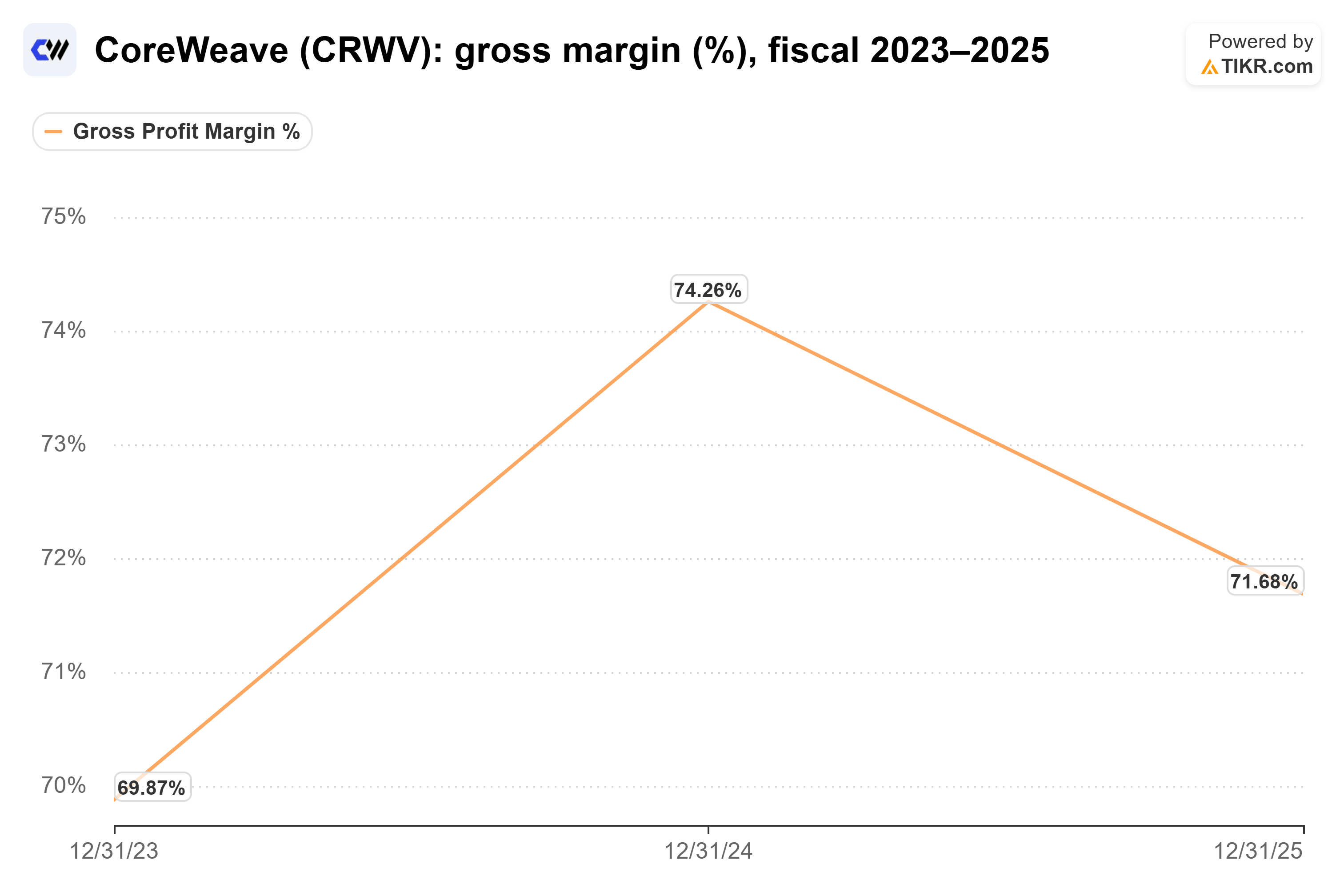
CoreWeave is the clearest test, because it shows what one dominant buyer looks like. Microsoft brought in about 67% of CoreWeave’s 2025 revenue, up from 62% in 2024, according to CoreWeave’s annual report. Over the same stretch, CoreWeave’s gross margin slipped from 74.3% to 71.7%.
The filing doesn’t attribute the decline to Microsoft’s bargaining power, and the 71.7% gross margin excludes server and networking-equipment depreciation. Customer concentration has since declined: CoreWeave’s largest customer accounted for 36% of revenue in Q2 2026.
That’s where Microsoft’s twist comes in. It runs Azure, one of the giant clouds that should gain as open-weight demand spreads. It’s also the big buyer with leverage over CoreWeave, which puts it on both sides of Baker’s argument.
Why Nebius Looks Better Placed
Nebius (NBIS) is the contrast. SemiAnalysis’s Dylan Patel noted on the Big Technology Podcast that Nebius has “the shortest average contract length of the top clouds” in SemiAnalysis’s ClusterMax ratings, adding:
“Nebius has been able to turn around and really jack up pricing and take advantage of this.”
CoreWeave, he said, locked itself into mostly long-term contracts, so it couldn’t take as much advantage.
Patel was talking about contract length. Still, short contracts are what let a cloud capture the pricing Baker describes. If demand from smaller customers keeps climbing, Nebius can reprice in months rather than years.
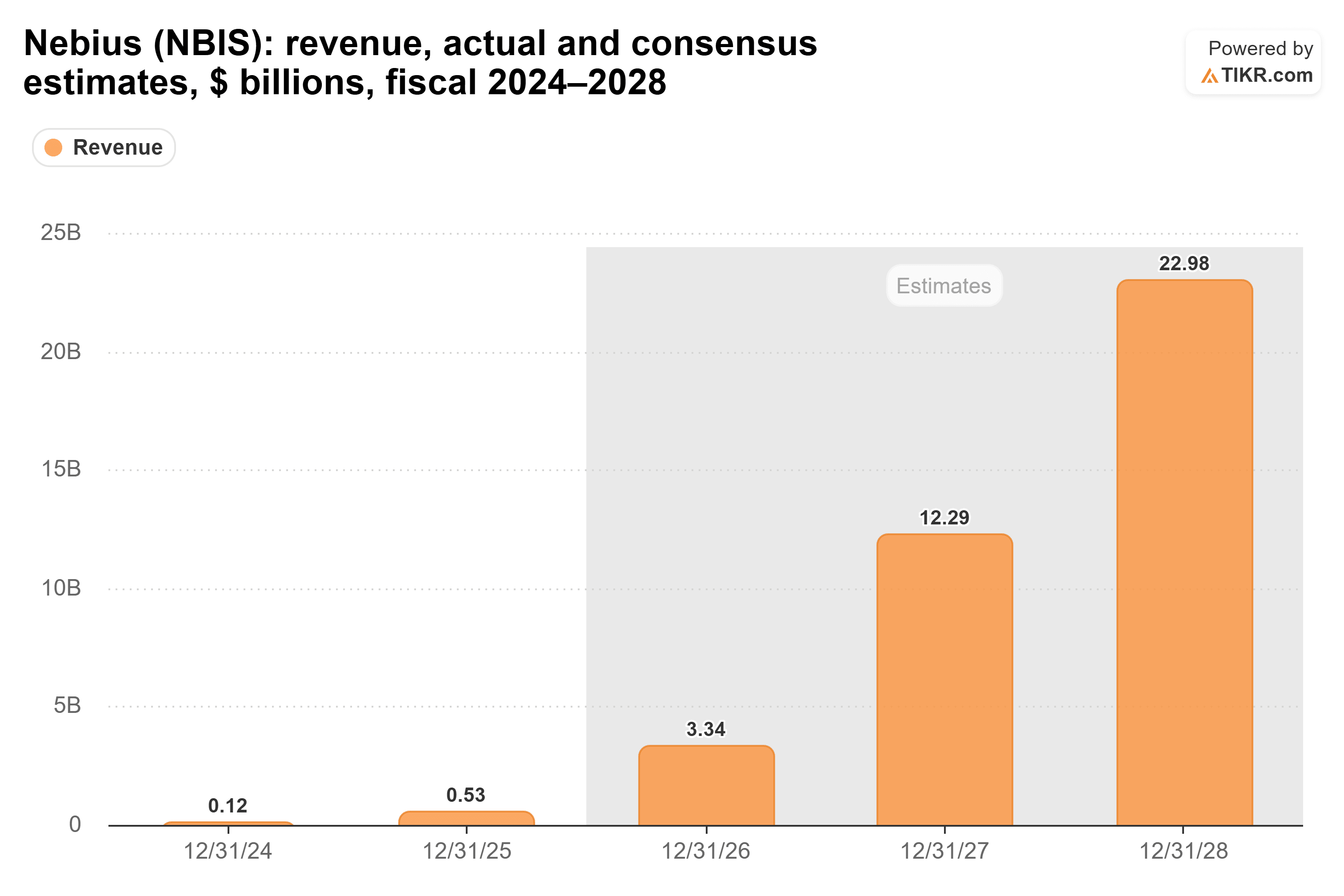
Analysts expect Nebius’s revenue to go from $530 million in fiscal 2025 to $3.34 billion this year, roughly six times larger, and $23.0 billion by fiscal 2028.
Those are estimates, and a lot has to go right to hit them. But the Street already expects a company that grows into its pricing power.
Where Amazon Fits

Amazon’s case is about scale. Its company-wide operating margin has already more than doubled, from 5.3% in fiscal 2021 to 11.2% in fiscal 2025.
That margin covers far more than AI, from retail to advertising, so it can’t prove Baker right on its own. What it shows is a business already turning more of each sales dollar into profit. More tokens from customers who can’t negotiate hard would push in the same direction.
The Labs Still Sign the Biggest Checks
The strongest case against Baker is that open-weight models push token prices down for everyone. If that squeezes OpenAI’s and Anthropic’s revenue, the huge compute commitments they’ve made to these same clouds could shrink too, and faster than open-weight volume replaces them.
Baker’s reply: “The entire supply chain benefits from open-weight models.” When another user pointed out that the labs put their profits back into training, he answered: “Training will inevitably asymptote to an irrelevant % of compute demand.”
That’s a bet that inference volume will outgrow everything else. Today, though, CoreWeave still leans on its biggest buyers, and an OpenAI that hits $70 billion would put more of the market back in the labs’ hands.
Conclusion
Baker’s logic holds up. A cloud earns the most when no single customer can set its price, and the open-weight surge brings it more of exactly those customers.
Nebius’s shorter contracts offer repricing opportunities, but it also has major multiyear agreements with Microsoft and Meta. CoreWeave’s longer contracts constrain repricing of existing business, although it has also reported price increases on new business. The disclosures do not establish which company will benefit most or fastest from open-weight demand.
One week of DeepSeek data on one gateway isn’t a trend yet. CoreWeave’s next report may offer clues about pricing and costs, but a lower gross margin alone would not establish pressure from its biggest buyers or reveal the profitability of open-weight workloads.
So what is Nebius stock actually worth?
TIKR lets you forecast the future price of any stock in less than a minute. Just enter a few assumptions into TIKR’s valuation model and see what Nebius could be worth. Start from Wall Street consensus estimates, or adjust the inputs to reflect your own view of the business. It’s free to use.
Disclaimer:
Please note that the articles on TIKR are not intended to serve as investment or financial advice from TIKR or our content team, nor are they recommendations to buy or sell any stocks. We create our content based on TIKR Terminal’s investment data and analysts’ estimates. Our analysis might not include recent company news or important updates. TIKR has no position in any of the stocks mentioned. Thank you for reading, and happy investing!


