


SpaceX (SPCX) just made its biggest move yet into the phone business, and Elon Musk is already talking about something much, much bigger.
On Thursday, SpaceX agreed to buy all of Grain Management’s nationwide 800 MHz spectrum. SpaceX plans to combine its satellite network with terrestrial infrastructure using the low-band spectrum to improve coverage inside buildings. Financial terms weren’t disclosed, and the deal still needs FCC approval. (TIKR covered the deal itself here.)
Musk’s take on X: “To the casual observer, this won’t seem like much. To those who understand the spectrum wars, it’s an earthquake.”
Then he went further:
“This will sound super crazy, but I see a path to SpaceX being worth orders of magnitude more than the current Earth economy.”
The World Bank puts that economy at about $118 trillion. One order of magnitude more would be $1.18 quadrillion, or more than 500 times SpaceX’s roughly $2.3 trillion market value today.
He did warn us it would sound crazy.
AT&T, Verizon and T-Mobile Took It Seriously
Whatever you make of the quadrillion talk, investors treated the spectrum deal as real. AT&T (T) and Verizon (VZ) each fell nearly 10% on Friday, and T-Mobile (TMUS) fell about 13%.
T-Mobile’s bigger drop comes with an awkward backstory. Those 800 MHz licenses used to be its own. T-Mobile handed them to Grain in August for $2.9 billion plus Grain’s 600 MHz holdings, and the FCC’s terms required Grain to find someone to put the underused spectrum to work. That someone is now a would-be rival. (Bloomberg reported in August that Grain was seeking about $6 billion for the portfolio.)
Scotiabank cut its price targets on all three carriers. Analyst Maher Yaghi said the purchase makes hybrid satellite-and-ground networks a more credible threat, though SpaceX still has to prove its network can handle crowded cities and that the economics work.
JPMorgan is calmer. It doesn’t expect Starlink Mobile to meaningfully challenge the US mobile-service market, which it sizes at roughly $240 billion, over its forecast horizon. It points to the time, infrastructure and capital a competitive ground network takes.
The selloff says more than the target cuts do. The deal isn’t approved, and the ground network isn’t built. The carriers dropped 10% or more anyway, so investors are already pricing in part of SpaceX as a phone company.
SpaceX’s Revenue Has to More Than Quadruple
That matters, because $2.3 trillion already assumes a lot of growth. As John Foley put it on the Prof G Markets podcast on Thursday: “I think its revenue is expected to quadruple by the end of 2028. If that happens, then these debt numbers start to look less scary.”
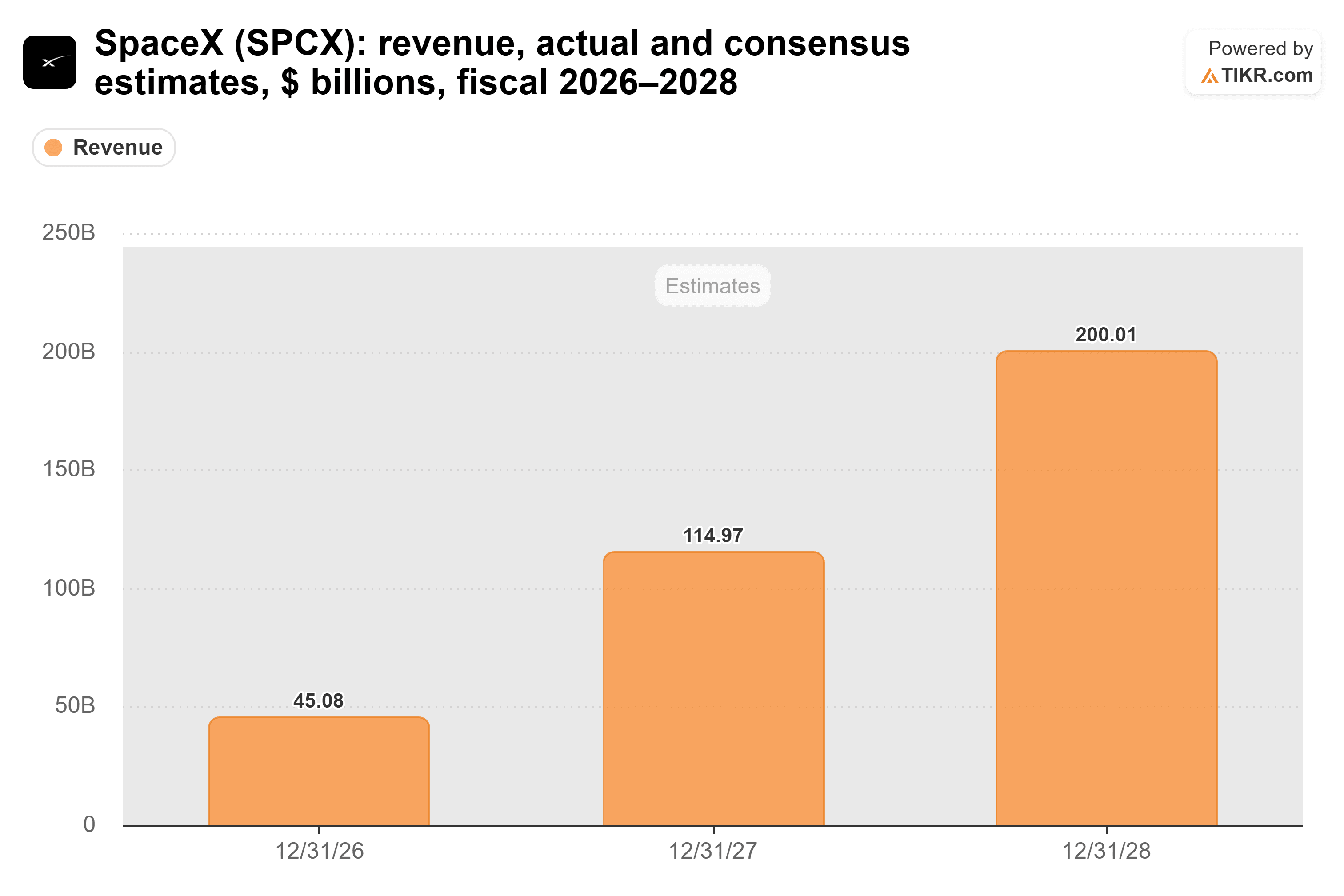
The consensus backs him up, and then some. Analysts expect revenue to climb from $45.1 billion in 2026 to $115 billion in 2027 and $200 billion in 2028. That’s about 4.4 times this year’s figure in two years.
Here’s the catch for the phone story. The whole $240 billion US mobile market JPMorgan describes is only about 20% bigger than the revenue analysts expect SpaceX to book in 2028. Even a huge win in phones leaves much of that growth to AI compute, and SpaceX is borrowing heavily to build it. The company is looking to raise $40 billion in debt to buy AI chips, and the cost of insuring its debt against default has hit a fresh high, Bloomberg reported on Friday.

Investors are paying up for that future now. SpaceX trades at about 106x forward earnings, down from a peak of about 272x in July. Before that, the multiple was negative: until early July, analysts expected SpaceX to lose money over the next 12 months.
Even after that drop, it’s a multiple that leaves little room for 2028 to come in short.
The Lockups Haven’t Sunk SpaceX Yet
Not everyone’s convinced. Veteran short seller Jim Chanos replied with a question: “Anybody recall when the $SPCX lockups come off?”
It’s a fair question. Another tranche of about 7% of SpaceX’s shares becomes free to trade this week. A bigger release of about 1.3 billion shares follows SpaceX’s third-quarter report in November, its second as a public company.
The stock has handled this before, though. The first lockup ended on Aug. 6, and Wall Street braced for a flood of selling. Instead, SpaceX shares rose 35% in five sessions and climbed back above their $135 IPO price. Since then, the float has grown from a single-digit share of the stock at the June IPO to about a third, and SpaceX has added back more than $750 billion in value since its August low.
Nancy Tengler, chief investment officer at Laffer Tengler, which holds SpaceX shares, told Bloomberg: “A lot of the SpaceX insiders want to hang on.”
The Bottom Line on SpaceX Stock
Foley put the bear case bluntly: “if you think that SpaceX is really worth $2.3 trillion, which is where it is today, it’s because you think Elon Musk is some kind of anomalous genius.”
You don’t need to believe in genius to own the stock here. You need to believe in about $200 billion of revenue by 2028. The quadrillion is a bonus.
Friday’s carrier selloff tells me plenty of investors already believe the phone part of that story, and I’m with them. Buying the low-band spectrum T-Mobile gave up closes a real gap in Starlink Mobile’s coverage. I wouldn’t count on mobile service alone to deliver that growth. That makes execution on SpaceX’s debt-funded AI expansion another major part of the investment case.
November is the first hard check: SpaceX reports its third quarter, and roughly 1.3 billion more shares come free to trade. If the stock absorbs that supply the way it handled August’s, and the quarter shows revenue on pace for the $115 billion analysts expect in 2027, the 2028 bar starts to look reachable.
Want to check the numbers yourself? Pull up SpaceX’s revenue estimates and forward P/E history on TIKR for free, then plug your own 2028 assumptions into the valuation model and see what the stock could be worth. Learn more here.
So what is SpaceX stock actually worth?
TIKR lets you forecast the future price of any stock in less than a minute. Just enter a few assumptions into TIKR’s valuation model and see what SpaceX could be worth. Start from Wall Street consensus estimates, or adjust the inputs to reflect your own view of the business. It’s free to use.
Disclaimer:
Please note that the articles on TIKR are not intended to serve as investment or financial advice from TIKR or our content team, nor are they recommendations to buy or sell any stocks. We create our content based on TIKR Terminal’s investment data and analysts’ estimates. Our analysis might not include recent company news or important updates. TIKR has no position in any of the stocks mentioned. Thank you for reading, and happy investing!


