Key Takeaways
- UPS’s cash dividend payout ratio is a stretched 99% over the last twelve months, against a comfortable 27% for FedEx in its latest fiscal year.
- UPS yields 7% but held its dividend flat this year, ending a run of annual raises that began in 2010.
- FedEx yields 1.7% after cutting its per-share dividend 16% when it spun off FedEx Freight, which it counts as its sixth straight annual raise.
- FedEx’s Oct. 28 report will be the first look at its free cash flow without FedEx Freight.
United Parcel Service (UPS) yields 7%, and its cash dividend payout ratio is a stretched 99%. Over the last twelve months, it paid $5.41 billion in dividends from $5.46 billion of free cash flow.
And the promise behind that dividend has changed. In July 2025, CEO Carol Tomé told investors, “you have our commitment to a stable and growing dividend.” This year, UPS held it at $1.64 a quarter, ending a run of annual raises that began in 2010. It now says it “has either maintained or increased its dividend each year since going public in 1999.”
That’s what makes FedEx (FDX) such an interesting comparison. It yields just 1.7% and cut its per-share dividend 16% when it spun off FedEx Freight in June. But its cash dividend payout ratio was a comfortable 27% in its latest fiscal year, so it looks a lot less stretched. So which dividend is better to own – the big check, or the one with more room to grow?
| Metric | UPS | FedEx |
|---|---|---|
| Forward dividend yield | 7.0% | 1.7% |
| Annual dividend | $6.56 | $4.88 |
| 5-yr dividend growth | 10.2% a year | 13.4% a year |
| Streak | Raised 2010-2025; held in 2026 | Six straight raises by FedEx’s count; June 2026’s was a 16% per-share cut |
| Cash dividend payout ratio, TTM | 99% | 27% |
| Net debt ÷ EBITDA | 1.63x | 1.65x |
| Interest coverage | 7.6x | 7.7x |
Source: TIKR, prices at the Sept. 29, 2026 close. FedEx’s figures use its post-spin $4.88 rate, and its payout ratio covers the year to May 31, 2026, including FedEx Freight.
UPS is getting smaller on purpose
UPS spent the last 18 months cutting its Amazon volume by more than half from 2024 levels and closing buildings. It finished in June. In the second quarter, U.S. volume fell 3.3%, revenue per piece rose 9.3%, and U.S. Domestic adjusted operating profit jumped 21%.
Paying for the dividend is another story…

Dividends have sat around $5.4 billion since 2023, while free cash flow swung between $4.8 billion and $6.2 billion. Dividends outran free cash flow in four of these ten years. That’s a dividend with no room to spare.
This year’s plan is about $5.4 billion of dividends from about $5.5 billion of free cash flow. That free cash flow absorbs about $1.1 billion of one-time driver buyouts, and the plan includes no buybacks.
The risk is obvious: In a soft year for shipping, part of the dividend comes from the balance sheet.
FedEx has room to spare
FedEx is reshaping its network too, with a lot more slack. It’s steering toward premium business-to-business and international shipping. Its Network 2.0 overhaul will close about 30% of its facilities by the end of 2027 to save $2 billion.
Revenue rose 8% last fiscal year, to $94.7 billion.
And its free cash flow has pulled well clear of its dividend…
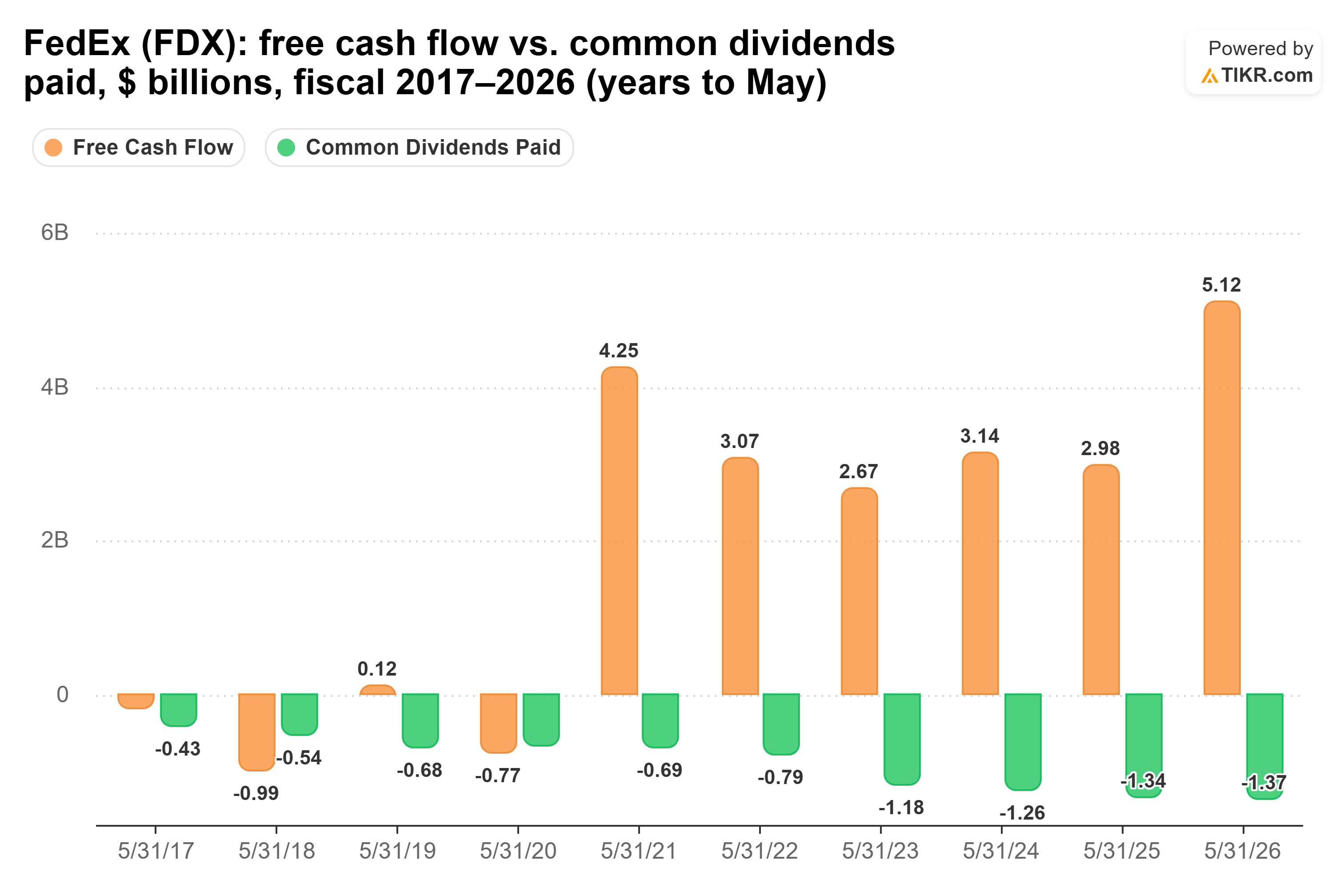
Dividends topped free cash flow every year from fiscal 2017 to 2020. Free cash flow has run at more than twice the dividend every year since. That’s the cushion I want to see.
Two catches. First, those figures include FedEx Freight.
Second, the new $1.22 quarterly dividend is 16% less per share than the old $1.45. Interim CFO Claude Russ still calls it “the sixth consecutive annual dividend increase,” after adjusting for the spin-off. (Shareholders did get Freight shares, which don’t pay a dividend yet.)
Even so, the new rate costs FedEx about $1.15 billion a year. That’s under a quarter of last year’s free cash flow.
So which dividend wins?
Ultimately, I have to go with the 7% yield. It’s just too much money to leave on the table! Both companies are rebuilding their networks, and UPS’s second quarter shows its plan working. And while FedEx is doing it with plenty of room between its free cash flow and its dividend, the difference in payout is just too much to overcome unless UPS starts cutting. Right now, if you put $10,000 in UPS, you’d collect about $700 a year at today’s rate, against about $170 from FedEx.
UPS has more going for it, too. Its profits are climbing again, with second-quarter adjusted EPS up 13.5%. This year’s free cash flow is carrying about $1.1 billion of one-time buyouts. And I’d expect management to defend a record of holding or raising the dividend every year since 1999.
So what is UPS stock actually worth?
TIKR lets you forecast the future price of any stock in less than a minute. Just enter a few assumptions into TIKR’s valuation model and see what UPS could be worth. Start from Wall Street consensus estimates, or adjust the inputs to reflect your own view of the business. It’s free to use.
Disclaimer:
Please note that the articles on TIKR are not intended to serve as investment or financial advice from TIKR or our content team, nor are they recommendations to buy or sell any stocks. We create our content based on TIKR Terminal’s investment data and analysts’ estimates. Our analysis might not include recent company news or important updates. TIKR has no position in any of the stocks mentioned. Thank you for reading, and happy investing!