Key Stats for United Airlines Stock
- Current Price: $102.78
- Target Price (Mid): ~$144
- Street Target: ~$132
- Potential Total Return: ~40%
- Annualized IRR: ~8% / year
- Earnings Reaction: -5.58% (April 21, 2026)
Now Live: Discover how much upside your favorite stocks could have using TIKR’s new Valuation Model (It’s free) >>>
What Happened?
United Airlines Holdings (UAL) is sitting in one of the more pointed disconnects in the airline sector right now. IATA just cut its 2026 global profit forecast nearly in half, jet fuel has risen roughly 70% year over year, and UAL has pulled back 14% from its 52-week high of $119.21. Yet on May 27, CEO Scott Kirby walked into Bernstein’s 42nd Annual Strategic Decisions Conference and made the confident case that 2027 will deliver double-digit pretax margins and that competitors are structurally unable to catch up. A week later, Morgan Stanley raised its price target on UAL to $182, maintaining an Overweight rating.
The question is not whether Kirby is optimistic. He always is. The question is whether the specific claims he made at Bernstein hold up against the numbers, and whether $102.78 already prices in the bad news without pricing in the good.
The Industry Backdrop
According to IATA’s official June 7 press release, global airline profits are expected to fall from $45 billion in 2025 to $23 billion in 2026. Jet fuel is projected to average $152 per barrel this year, up from $90 in 2025, pushing the industry’s total fuel bill to roughly $350 billion and consuming more than 31% of every operating dollar.
United is not immune. When it reported Q1 2026 results on April 21, the company cut its full-year adjusted EPS guidance from $12-$14 down to $7-$11, citing roughly $340 million in added fuel costs from the Iran conflict. The stock fell 5.58% that day despite a genuine beat: Q1 revenue of $14.6 billion (up 10.6% year over year) and adjusted EPS of $1.19 both topped estimates, per the United Q1 2026 earnings release. The $1.08 consensus EPS estimate was beaten by nearly 10%.
Strong execution, a challenged near-term cost structure, and a stock punished despite the beats.

See historical and forward estimates for United Airlines stock (It’s free!) >>>
What Kirby Said at Bernstein
Conference appearances by airline CEOs often produce talking points. Kirby’s May 27 session with Bernstein analyst David Vernon produced something more specific. Four claims deserve direct scrutiny.
On 2027 double-digit margins: Kirby said he is “increasingly confident that 2027 will be double-digit pretax margins,” adding that “nothing special needs to happen” to get there. His internal target assumes oil normalizes and calls for roughly 3 points of margin improvement over 2024 levels, implying around 11%. When Vernon asked whether the market was simply pushing 2026 targets one year forward, Kirby pushed back: “I don’t think it will be.”
TIKR’s consensus estimates support the direction. EBITDA is estimated to recover from $7.6 billion in 2026 to around $10 billion in 2027, a 31% increase. Normalized EPS is estimated to jump from $9.27 in 2026 to $14.22 in 2027, a 53% recovery, per TIKR. Net income margin is estimated at 4.4% in 2026, expanding to 6.5% in 2027. The consensus is directionally with Kirby, even if the exact margin level is still debated.
On the loyalty program: Kirby described the Chase partnership as “a decade old” and said competing deals have already been modernized. United is “in the opening innings of starting to modernize our deal” and expects to double the EBITDA of that business. He was explicit that this sits on top of, not in place of, the core airline’s earnings. MileagePlus loyalty revenue grew 13% in Q1 2026 per the earnings release. The loyalty-doubling thesis is the largest piece of upside not obviously reflected in today’s multiple.
On Starlink and technology: Kirby called full-fleet Starlink Wi-Fi the single biggest near-term customer differentiator. The airline is already close to 500 aircraft equipped and expects 100% fleet coverage within a year. He cited Starlink’s net promoter score (NPS, the standard measure of customer satisfaction) at above 90. For context, United’s previous Wi-Fi providers were nowhere near that level.
On consolidation: Kirby closed this chapter cleanly. “I don’t think that United at least is going to participate in any consolidation for any time I can see in the foreseeable future.” The American Airlines overhang that weighed on the stock for several weeks is gone.
What the Recovery Requires, and What Could Derail It
The upside case is straightforward. Fuel normalizes in 2027, as Kirby expects. United exits the cost headwind with a stronger competitive position than when it entered, because it never cut product investment or technology spending. The loyalty modernization adds a new earnings layer on top. At $66.8 billion in 2026 revenue growing toward $69.7 billion in 2027, double-digit margins would imply earnings power well above where the stock is priced today.
The risk is equally clear. Free cash flow is estimated to fall roughly 59% from $2.6 billion in 2025 to around $1.05 billion in 2026, per TIKR. LTM net debt stood at $16.8 billion with a net debt/EBITDA ratio of 1.31x. Fuel does not normalize as quickly as Kirby expects, and the $4-wide EPS guidance range for 2026 ($7-$11) reflects genuine uncertainty. Any extended disruption pressures both the income statement and the balance sheet.
Kirby acknowledged this at Bernstein without deflecting: “We are confident that this one way or another will be temporal.” He also flagged competitor capacity as unlisted upside. “If you’re breakeven or worse as an airline, that means you got a bunch of flying that loses money. It’s just simple math.” When weaker carriers pull back, that is incremental demand that United does not need to fight for.
See how United Airlines performs against its peers in TIKR (It’s free!) >>>
TIKR Advanced Model Analysis
- Current Price: $102.78
- Target Price (Mid): ~$144
- Potential Total Return: ~40%
- Annualized IRR: ~8% / year

See analysts’ growth forecasts and price targets for United Airlines stock (It’s free!) >>>
The TIKR mid-case model targets approximately $144 by 12/31/30, producing around 40% total return and an annualized IRR of roughly 8%. The two CAGR drivers are international segment recovery (United’s Atlantic and Pacific geographic segments together generated $18.5 billion in 2025 operating revenue per TIKR, both growing year over year) and loyalty scaling as MileagePlus modernization begins. The margin driver is fuel normalization, with the mid-case net income margin estimated at 7.0%. The primary risk is a prolonged fuel cost environment, which would keep margins compressed and free cash flow under pressure.
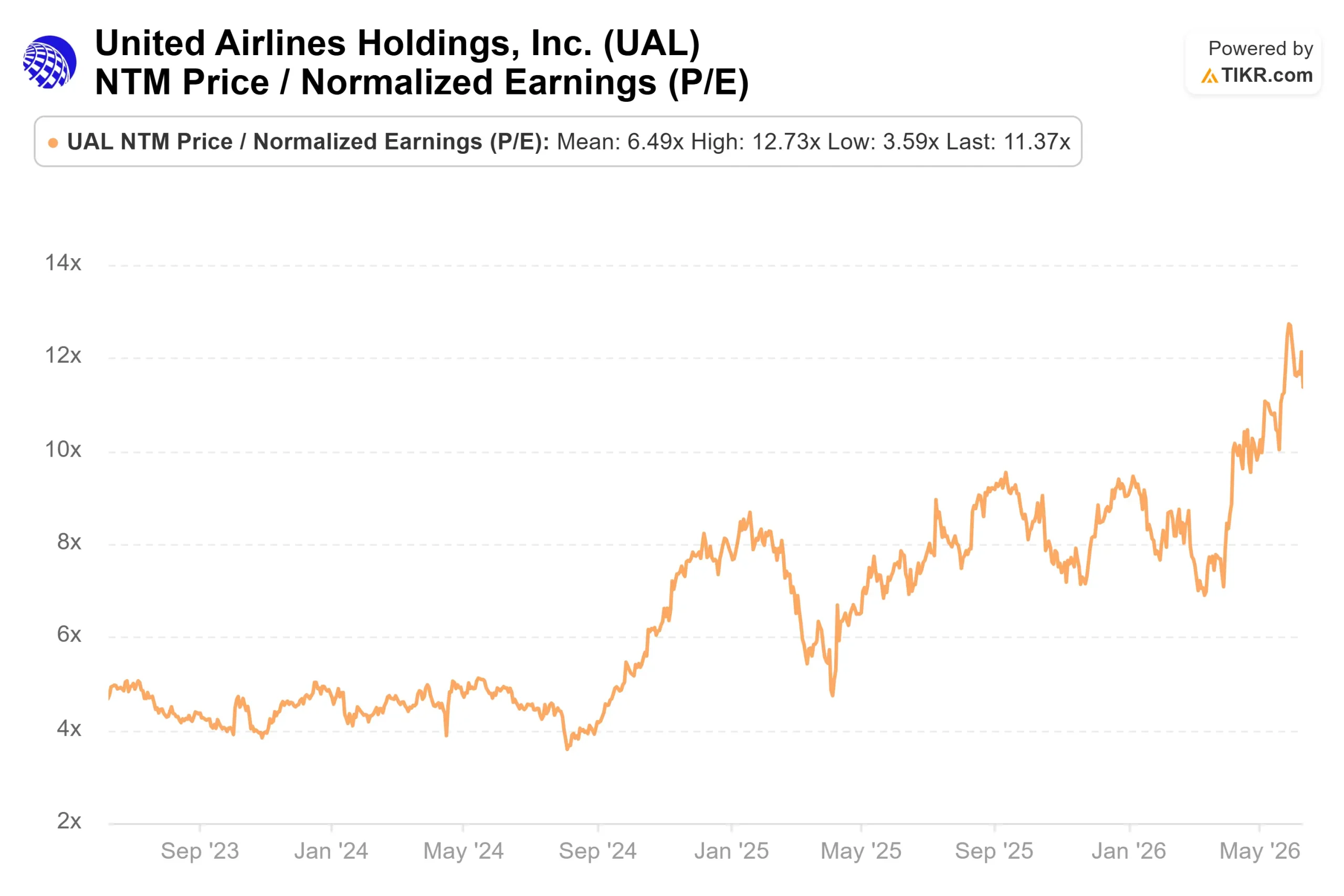
Neither the Street consensus at around $132 nor the TIKR mid-case at $144 comes close to Morgan Stanley’s $182. Getting there requires the loyalty EBITDA doubling to materialize, margins to recover to double digits, and the NTM P/E to re-rate from today’s 11.37x. That is a chain of events, not one catalyst. None of it is implausible, but the TIKR mid-case does not assume all of it arrives in full.
At $102.78, the near-term headwind looks priced in. The recovery that the consensus, the TIKR model, and the CEO all expect does not. The only real debate is timing.
Conclusion
The most important near-term test is Q2 2026 earnings, expected in mid-July. Kirby said at Bernstein that demand “is developing much like we thought” and that fuel cost recovery is coming “probably even sooner than we otherwise would have as oil prices start to come down.” If Q2 shows RASM (revenue per available seat mile, the airline industry’s unit revenue standard) continuing to offset the fuel headwind, and full-year guidance holds at $7-$11, the 2027 double-digit margin call survives. A miss on either front reopens the question. Kirby has been right about United’s structural positioning for years. Whether he is right about the timing will begin to be answered in mid-July.
See what stocks billionaire investors are buying so you can follow the smart money with TIKR.
Should You Invest in United Airlines?
The only way to really know is to look at the numbers yourself. TIKR gives you free access to the same institutional-quality financial data that professional analysts use to answer exactly that question.
Pull up United Airlines, and you’ll see years of historical financials, what Wall Street analysts expect for revenue and earnings in the quarters ahead, how valuation multiples have moved over time, and whether price targets are trending up or down.
You can build a free watchlist to track United Airlines alongside every other stock on your radar. No credit card required. Just the data you need to decide for yourself.
Analyze United Airlines on TIKR Free →
Looking for New Opportunities?
- See what stocks billionaire investors are buying so you can follow the smart money.
- Analyze stocks in as little as 5 minutes with TIKR’s all-in-one, easy-to-use platform.
- The more rocks you overturn… the more opportunities you’ll uncover. Search 100K+ global stocks, global top investor holdings, and more with TIKR.
Disclaimer:
Please note that the articles on TIKR are not intended to serve as investment or financial advice from TIKR or our content team, nor are they recommendations to buy or sell any stocks. We create our content based on TIKR Terminal’s investment data and analysts’ estimates. Our analysis might not include recent company news or important updates. TIKR has no position in any stocks mentioned. Thank you for reading, and happy investing!