Key Stats for Uber Stock
- Past-Week Performance: -0.4%
- 52-Week Range: $60.6 to $102
- Current Price: $73.8
What Happened?
Uber (UBER), the global ride-hailing and food delivery giant, is executing a platform expansion that pushed full-year 2025 free cash flow to $9.8 billion, up 42%, while shares trade at $73.84, well off the 52-week high of $101.99.
The February 4 Q4 earnings call confirmed gross bookings grew 22% in Q4 and monthly active users hit 202 million, with the Uber One membership program, which charges subscribers for discounts across rides and food delivery, surging 55% to 46 million members.
Non-top-20 U.S. cities, markets outside major urban centers that many investors overlook, now generate roughly 75% of U.S. mobility profits and are growing 1.5x faster than dense metros, proving the platform’s monetization runway extends far beyond San Francisco and New York.
Balaji Krishnamurthy, Chief Financial Officer, stated on the Q4 2025 earnings call that “we think our stock is dislocated right now, and we are being aggressive,” tying directly to the company’s continuation of over $6 billion in 2025 shareholder returns with no sign of slowing buybacks.
With Uber targeting 15 autonomous vehicle cities by end of 2026, a $100 million AV charging infrastructure commitment, the Joby Aviation air taxi partnership launching in Dubai, and a $1 billion European food delivery expansion expected to compound over three years, the platform is widening its addressable market on every front simultaneously.
Wall Street’s Take on UBER Stock
The 22% Q4 gross bookings growth and $9.8 billion free cash flow confirm Uber’s platform is compounding efficiently, making the current $73.84 price look increasingly disconnected from forward earnings momentum.

Street estimates project revenue scaling from $52 billion in 2025 to $58.4 billion in 2026, with adjusted EBITDA, the platform’s operating profit before non-cash items, expanding from a 16.8% margin in 2025 toward 18.9% in 2026, a trajectory proving the business model is structurally improving, not plateauing.
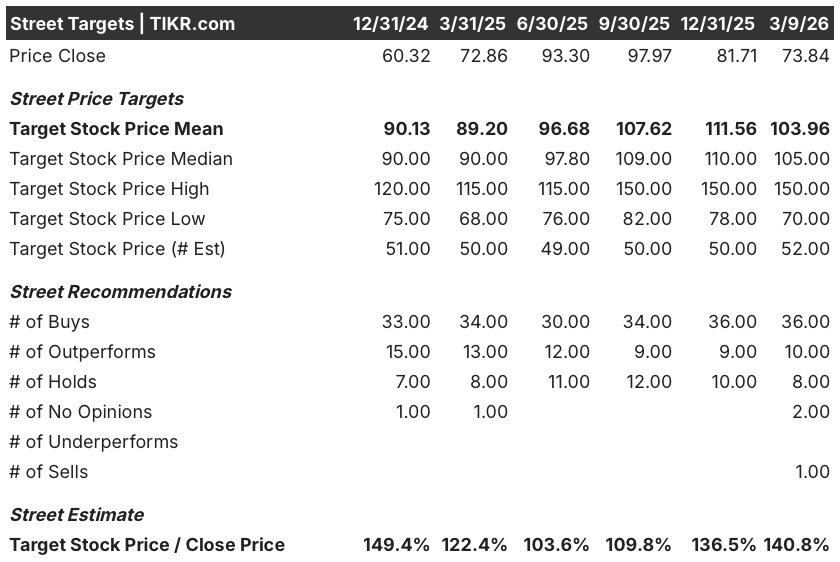
Forty-six analysts currently cover UBER, with 36 buys and 10 outperforms against just 8 holds and 1 sell, and a mean price target of $103.96 that implies 40.8% upside from today’s close, reflecting broad conviction that the selloff from the $101.99 52-week high is a dislocation, not a re-rating.
The analyst target range runs from $70 to $150, where the low end reflects AV competitive risk and the Portnoy Law Firm securities fraud probe, while the $150 bull case prices in the full monetization of the 15-city AV rollout and $1 billion European delivery expansion already underway.
What Does the Valuation Model Say?

The TIKR mid-case model prices UBER at $205.32 by December 2030, a 178.1% total return at a 23.7% annualized IRR, built on a conservative 10.9% revenue CAGR and 16% net income margin, both already within reach given 2025 actuals of 18% revenue growth and a 10% net income margin that is still early in its expansion curve.
The market is pricing Uber as a ride-hailing commodity, but the EBITDA margin has expanded from negative in 2021 to 16.8% in 2025, with the model projecting 22.9% by 2030.
Non-top-20 U.S. cities, growing 1.5x faster than dense markets and generating 75% of U.S. mobility profits, validate the model’s assumption that Uber’s profit pool is still widening, not narrowing.
Balaji Krishnamurthy called the stock “dislocated” and committed to aggressive buybacks, a management signal that insiders view $73.84 as a structural mispricing, not a fair value.
The securities fraud probe opened by Portnoy Law Firm on March 3 is the primary risk: if it escalates into a class action with material damages, it pressures the free cash flow that funds buybacks and AV investment simultaneously.
Watch the Q1 2026 earnings report for MAPC growth sustaining above 18% year-on-year and any update on the 15-city AV deployment timeline, the two inputs the TIKR model’s revenue growth assumption depends on most directly.
Should You Invest in Uber Technologies, Inc.?
The only way to really know is to look at the numbers yourself. TIKR gives you free access to the same institutional-quality financial data that professional analysts use to answer exactly that question.
Pull up UBER stock and you’ll see years of historical financials, what Wall Street analysts expect for revenue and earnings in the quarters ahead, how valuation multiples have moved over time, and whether price targets are trending up or down.
You can build a free watchlist to track Uber Technologies, Inc. alongside every other stock on your radar. No credit card required. Just the data you need to decide for yourself.
Access Professional Tools to Analyze UBER stock on TIKR for Free →