Key Takeaways
- Uber beat third-quarter profit and revenue estimates on November 4 as gross bookings rose 20%, and the stock closed up 4.9%.
- Josh Brown says Uber is “narratively challenged.” The stock trades on the robotaxi race, where Alphabet’s Waymo and Tesla get the attention, more than on its results.
- Bookings growth slowed from 22% in the second quarter, but free cash flow rose to $2.5 billion. Going into the report, analysts already expected earnings per share to more than double from 2025 to 2028.
- At about 17x forward earnings against a three-year average of 25x, Uber is priced for the robotaxi fear. If the driverless rollout stays on schedule, starting with 700 vehicles by year-end, that discount looks too steep.
Uber Technologies (UBER) beat third-quarter profit and revenue estimates on November 4, as gross bookings rose 20%. The stock closed up 4.9% at $69.87.
Uber holders have seen this movie before, though.
On the November 3 episode of The Compound and Friends, Michael Batnick said Uber has fallen after six of its last seven earnings reports. Ritholtz Wealth Management CEO Josh Brown explained why: “in the end they are narratively challenged.”
Uber keeps announcing partnerships with robotaxi companies that people don’t see on the streets, Brown said, while Waymo, owned by Alphabet (GOOG), is “full speed ahead.” His advice for CEO Dara Khosrowshahi was to talk about autonomous taxis “as much as Elon does.” That’s Elon Musk of Tesla (TSLA).
Ouch. But it’s hard to argue with the way the stock trades.
The results keep showing up
The quarter itself was strong. Adjusted EPS came in at $0.88, the top of Uber’s own guidance range and above analysts’ estimates of $0.86 to $0.87. Revenue rose 10% to $14.8 billion, adjusted EBITDA rose 31% to $2.96 billion, and trips grew 16% to 4.06 billion.
Going into the report, analysts already expected Uber’s earnings per share to more than double from 2025 to 2028:
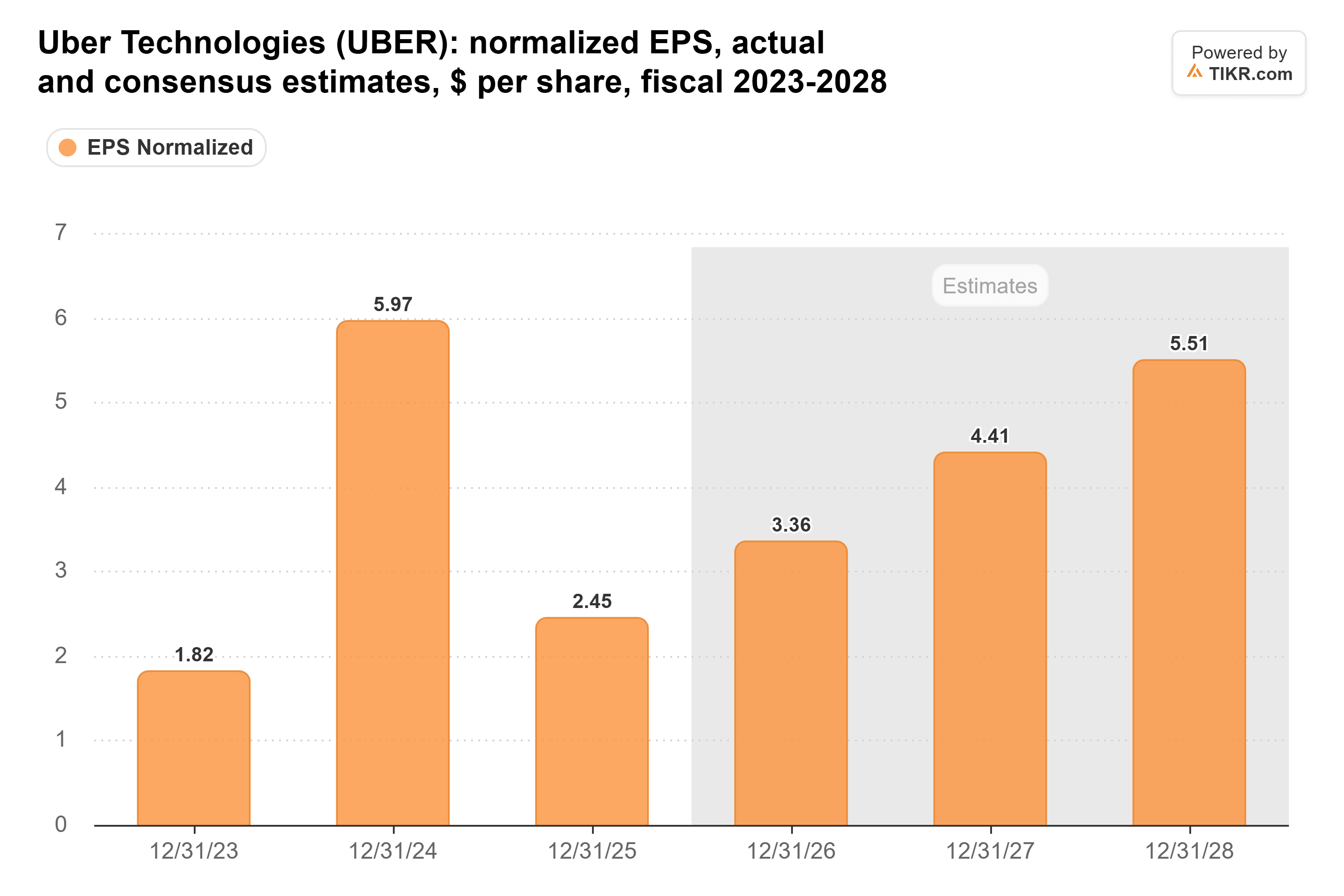
Uber’s fourth-quarter guidance for adjusted EPS of $0.95 to $0.99 was broadly in line with most analysts’ estimates at the midpoint, so analysts have little reason to cut those numbers.
TIKR tracks 50 analysts on Uber. How many say “Buy”?
See the full breakdown of Buy, Hold, and Sell ratings on Uber, along with Wall Street’s revenue and earnings estimates, all in one place. More than 500,000 investors use TIKR to research stocks like this one. See Uber’s Analyst Ratings
Priced like a robotaxi loser
Uber’s forward P/E was still only about 17x on November 2. That’s barely above the three-year low it hit on October 30 and well below its 25x average:
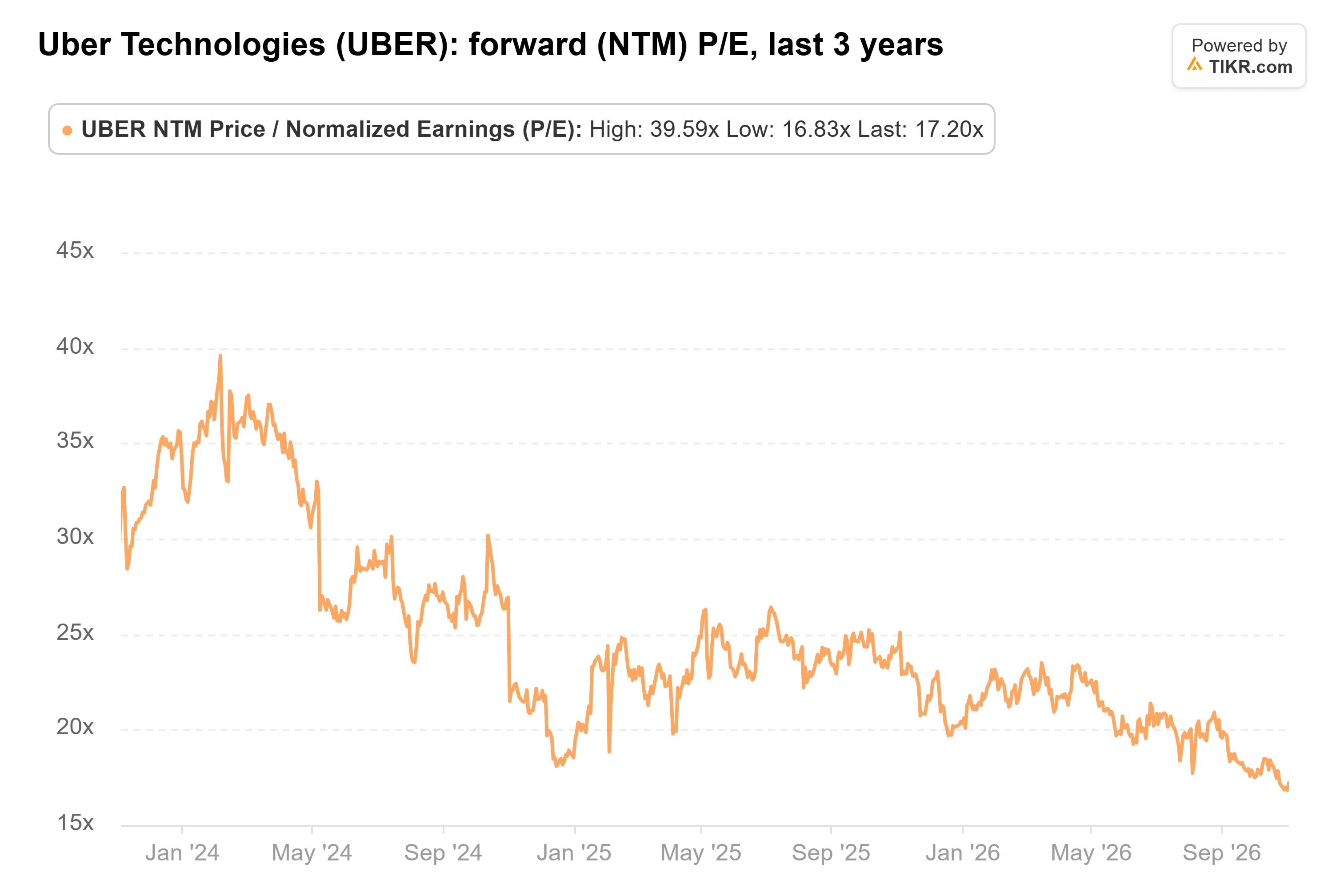
That’s a steep discount for a company whose earnings analysts expect to grow about 31% a year through 2028. After the November 4 jump, the multiple is a bit higher, but not by much.
So Brown has the market right. Investors are pricing the robotaxi story and barely looking at the results.
Growth did slow, a little
Bookings grew 20% at constant currency, down from 22% in the second quarter, and Uber guided for 18%-22% in the fourth. William Blair’s analysts said bookings ended “roughly in line with the midpoint of consensus.” So some of the market’s caution comes from the numbers.
Mobility was the soft spot. Its bookings grew 17% at constant currency, down from 20% in the second quarter, as driver supply lagged demand in several international markets. Uber said the Middle East conflict alone cut 75 basis points from Mobility bookings growth, and it assumes a 100-basis-point hit in the fourth quarter. Even so, it was Uber’s fifth straight quarter of total bookings growth at 20% or better.
The cash held up too. Going in, the open question was whether Uber’s free cash flow could hold. It has been steady for two years:
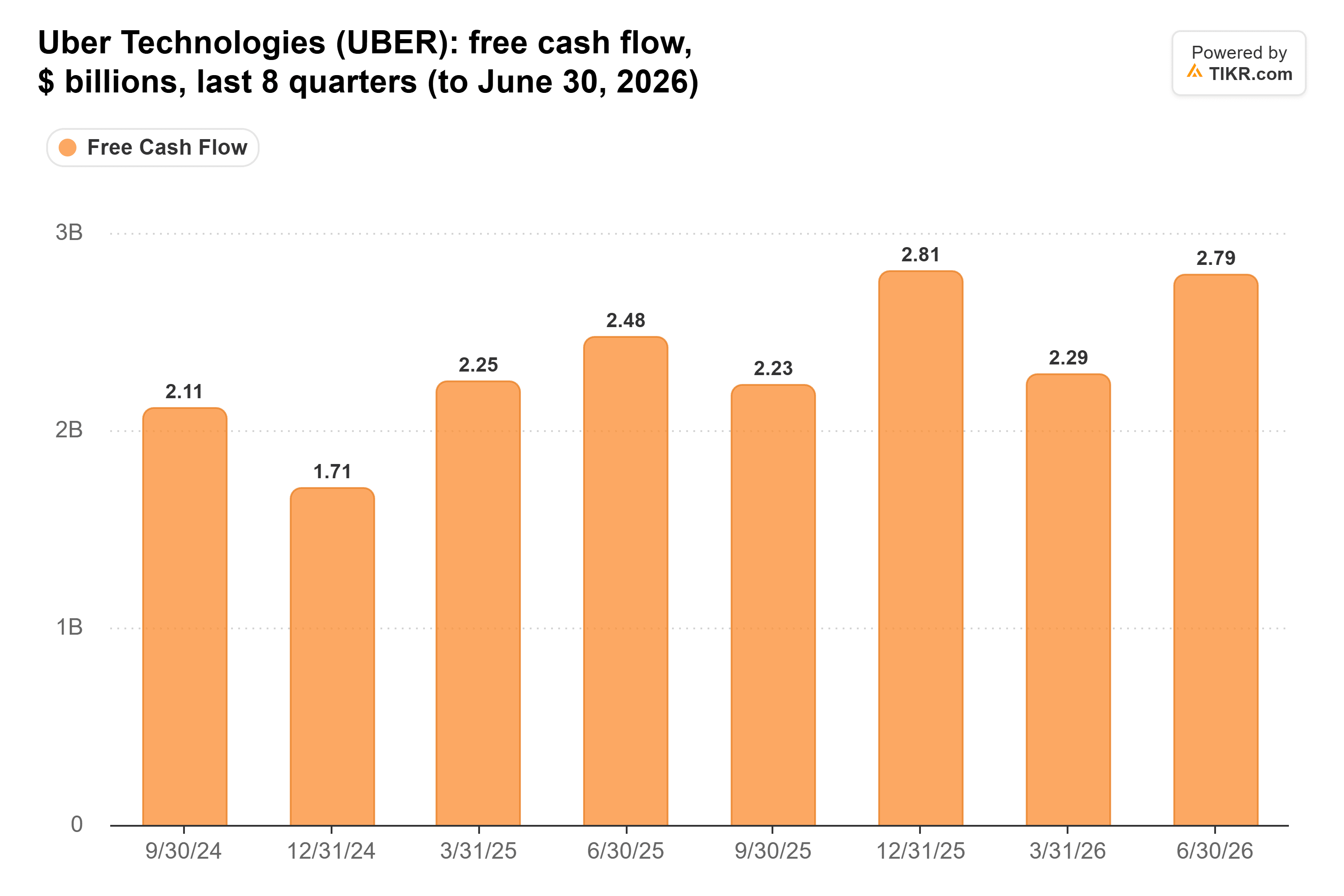
In the third quarter, it was $2.5 billion, up from $2.2 billion a year earlier.
Khosrowshahi is talking robots
Plus: Uber may already be taking Brown’s advice. Khosrowshahi put autonomy front and center in Uber’s November 4 earnings release: “Our focus on autonomous is now on commercial execution, with approximately 700 fully driverless vehicles expected on Uber by year-end and over 2,000 in 2027.”
That’s Tesla-style robotaxi talk, with a number investors can hold him to.
The risk is that the best fleets keep their rides for themselves. Alphabet’s Waymo has told Uber it plans to launch its own service in Austin and Atlanta from January 2028. And management said on its second-quarter call that autonomous rides were still under 0.5% of trips.
A cheap price for a hard story
Brown is right that Uber has a story problem. But earnings and cash keep growing, and at 17x forward earnings, investors are already charging Uber for the robotaxi fear. If those driverless cars show up on schedule, the multiple has plenty of room to climb back toward its average.
Of course, one good quarter has rarely been enough for this stock. The next test is whether those 700 driverless vehicles are on the app by year-end, and Uber’s fourth-quarter report early next year will show it.
So what is Uber stock actually worth?
TIKR lets you forecast the future price of any stock in less than a minute. Just enter a few assumptions into TIKR’s valuation model and see what Uber could be worth. Start from Wall Street consensus estimates, or adjust the inputs to reflect your own view of the business. It’s free to use.
Disclaimer:
Please note that the articles on TIKR are not intended to serve as investment or financial advice from TIKR or our content team, nor are they recommendations to buy or sell any stocks. We create our content based on TIKR Terminal’s investment data and analysts’ estimates. Our analysis might not include recent company news or important updates. TIKR has no position in any of the stocks mentioned. Thank you for reading, and happy investing!