Key Takeaways
- Uber reports third-quarter results before the open on Wednesday, Nov. 4. The stock is down 18% this year and hit a 52-week low last week.
- At about 17x forward earnings and 13x trailing free cash flow, Uber looks cheap as long as its cash keeps growing and analysts don’t cut their earnings estimates.
- Free cash flow rose 7% in the first half of 2026 even though insurance reserves added less cash than a year earlier, and earnings estimates haven’t moved much in three months.
- If the quarter lands inside guidance and free cash flow grows from a year ago, 13x free cash flow looks too low, but robotaxi news still sets the stock’s multiple.
Uber Technologies (UBER) reports third-quarter results before the open on Wednesday, Nov. 4. The stock is down 18% this year and hit a 52-week low last week.
Some investors see a bargain. A post on X said consumer internet stocks like Uber “go down 100 days in a row in a straight line.” Early Uber investor Jason Calacanis replied: “Huge buying opportunity.”
The numbers make his case easy to see. Uber trades at about 17x forward earnings, against a three-year average of about 25x. Its market value is about $136 billion. That’s about 13x the $10.1 billion of free cash flow it made over the four quarters to June.
But Uber is only cheap if two things hold up: its cash keeps growing, and analysts don’t start cutting their earnings estimates. Wednesday’s numbers are the first hard data since the slide.
Analysts already took their cut
A 17x multiple is only cheap if the earnings arrive. Analysts expect Uber’s normalized EPS to more than double, from $2.45 in 2025 to $5.51 in 2028:
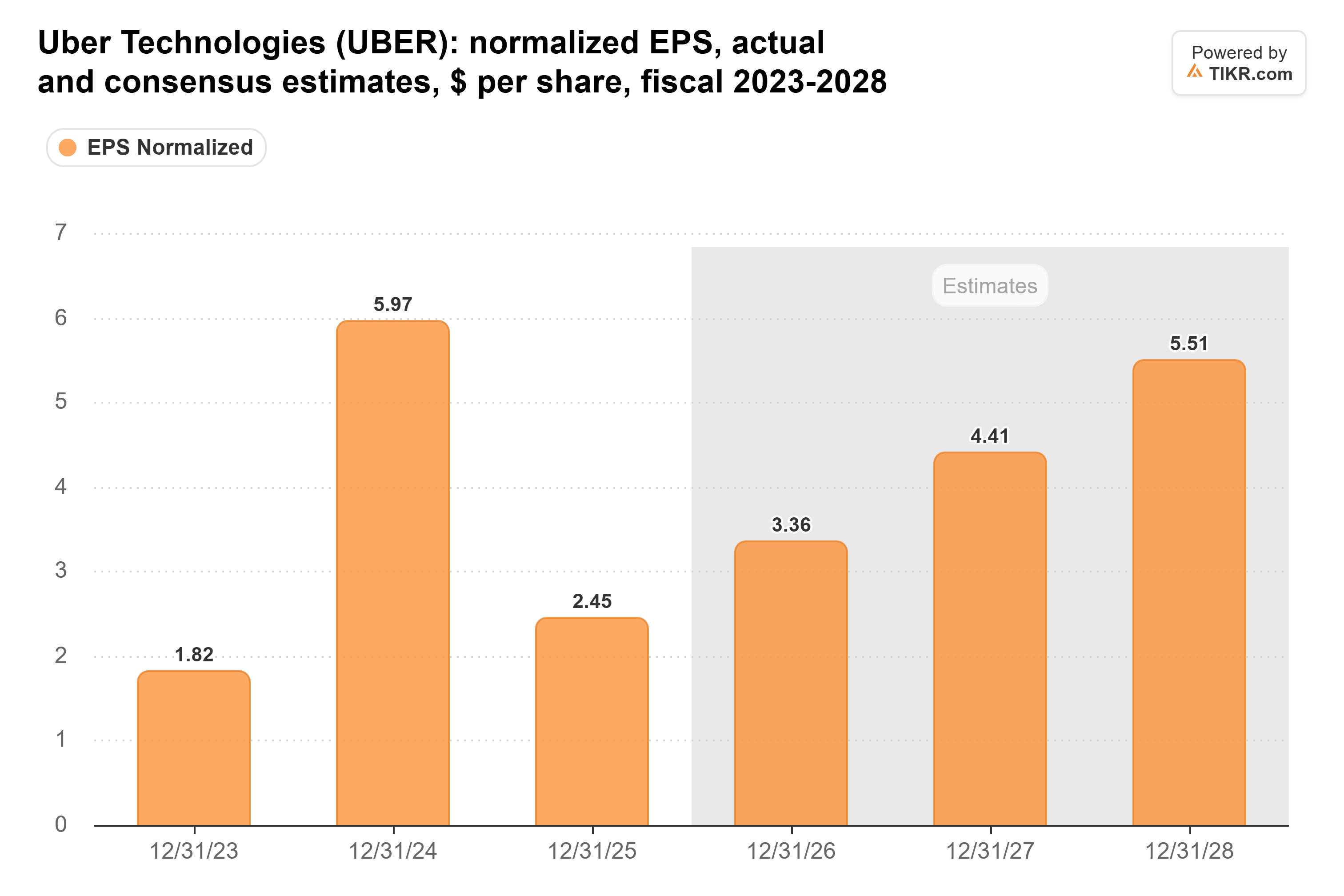
Those estimates have barely moved lately. From June 30 to Oct. 23, the consensus for this year and next moved less than 1%, and 2028’s rose 2%. The big cut came earlier in the year. This year’s consensus fell from $4.17 to $3.31 in the quarter when Uber started reporting a non-GAAP EPS that deducts stock pay, missed on fourth-quarter EPS and gave cautious guidance. Most of that was the accounting switch: Uber expects $1.95 billion to $2.10 billion of stock pay this year, close to $1 a share before tax.
Some analysts are still trimming. UBS analyst Stephen Ju kept his Buy rating ahead of the report but cut his price target to $106 from $110. He pointed to harder year-over-year comparisons for US rides and to scooter competition in Brazil.
TIKR Tracks 50 Analysts on Uber. How Many Say “Buy”?
See the full breakdown of Buy, Hold, and Sell ratings on Uber, along with Wall Street’s revenue and earnings estimates, all in one place. More than 500,000 investors use TIKR to research stocks like this one. See Uber’s Analyst Ratings
The cash is still growing
Uber’s quarterly free cash flow has roughly tripled in three years, from $910 million in the September 2023 quarter to $2.79 billion in the June 2026 quarter:

Some of that cash comes from insurance. When Uber adds more to its reserves for future claims than it pays out, the difference shows up as operating cash. That boost is shrinking. Rising insurance reserves added $830 million of cash in the first half of 2026, against $1.5 billion a year earlier, and free cash flow still grew 7%, to $5.1 billion.
That’s a good sign the cash is real.
Analysts expect $10.5 billion of free cash flow for the full year. After $5.1 billion in the first half, Uber needs about $5.4 billion in the second half to get there, up 7% from last year’s $5.0 billion. That puts the bar for the third quarter at more than last year’s $2.23 billion.
Investors still price Uber on robotaxis
A strong cash quarter may not be enough on its own. The stock has traded on the fear that self-driving cars will cut Uber out. Investors may not pay a higher multiple unless management says something that changes that story.
On its second-quarter call, management said autonomous rides make up less than 0.5% of Uber’s trips. It aims to be live in 15 autonomous cities by year-end, up from seven in August, backed by a $10 billion investment over several years. If that goal slips, or management puts a first number on what scaling those fleets will cost, investors may care more about that than about the quarter’s cash.
Clear the bar, and 13x looks too cheap
For the quarter, Uber guided to gross bookings of $58.25 billion to $60.25 billion and non-GAAP EPS of $0.84 to $0.88. If it lands inside those ranges and free cash flow grows from a year ago, analysts have little reason to cut.
If Uber gets there, I think the stock is too cheap at 13x free cash flow. Its cash grew even as the insurance boost shrank, and its estimates have held since the cut earlier this year. Analysts also expect earnings to grow about 31% a year through 2028, and 13x is a low price for that.
Of course, if management trims its outlook or says little about robotaxis, the stock could stay cheap for a while longer.
So what is Uber stock actually worth?
TIKR lets you forecast the future price of any stock in less than a minute. Just enter a few assumptions into TIKR’s valuation model and see what Uber could be worth. Start from Wall Street consensus estimates, or adjust the inputs to reflect your own view of the business. It’s free to use.
Disclaimer:
Please note that the articles on TIKR are not intended to serve as investment or financial advice from TIKR or our content team, nor are they recommendations to buy or sell any stocks. We create our content based on TIKR Terminal’s investment data and analysts’ estimates. Our analysis might not include recent company news or important updates. TIKR has no position in any of the stocks mentioned. Thank you for reading, and happy investing!