


Key Stats: Travelers Companies (TRV) — Q1 2026
- Current Price: $301
- Q1 2026 Net Written Premiums: $10.3 billion
- Q1 2026 Core Income: $1.7 billion / $7.71 per diluted share
- Q1 2026 Core ROE: ~20% (trailing 12-month: ~23%)
- Q1 2026 Combined Ratio: ~89%
- Q1 2026 Underlying Combined Ratio: ~85%
- Q1 2026 After-Tax Net Investment Income: $833 million (+9% YoY)
- Capital Returned to Shareholders: $2.2 billion (including ~$2 billion in buybacks)
- Dividend Increase: 14% to $1.25/share quarterly (22 consecutive years of increases)
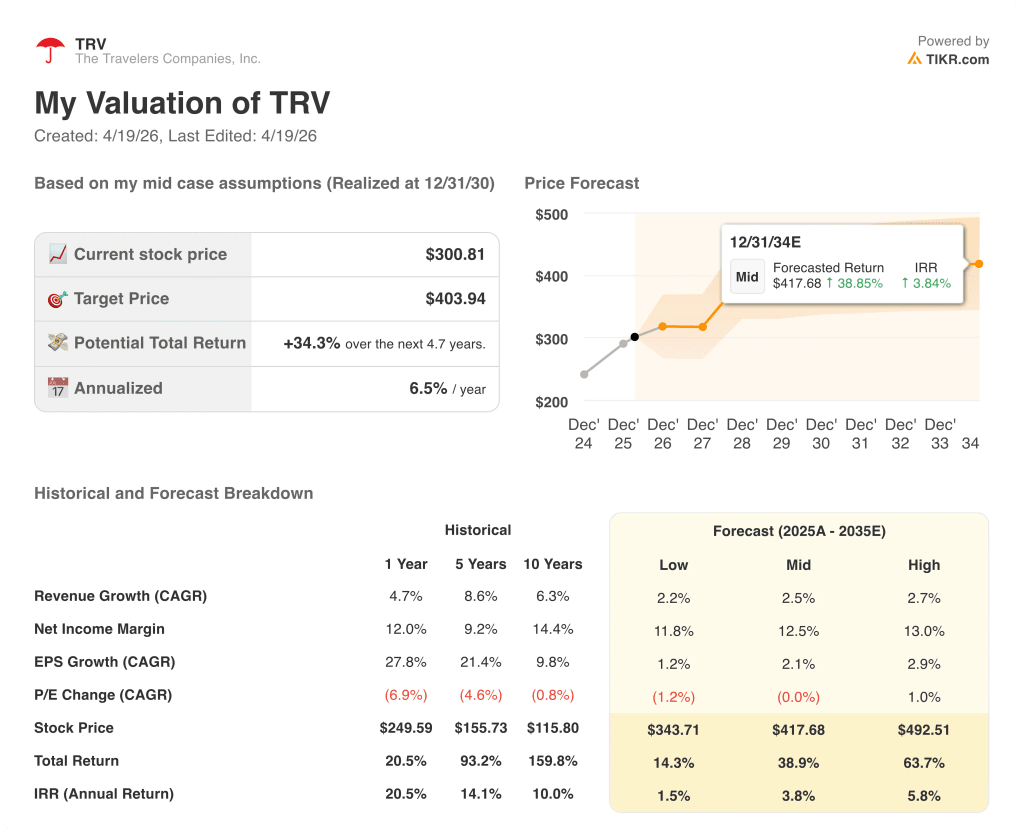
- TIKR Model Price Target: $404
- Implied Upside: +34% over ~5 years (~7% annualized)
Travelers Companies Stock Delivers Record Business Insurance Income in Q1 2026
Travelers Companies stock (TRV) opened 2026 with core income of $1.7 billion, or $7.71 per diluted share, marking the seventh consecutive quarter of more than $1 billion in underlying underwriting income.
Net written premiums reached $10.3 billion for the quarter, supported by growth across all three operating segments.
Business Insurance led the quarter, generating segment income of $839 million, a first quarter record, with net written premiums of $5.8 billion and an underlying combined ratio below 90% for the 14th consecutive quarter.
New business in Business Insurance hit $775 million, also a quarterly record, driven by the company’s investments in product segmentation, digital quoting, and field execution.
Bond & Specialty Insurance grew net written premiums by 7% to $1.1 billion, with the Surety business accelerating to 14% premium growth, supported by broad-based infrastructure spending.
Personal Insurance produced segment income of $704 million and a combined ratio of 82.9%, the lowest first quarter result in the segment over the last decade.
CEO Alan Schnitzer said the results reflect “structural advantages that hold up regardless of the environment,” citing the company’s breadth across nine major insurance lines, North American concentration, and growing investment in AI-powered underwriting tools.
After-tax net investment income rose 9% year-over-year to $833 million, with fixed income new money yields sitting approximately 70 basis points above the embedded portfolio yield.
Travelers returned $2.2 billion to shareholders in the quarter, including $1.8 billion in open market repurchases and $185 million tied to employee equity plans, with $5.2 billion remaining under existing buyback authorizations.
The board declared a 14% dividend increase to $1.25 per share quarterly, extending the company’s streak to 22 consecutive years of dividend growth at an 8% compound annual rate.
Catastrophe losses of $761 million pretax were the primary drag, driven by a January winter storm and a March tornado and hail event.
Personal Insurance domestic net written premiums declined 5% year-over-year, partly reflecting actions taken to improve property pricing terms and reduce exposure in high-catastrophe geographies, as well as the completion of the Canadian operations sale in January.
Management guided for second quarter fixed income net investment income of approximately $810 million after tax, rising to roughly $840 million in Q3 and approximately $870 million in Q4.
Travelers Companies Stock: What the Income Statement Shows
Travelers Companies stock is operating in a margin expansion environment, with operating income more than tripling year-over-year as underwriting discipline compounds through the income statement.

Total revenues for Q1 2026 came in at $11.92 billion, up 1% year-over-year against a prior-year quarter that already reflected a ~5% gain, reflecting the mechanical drag from the Canadian business exit.
Operating income for Q1 2026 was $2.24 billion, a ~294% increase year-over-year from $0.57 billion in Q1 2025, which was suppressed by elevated catastrophe losses including the Los Angeles wildfires.
Operating margin reached around 19% in Q1 2026, a material recovery from the ~5% operating margin posted in Q1 2025.
Over the trailing eight quarters, operating margins have swung from ~7% (Q2 2024) to 26% (Q4 2025), underscoring the inherent seasonality and catastrophe sensitivity in the P&C insurance model.
The combined ratio of around 89% and underlying combined ratio of ~85% confirm that the core underwriting engine is generating durable income, not a one-quarter anomaly.
Valuation Model Take
The TIKR model prices Travelers Companies stock at $404, implying ~34% total upside from the current $301 price, or approximately 7% annualized over the next ~5 years.
The mid-case model assumes a revenue CAGR of ~3% and a net income margin of about 13% through 2035, both conservative relative to Travelers’ trailing five-year net income margin of ~9% and the 12% margin posted over the last twelve months.
Q1 2026 demonstrated the earnings power available when catastrophe losses normalize: $7.71 in core EPS in a single quarter, a trajectory that supports the model’s 2% EPS CAGR assumption being cleared with room to spare in favorable environments.
Travelers Companies stock enters the second quarter with the investment case intact: underwriting margins at decade highs, investment income growing sequentially, capital being returned aggressively, and a valuation model that suggests the stock is still priced below fair value despite a ~21% one-year return.
The central tension is whether Travelers can sustain record-level underwriting margins as pricing growth moderates and catastrophe exposure remains structurally elevated.
Bull Case
- Business Insurance underlying combined ratio has held below 90% for 14 consecutive quarters, signaling structural, not cyclical, underwriting discipline
- Fixed income NII is on a guided path from $810 million in Q2 to approximately $870 million in Q4, adding roughly $240 million in incremental annual run-rate income as the portfolio reprices higher
- Personal Insurance domestic combined ratio of 83% in Q1 is the segment’s best first-quarter result in ten years, creating pricing flexibility to accelerate new business growth without sacrificing margin
- $5.2 billion remaining in buyback authorization, alongside 22 consecutive dividend increases, gives Travelers a capital return engine that supports EPS growth independent of top-line acceleration
Bear Case
- Renewal premium change in Business Insurance was around 6%, with management acknowledging moderation in property pricing; if loss cost trends remain in the mid-single digits, underwriting margins face compression in 2026 and 2027
- Catastrophe losses of $761 million in Q1 came from two discrete events; Q2 is historically the seasonally highest quarter for homeowners weather losses, and management’s own guidance flags alternative investment portfolio headwinds from Q1 equity market declines flowing through in Q2 results
- Personal Insurance domestic net written premiums declined 5% year-over-year, and the path to growth depends on unwinding eligibility restrictions and lifting agent binding limitations, initiatives that carry execution risk in a competitive personal lines market
- The TIKR model’s high-case scenario requires only about 3% revenue CAGR through 2035, but even that modest assumption could be pressured if the Canadian exit reduces the premium base more materially than management’s two-point growth rate guidance implies
Should You Invest in The Travelers Companies, Inc.?
The only way to really know is to look at the numbers yourself. TIKR gives you free access to the same institutional-quality financial data that professional analysts use to answer exactly that question.
Pull up TRV stock and you’ll see years of historical financials, what Wall Street analysts expect for revenue and earnings in the quarters ahead, how valuation multiples have moved over time, and whether price targets are trending up or down.
You can build a free watchlist to track The Travelers Companies, Inc. alongside every other stock on your radar. No credit card required. Just the data you need to decide for yourself.
Access Professional Tools to Analyze TRV stock on TIKR for Free →


