Key Stats for Seagate Stock
- Current Price: $891.83
- Target Price (Mid): ~$2,000
- Street Target: ~$1,009
- Potential Total Return: ~124%
- Annualized IRR: ~23% / year
- Max Drawdown: 31.86% on 7/16/26
Now Live: Discover how much upside your favorite stocks could have using TIKR’s new Valuation Model (It’s free) >>>
What Happened?
Seagate Technology Holdings (STX) closed at $891.83, up 11.14% in a single session, and the timing matters more than the number. The company reports fiscal fourth-quarter results after the close on July 28. It arrives at that print having whipsawed for a month: a record close near $1,093 on June 22, a slide into the $720s by July 16, and then a sharp bounce that clawed back most of the loss. Even after that rebound, the stock still sits about 18% below its June high. The drop already got bought. Anyone weighing the stock today is not buying weakness. They are paying up again, at 84 times trailing earnings, right before the one event that tests whether the last year of gains holds.
That is the setup Jim Cramer flagged on July 17, calling Seagate’s comeback one of the most impressive in the S&P 500 while warning it “might be an excellent opportunity to trim if you don’t have much cash on hand.” He was not calling it a sell, and the distinction is the point. After a year in which the stock rose more than 480%, taking something off the table into a binary event is position management, not a bear thesis. When a name compounds this hard, the question stops being whether the business is good and becomes whether the price already assumes it.
The Guidance Is Public, So Meeting It May Not Be Enough
The trouble with a print this well-telegraphed is that the easy version is already priced. In its April report, management guided fiscal Q4 to revenue of $3.45 billion, give or take $100 million, and non-GAAP earnings of $5.00 per share, give or take $0.20. Seagate has then beaten its own guidance for four straight quarters. That track record is exactly why merely landing on the $5.00 midpoint could disappoint: the market has been trained to expect a beat, so the bar that moves the stock sits above the number management printed, not on it.
There is a quieter source of potential upside that the contracted numbers do not capture. At the Bank of America Global Technology Conference on June 2, CFO Gianluca Romano pointed to the roughly 20% of Seagate’s business outside data centers, the lower-capacity consumer and edge drives, as a segment now turning profitable as solid-state prices stay elevated. “Now even the other part gets good,” he said, noting that this slice is not locked into long-term agreements, so Seagate can price it opportunistically. That is the part of the quarter least visible to the Street, and the most likely to surprise on July 28.
See historical and forward estimates for Seagate stock (It’s free!) >>>
A Business That Can See Around the Corner, Priced Like It Might Trip
The bull case rests on visibility that most hardware makers never get. Firm customer orders already lock in mix, volume, and price for the next four to five quarters, which is why this print carries less fundamental suspense than a normal earnings date. The engine underneath is Seagate’s shift to HAMR, or heat-assisted magnetic recording, a technology that packs far more capacity onto each drive without adding units or factories. That is what makes this cycle look structural rather than cyclical. Seagate reported fiscal Q3 2026 revenue of $3.11 billion, up around 44% year over year, with non-GAAP gross margin hitting 47%, a level it had never sustained before. Net income of $934 million beat consensus by nearly 16%.
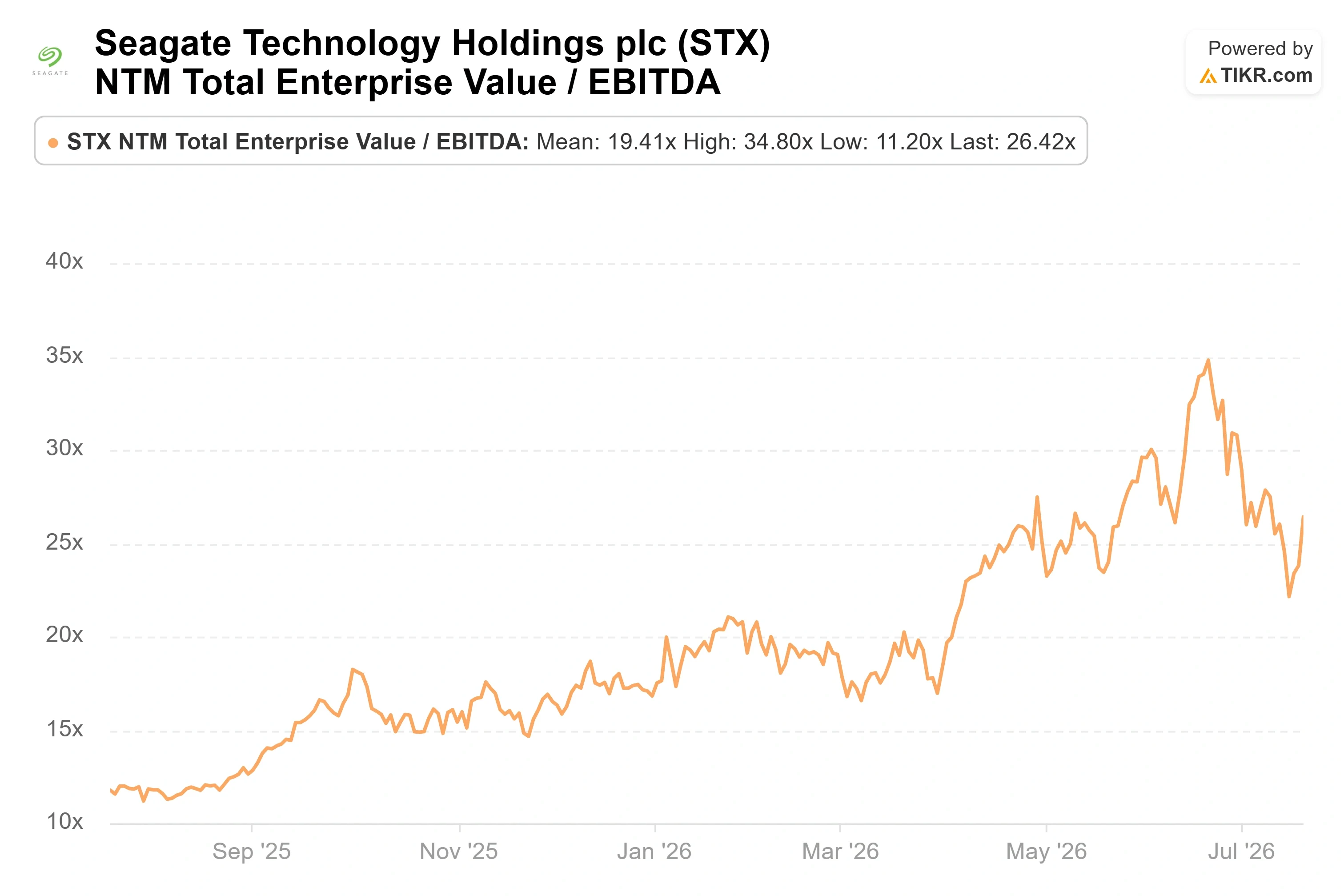
The problem is what the market now pays for those margins. Seagate trades at an NTM EV/EBITDA (next-twelve-months enterprise value to earnings before interest, taxes, depreciation, and amortization) of around 26x, against Western Digital near 23x and NetApp around 13x. A modest premium to Western Digital is defensible given Seagate’s margin lead and order visibility. The trailing multiple is harder to defend: at 84 times earnings, the stock sits far above the mid-teens levels the market paid for this business through most of its history, and that gap is the valuation argument in one number. Insiders have leaned into the strength too, with roughly $126 million in stock sold over the past three months according to GuruFocus data, though the CEO’s July sales ran under a pre-arranged trading plan rather than a discretionary call on the price.

See how Seagate performs against its peers in TIKR (It’s free!) >>>
TIKR Advanced Model Analysis
- Current Price: $891.83
- Target Price (Mid): ~$2,000
- Potential Total Return: ~124%
- Annualized IRR: ~23% / year

See analysts’ growth forecasts and price targets for Seagate stock (It’s free!) >>>
Even after the round trip, the TIKR model’s mid-case scenario still points higher, to a target near $2,000 by mid-2030. That implies a total return of around 124% and an annualized return of roughly 23% over the next 3.9 years. The gap between that figure and the ~$1,009 Street mean is worth naming: the Street is pricing the next year, while the model extends a full HAMR adoption cycle out to 2030, so the two are answering different questions rather than contradicting each other.
The mid case runs on a forward revenue CAGR (compound annual growth rate) of around 20%, driven by two levers: nearline HDD exabyte demand from AI data-center buildout, and pricing gains as build-to-order contracts renew at higher levels. The margin driver is operating leverage, with mid-case net income margins modeled above 40% as higher-capacity drives spread fixed factory costs across far more exabytes. The primary risk is the mirror image: pricing pushback when 2027 contracts renew, or a memory-sector rotation that resets the multiple regardless of what the business delivers. The upside is that locked-in orders and the HAMR cost curve carry margins higher for years. The downside is that a hardware maker at 84 times earnings has priced in near-perfect execution, and any wobble on 2027 pricing takes the multiple down with it.
Conclusion
July 28 is the whole story now. The guide is roughly $3.45 billion in revenue and $5.00 in adjusted EPS, but after four straight beats, the market is positioned for more, so the tape will trade on two things that guidance does not settle. First, whether gross margin holds near that 47% high or pushes past it. Second, whether management opens fiscal 2027 with pricing commentary that confirms contracts are renewing at higher rates rather than flattening. A clean beat with soft 2027 signaling could still sell off, because the multiple leaves no room for hesitation. A beat paired with firm 2027 pricing is what justifies paying up here. Watch the guidance, not the headline number, when the print lands after the close on July 28.
See what stocks billionaire investors are buying so you can follow the smart money with TIKR.
Should You Invest in Seagate?
The only way to really know is to look at the numbers yourself. TIKR gives you free access to the same institutional-quality financial data that professional analysts use to answer exactly that question.
Pull up Seagate, and you’ll see years of historical financials, what Wall Street analysts expect for revenue and earnings in the quarters ahead, how valuation multiples have moved over time, and whether price targets are trending up or down.
You can build a free watchlist to track Seagate alongside every other stock on your radar. No credit card required. Just the data you need to decide for yourself.
Analyze Seagate on TIKR Free →
Looking for New Opportunities?
- See what stocks billionaire investors are buying so you can follow the smart money.
- Analyze stocks in as little as 5 minutes with TIKR’s all-in-one, easy-to-use platform.
- The more rocks you overturn… the more opportunities you’ll uncover. Search 100K+ global stocks, global top investor holdings, and more with TIKR.
Disclaimer:
Please note that the articles on TIKR are not intended to serve as investment or financial advice from TIKR or our content team, nor are they recommendations to buy or sell any stocks. We create our content based on TIKR Terminal’s investment data and analysts’ estimates. Our analysis might not include recent company news or important updates. TIKR has no position in any stocks mentioned. Thank you for reading, and happy investing!