Key Stats for ARM Stock
- Current Price: $289.73
- Target Price (Mid): ~$1,706
- Street Target: ~$302
- Potential Total Return: ~489%
- Annualized IRR: ~46% / year
- Max Drawdown: 41.47% on 2/3/26
Now Live: Discover how much upside your favorite stocks could have using TIKR’s new Valuation Model (It’s free) >>>
What Happened?
Arm Holdings (ARM) spent the past week doing two contradictory things at once, and the market has not decided which one to believe. Shares closed at $289.73 on July 21, up 7.46% in a single session, riding a broad rebound in AI-chip names and a renewed focus on the company’s July 29 earnings date. Yet in the same stretch of days, some of the loudest bulls on Wall Street quietly walked their price targets down. When buyers push a stock up, and analysts trim their numbers in the same week, the two sides are usually looking at different clocks. One is trading the next data center headline. The other is staring at an earnings report that could settle the argument.
The disagreement is not about whether Arm is a good business. Almost nobody argues that. It is about what you should pay for it, and whether the demand management keeps describing shows up on the income statement fast enough to justify a stock trading near 134 times next-twelve-months earnings. The setup is unusually clean: a stock that just climbed, a Street that just blinked, and a model that still sees a very different number.
The Same Week That UBS and Wells Fargo Trimmed, the Stock Climbed
The target cuts were real, and they came from firms that are still, on paper, bullish. UBS lowered its target to $360 from $470 on July 20 while keeping a Buy rating, and Wells Fargo trimmed its own target while holding an Overweight rating. HSBC went further, downgrading the stock to Hold from Buy on July 14, though it raised its target to $315 in the process. Set against late-June, when TD Cowen reached for $475, and Mizuho stretched to $500, the tone shift is obvious. The high-water marks are getting marked down.
None of that stopped the stock from climbing. The cuts are not calls that the business is breaking. They are calls that the price ran ahead of what the next few quarters can prove. On a closing basis, the stock sits about 36% below its 52-week high of $452.70, so the July 21 gain claws back only part of a much deeper repricing. Some buyers think that repricing has gone far enough. The trimmed targets say the analysts who chased it higher are no longer sure. TIKR’s prior coverage of the July 29 setup flagged the flat-target problem before this week’s cuts even landed.
Why the Data Center Line Is Doing the Heavy Lifting
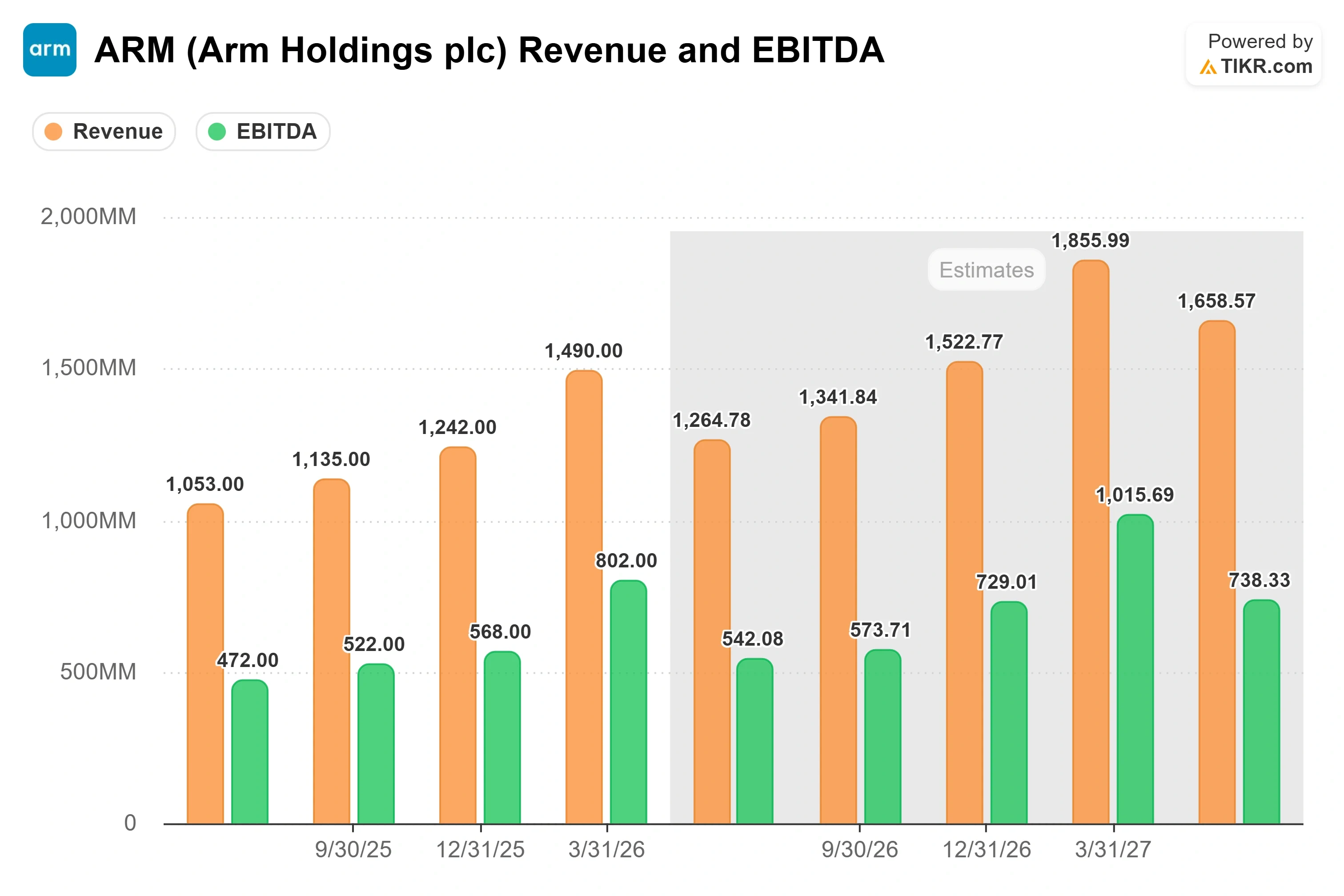
To see what buyers are responding to, look at where growth is coming from. In the fiscal fourth quarter reported May 6, revenue reached a record $1.49 billion, up 20% year over year, and non-GAAP EPS hit a record $0.60. Licensing did much of the work, up 29% to $819 million. But the line that matters most is the data center.
CEO Rene Haas was direct about it. “Soon the data center will be Arm’s largest business,” he told analysts, describing data center royalty revenue that “has more than doubled year-over-year.” Every major hyperscaler is leaning harder on custom Arm silicon. Google’s newest TPU systems now pair with Arm-based Axion processors instead of x86 hosts, which Haas said delivers an 80% performance improvement at half the power. Arm-based compute now holds close to 50% share with top hyperscalers.
The newer growth vector is the Arm AGI CPU, the company’s first production silicon for the data center, rather than licensed intellectual property. Management now sees more than $2 billion of customer demand across fiscal 2027 and 2028, double its March launch figure, with Meta as lead partner on a multi-generation roadmap. The commitments are widening beyond chipmakers: Haas said SAP will move its core database and business application workloads to Arm, which he called “a significant strategic shift,” while Cloudflare, F5, and SK Telecom have signed on. The catch is supply. Arm has secured chip, memory, and packaging capacity for only the first $1 billion of that order book. The second billion is real demand chasing capacity that does not exist yet, which is why the stock fell after May’s otherwise strong print. That gap, not the demand, is the honest near-term risk.
See historical and forward estimates for ARM stock (It’s free!) >>>
A Multiple That Only Works If the Growth Shows Up
Here is where the analyst caution earns its keep. Arm trades near 134 times NTM P/E and roughly 109 times NTM EV/EBITDA, figures that sit far above almost anything in semiconductors. Against its own peer set, the premium is stark. Intel trades near 27 times NTM EV/EBITDA and Rambus near 25 times, versus Arm’s 109 times.
The bull answer is that it is close: for fiscal 2027, management guided first-quarter revenue to about $1.26 billion, up roughly 20%, with royalty and licensing both growing around 20% for the year. If Arm converts its AGI CPU order book into secured supply and revenue, the multiple compresses on its own as earnings catch up. If the supply gap lingers or the ramp slips, the same multiple drags the stock down. That is the real content of this week’s cuts: a bet that the timeline is tighter than the price assumed. One note of caution on the data itself, some third-party services showed the July 21 gain closer to 6% rather than the 7.46% in TIKR’s live feed, a reminder to check the source before anchoring on any single figure.

See how ARM performs against its peers in TIKR (It’s free!) >>>
TIKR Advanced Model Analysis
- Current Price: $289.73
- Target Price (Mid): ~$1,706
- Potential Total Return: ~489%
- Annualized IRR: ~46% / year

See analysts’ growth forecasts and price targets for ARM stock (It’s free!) >>>
TIKR’s mid-case model values Arm at around $1,706 by March 2031, implying a total return near 489% from today’s price, or roughly 46% annualized over 4.7 years. Two revenue drivers sit behind it: the Neoverse and CSS royalty business, where data center royalties doubled year over year and are guided to double again, and the AGI CPU silicon business, targeted at $15 billion in revenue by fiscal 2031. On margins, the model leans on Arm’s licensing-led gross margin near 97%, with operating leverage building as revenue outgrows R&D. The primary risk is the one already named: the unsecured half of the AGI CPU order book.
The upside case is that both engines scale together, and Arm becomes the default CPU layer of the AI data center. The downside case is that the supply gap, the ongoing Qualcomm licensing dispute (a legal matter whose outcome remains unproven), or a slower-than-modeled ramp turns a 134-times multiple into a liability well before 2031.
Conclusion
Watch the data center royalty line when Arm reports Q1 fiscal 2027 on July 29. Management says it doubled year over year last quarter and guided it to double again this year. If the royalty print confirms that pace and management lifts its secured supply above the current $1 billion, the bounce looks like an early read on a beat, and the trimmed targets look premature. If royalty growth cools toward the high teens or the supply gap stays stuck at half the order book, the analysts who cut this week will look early, not wrong. One report, one week away, decides which side was reading the right clock.
See what stocks billionaire investors are buying so you can follow the smart money with TIKR.
Should You Invest in ARM?
The only way to really know is to look at the numbers yourself. TIKR gives you free access to the same institutional-quality financial data that professional analysts use to answer exactly that question.
Pull up ARM, and you’ll see years of historical financials, what Wall Street analysts expect for revenue and earnings in the quarters ahead, how valuation multiples have moved over time, and whether price targets are trending up or down.
You can build a free watchlist to track ARM alongside every other stock on your radar. No credit card required. Just the data you need to decide for yourself.
Looking for New Opportunities?
- See what stocks billionaire investors are buying so you can follow the smart money.
- Analyze stocks in as little as 5 minutes with TIKR’s all-in-one, easy-to-use platform.
- The more rocks you overturn… the more opportunities you’ll uncover. Search 100K+ global stocks, global top investor holdings, and more with TIKR.
Disclaimer:
Please note that the articles on TIKR are not intended to serve as investment or financial advice from TIKR or our content team, nor are they recommendations to buy or sell any stocks. We create our content based on TIKR Terminal’s investment data and analysts’ estimates. Our analysis might not include recent company news or important updates. TIKR has no position in any stocks mentioned. Thank you for reading, and happy investing!