Key Stats for Sandisk Stock
- Current Price: $1,589.40
- Target Price (Mid): ~$3,680
- Street Target: ~$2,200
- Potential Total Return: ~132%
- Annualized IRR: ~24% / year
- Max Drawdown: 41.98% (July 17, 2026)
Now Live: Discover how much upside your favorite stocks could have using TIKR’s new Valuation Model (It’s free) >>>
What Happened?
Sandisk Corporation (SNDK) has a problem most companies would envy and a question none of them can answer for it. The stock has multiplied many times over since its 2025 spinoff. A company the market expects to grow revenue more than 30% a year trades at a multiple normally reserved for businesses in decline. On August 5, when Sandisk reports fiscal fourth-quarter results, investors get their first real chance to test which number is lying: the growth rate or the multiple.
The disconnect exists because Sandisk sells NAND flash, the memory that stores data in everything from phones to AI servers, and the market has spent a decade learning that NAND is a commodity that always crashes. Bulls say the business has changed underneath that reputation. Bears say a memory company earning 56% gross margins is sitting at a cycle peak, not a new plateau. Both sides are looking at the same August 5 report for evidence.
Why the Market Won’t Pay Up for 30% Growth
Start with the multiple, because it is the argument in one number. Sandisk trades at about 8.6 times next twelve months earnings and 6.5 times NTM EV/EBITDA, a measure of value against operating cash profits. A stalling industrial company might carry a similar tag. The market is not confused about the growth. It is discounting how long that growth lasts, because memory has burned investors before.
CEO David Goeckeler knows why the skepticism exists. Speaking at the Mizuho Technology Conference on June 9, he described the reflexive reaction whenever the company pitches long-term agreements to break the cycle: audiences insist “they won’t work,” weighed down by years of “scar tissue” from prior memory busts. His answer was not a promise but a challenge to keep watching. “It’s very hard to disprove something except you just keep putting points on the board, that’s what we do. We keep putting the numbers up.”
That is why August 5 matters more as a credibility test than as a consensus beat. The question is whether Sandisk can put down another point that makes the cyclicality case harder to hold.
See historical and forward estimates for Sandisk stock (It’s free!) >>>
The Guidance Nobody Wanted to Believe, and the Track Record Behind It
The strongest evidence for durability is what management has already guided and then blown past. For fiscal Q4, Sandisk guided revenue of $7.75 billion to $8.25 billion, a non-GAAP gross margin of 79% to 81%, and non-GAAP EPS of $30 to $33. Set that against the trajectory. The company guided fiscal Q3 to $12 to $14 in EPS, then delivered $23.41, nearly double the top of its own guide and about 60% above the $14.66 analyst consensus. Each quarter has not just cleared expectations but reset them higher.
The demand mix is what keeps resetting the bar. In Q3, reported April 30, datacenter revenue rose 233% sequentially, and enterprise SSD reached roughly 25% of total revenue, up from about 10% a quarter earlier. At Mizuho, Goeckeler framed why that mix shift is still early. “We’ve got one side of the portfolio in kind of full bloom” while “now we’ve got the second leg of that growth coming,” he said, referring to the storage-class enterprise product that only began recognizing revenue this year. Demand is pulling from a source management says keeps expanding: data-center capital budgets that have been revised up “14x, all going up,” in his words at the conference.
August 5 tests whether that $30-to-$33 EPS guide is another number Sandisk clears with room to spare or the first one it merely meets.
The Cycle Risk, the Peer Discount, and the Option that the Multiple Ignores
Here is the tension that valuation cannot resolve on its own. A gross margin near 56% on a trailing basis, which blends in the weak quarters before the AI surge, has already reached the high-70s in recent quarters and is guided to 79% to 81% for Q4. Margins that high are extraordinary for memory, and extraordinary numbers invite the question of whether they last. The competitor comparison sharpens it. Samsung Electronics, the largest memory maker on the planet, trades at about 4.5 times NTM earnings and 2.8 times NTM EV/EBITDA. Sandisk trades at nearly double those multiples. That premium is defensible only if the contract structure gives Sandisk earnings visibility that a spot-market giant lacks. It is a genuine bet, not a settled fact.
Two things anchor the bet on the durable side. Sandisk’s new business model contracts already cover more than a third of its fiscal 2027 bit shipments, backed by over $11 billion in financial guarantees, and management extended its Kioxia manufacturing joint venture through December 2034 while investing $1 billion in Nanya to secure DRAM supply. Goeckeler was blunt that the model is about stability, not discounting: “We’re not trading duration for price,” he said. “The value proposition is continuity of supply, and price is price.”
What the multiple gives almost no credit for is HBF, or high-bandwidth flash, a new NAND design aimed at delivering memory bandwidth close to DRAM at a fraction of the cost. Goeckeler called it “a system play” that needs customers to redesign around it, with a production die due later in 2026 and a controller in 2027. That is the optionality the market is currently pricing at zero.
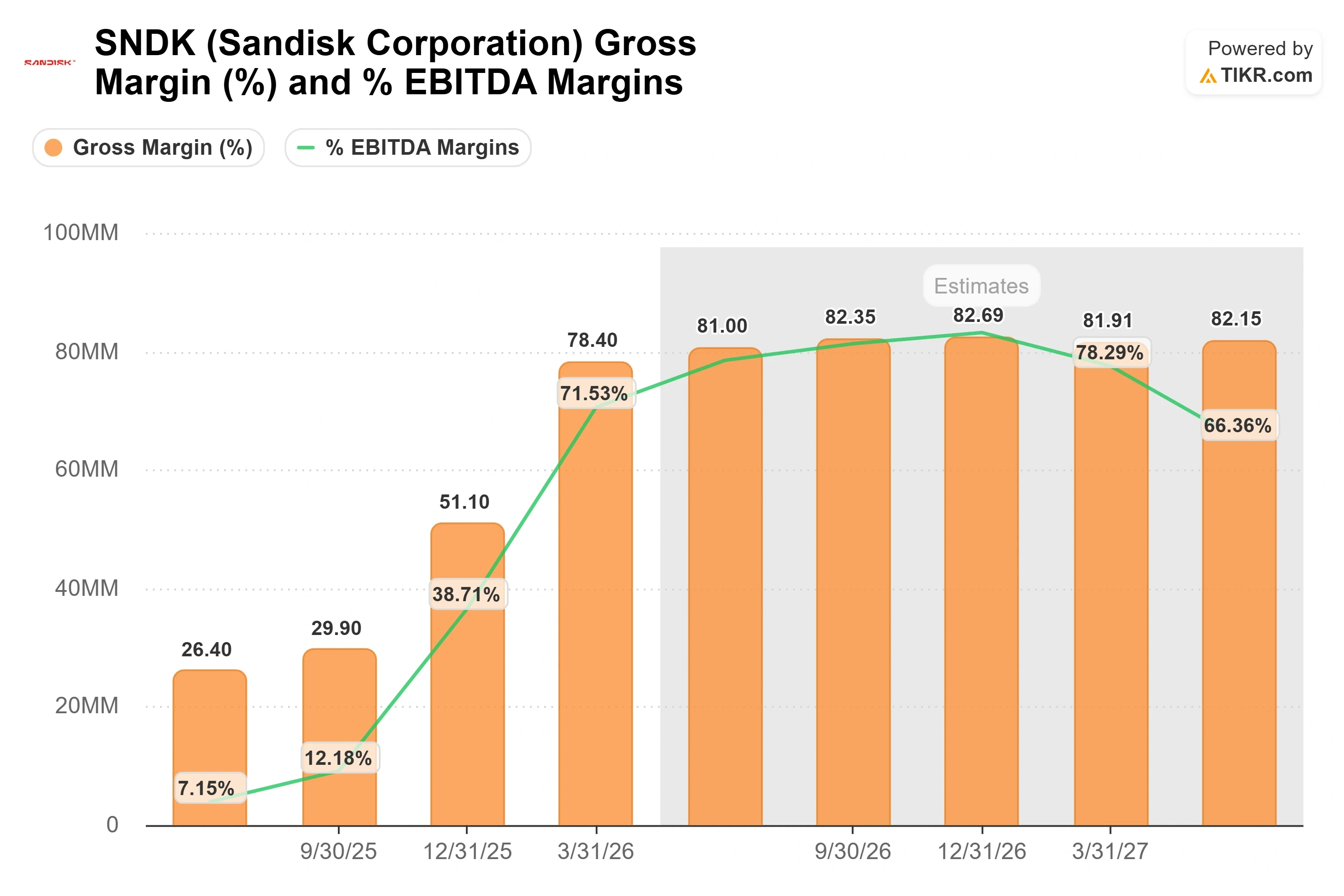

See how Sandisk performs against its peers in TIKR (It’s free!) >>>
TIKR Advanced Model Analysis
- Current Price: $1,589.40
- Target Price (Mid): ~$3,680 (realized by mid-2030)
- Potential Total Return: ~132%
- Annualized IRR: ~24% / year

See analysts’ growth forecasts and price targets for Sandisk stock (It’s free!) >>>
Two revenue drivers carry the mid case: continued datacenter and enterprise SSD share gains as AI inference scales, and the mid-to-high-teens annual bit growth management says is built into the franchise each year. The margin driver is the contracted pricing inside the new business model agreements, which the model assumes supports a net income margin near 59%. The primary risk is the oldest one in memory, that NAND pricing rolls over, and contracted volume cannot fully offset it.
The upside case: the contract structure proves durable, the multiple re-rates from cyclical to structural, and contracted EPS compounds into a much higher stock. The downside case: the cycle turns as it always has, the premium to Samsung collapses, and the market decides nine times earnings were generous for a commodity at its peak.
Conclusion
The one number to watch on August 5 is the fiscal fourth-quarter gross margin against management’s 79% to 81% guide. Land inside or above that band, and the claim that these margins are structural rather than cyclical gets its first hard confirmation, which is the single fact most likely to pry the multiple off its cyclical anchor. Come in below it, and the bears get exactly the evidence they have waited for. Management’s investor day follows on August 13, so the two weeks after August 5 either reset the story or reinforce the doubt. Watch the margin line first. Everything else in the debate flows from it.
See what stocks billionaire investors are buying so you can follow the smart money with TIKR.
Should You Invest in Sandisk?
The only way to really know is to look at the numbers yourself. TIKR gives you free access to the same institutional-quality financial data that professional analysts use to answer exactly that question.
Pull up Sandisk, and you’ll see years of historical financials, what Wall Street analysts expect for revenue and earnings in the quarters ahead, how valuation multiples have moved over time, and whether price targets are trending up or down.
You can build a free watchlist to track Sandisk alongside every other stock on your radar. No credit card required. Just the data you need to decide for yourself.
Analyze Sandisk on TIKR Free →
Looking for New Opportunities?
- See what stocks billionaire investors are buying so you can follow the smart money.
- Analyze stocks in as little as 5 minutes with TIKR’s all-in-one, easy-to-use platform.
- The more rocks you overturn… the more opportunities you’ll uncover. Search 100K+ global stocks, global top investor holdings, and more with TIKR.
Disclaimer:
Please note that the articles on TIKR are not intended to serve as investment or financial advice from TIKR or our content team, nor are they recommendations to buy or sell any stocks. We create our content based on TIKR Terminal’s investment data and analysts’ estimates. Our analysis might not include recent company news or important updates. TIKR has no position in any stocks mentioned. Thank you for reading, and happy investing!