Key Takeaways
- Netflix stock is down 40.9% over the past year to $65.85 on October 23, with the latest drop following a cut to its 2026 ad forecast to about $2.7 billion from about $3 billion.
- The Street’s mean price target has fallen to $84.83, still 28.8% above the close.
- Netflix now trades at 18.34x NTM earnings, versus a three-year mean of 33.30x.
- January brings Netflix’s 2027 guidance, with analysts expecting normalized EPS growth of just 5.6% to $3.77.
Netflix (NFLX) stock has dropped 40.9% over the past year, closing at $65.85 on October 23, after a third-quarter report that cut the company’s 2026 advertising forecast and guided fourth-quarter profit below Wall Street’s estimate.
That report only finished a slide that started last fall. All four of Netflix’s 2026 earnings reports sent the stock lower, and a failed run at Warner Bros. sat in the middle of them. By my math, shares started this stretch at $111.42. The open question is whether 18.34x forward earnings is cheap for a slower Netflix or simply the right price for one.
How the Warner Bros. Bid Dragged Netflix Stock Into February
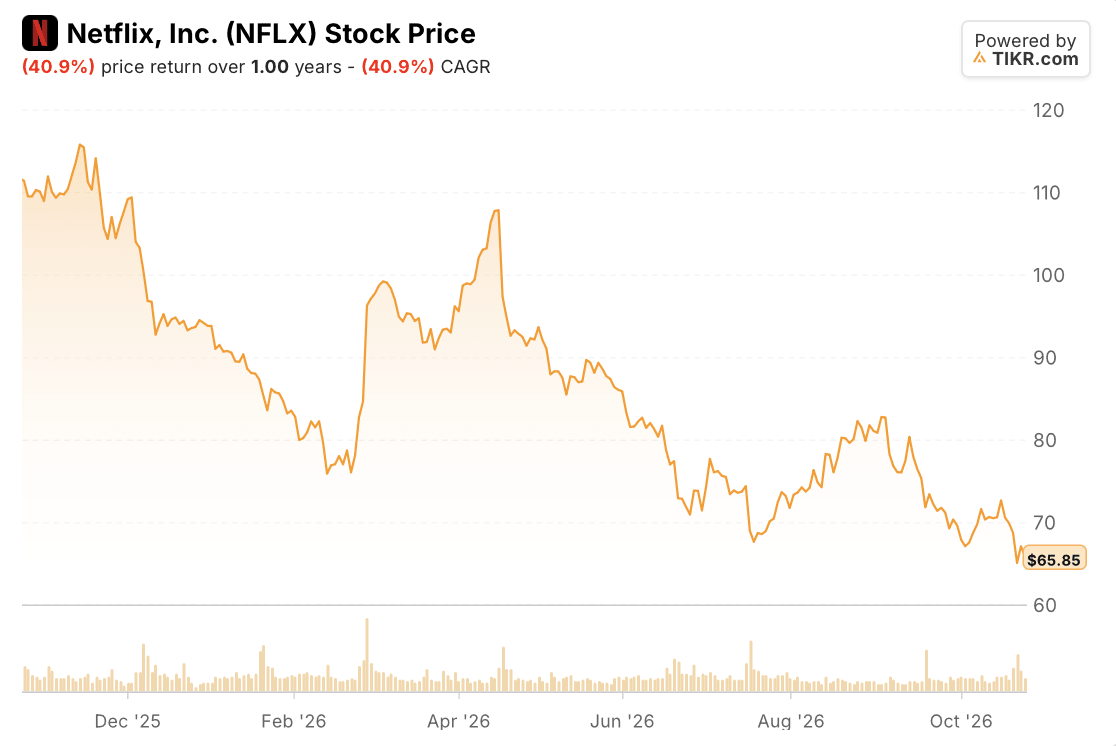
Netflix agreed in December to buy Warner Bros. Discovery (WBD)’s studio and streaming assets in a deal valued at $27.75 a share, according to Reuters. Netflix stock slid from the mid-$110s in late November to the low $90s by the end of December. The January 20 fourth-quarter report didn’t help: shares fell more than 7% in premarket trading even though membership passed 325 million, and the slide ran into the high $70s by mid-February.
Then Netflix let the deal go. On February 26, after Warner Bros. Discovery’s board called Skydance Corporation (SKYD) (formerly known as Paramount Skydance) revised $31-a-share offer superior, Netflix declined to raise its bid and said matching it would make the deal no longer financially attractive. It walked away with a $2.8 billion termination fee and a plan to restart buybacks. Netflix stock jumped 13.75% to $96.24 the next day.
Netflix Stock Gave the Rebound Back One Guide at a Time
The rally carried shares to just under $110 by mid-April. It didn’t survive the first-quarter report. Netflix stock fell 9.72% on April 17 after the company guided second-quarter EPS to $0.78, below the $0.84 analysts expected, and said co-founder Reed Hastings wouldn’t stand for re-election to the board.
July ran the same play. Netflix’s July 16 report guided third-quarter revenue to $12.86 billion against a $13.01 billion consensus, and the stock fell to a 52-week low within days. Netflix also said view hours grew just 2% in the first half and that its engagement report would move to once a year starting in 2027.
A late-summer bounce lifted the stock back to $83 by September 3. It didn’t hold, and Netflix stock closed at $67.85 on October 1.
TIKR Tracks 54 Analysts on Netflix. How Many Say “Buy”?
See the full breakdown of Buy, Hold, and Sell ratings on Netflix, along with Wall Street’s revenue and earnings estimates, all in one place. More than 500,000 investors use TIKR to research stocks like this one. See Netflix’s Analyst Ratings
Netflix’s October Shake-Up Ran Into a Soft Guide
October opened with co-CEO Ted Sarandos telling Bloomberg’s Screentime conference on September 30 that Netflix wasn’t growing as fast as he wanted. Two weeks later, on October 14, Netflix cut 6% of its workforce, about 1,000 jobs and its biggest cut since 2022. A day after that, chief content officer Bela Bajaria was out, with former Walt Disney (DIS) executive Peter Rice named to replace her.
The third-quarter shareholder letter on October 20 had a decent quarter in it. Revenue rose 11.8% to $12.87 billion (in line, but the slowest growth in nearly three years), and EPS of $0.87 beat the $0.82 estimate. The outlook was the problem:
- Fourth-quarter EPS guidance of $0.67 came in 8.2% below the $0.73 consensus, and the quarter’s 26.0% operating margin guide carries about 120 basis points of layoff costs.
- Netflix cut its 2026 ad revenue forecast to about $2.7 billion from about $3 billion, blaming slower rollouts and partner integrations, even as co-CEO Greg Peters said ads are still growing more than 80% this year.
Netflix stock sank 5.3% on October 21. On the Q3 2026 earnings call, Sarandos put the problem plainly: “Now the U.S. is also working. It’s just not growing as fast as it could or as fast as we’d like.” Netflix said it will give 2027 guidance, margin included, with its fourth-quarter report in January.
Analysts Have Cut Their Netflix Target 37% From the Peak
The Street’s mean price target now sits at $84.83, down 37% from its $134.73 high and still 28.8% above the $65.85 close. The steepest cut came after the July report, when the mean dropped from the low $110s to the high $90s, and more than 20 brokerages lowered targets after the October report, per LSEG data cited by Reuters. Over the same year, the stock fell 40.9%, so the target has dropped almost as fast as the price.
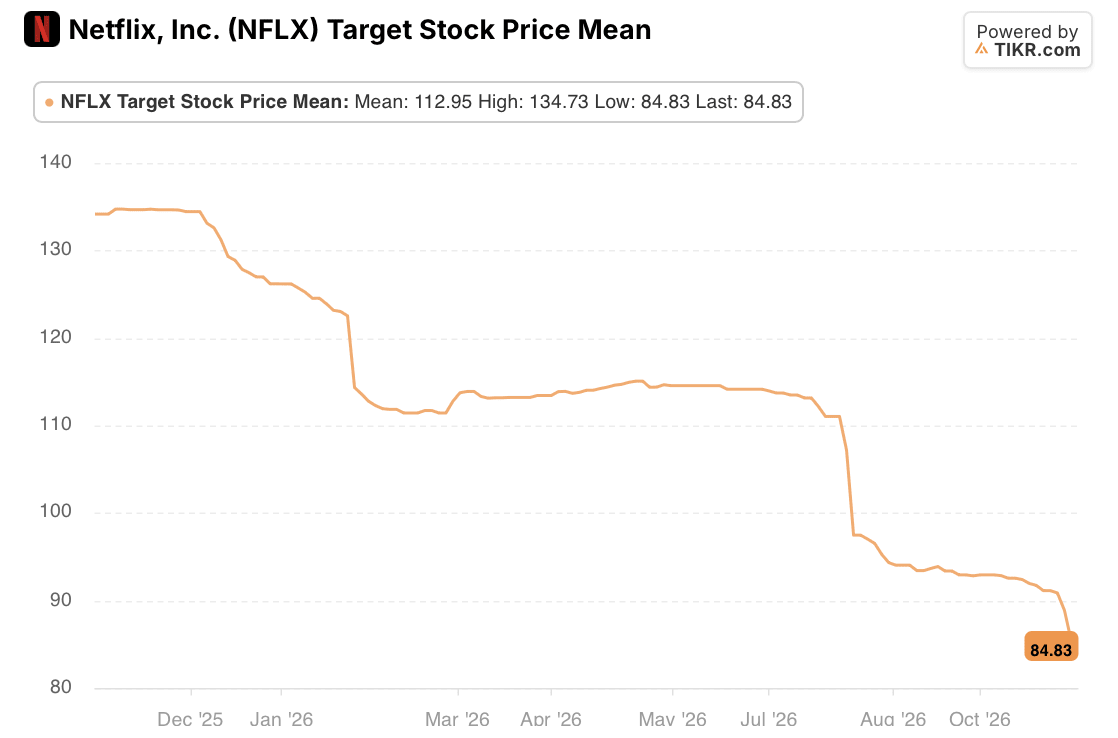
The estimates show how little growth the Street pencils in for next year. Analysts see normalized EPS of $3.57 for 2026 and only $3.77 for 2027, a 5.6% gain. Growth picks back up after that, to $4.50 in 2028 and $5.27 in 2029.

Cheap Netflix Stock or a Cheaper Business?
The bull case starts with the multiple. Netflix trades at 18.34x NTM earnings, 44.9% below its three-year mean of 33.30x and far below the 50.14x it hit in June 2025. At $65.85, that’s 17.5x the Street’s 2027 EPS. Netflix is also buying its own shares hard: it spent $4.8 billion on buybacks in the third quarter, its biggest quarter yet, and churn improved year over year in the U.S. and globally.
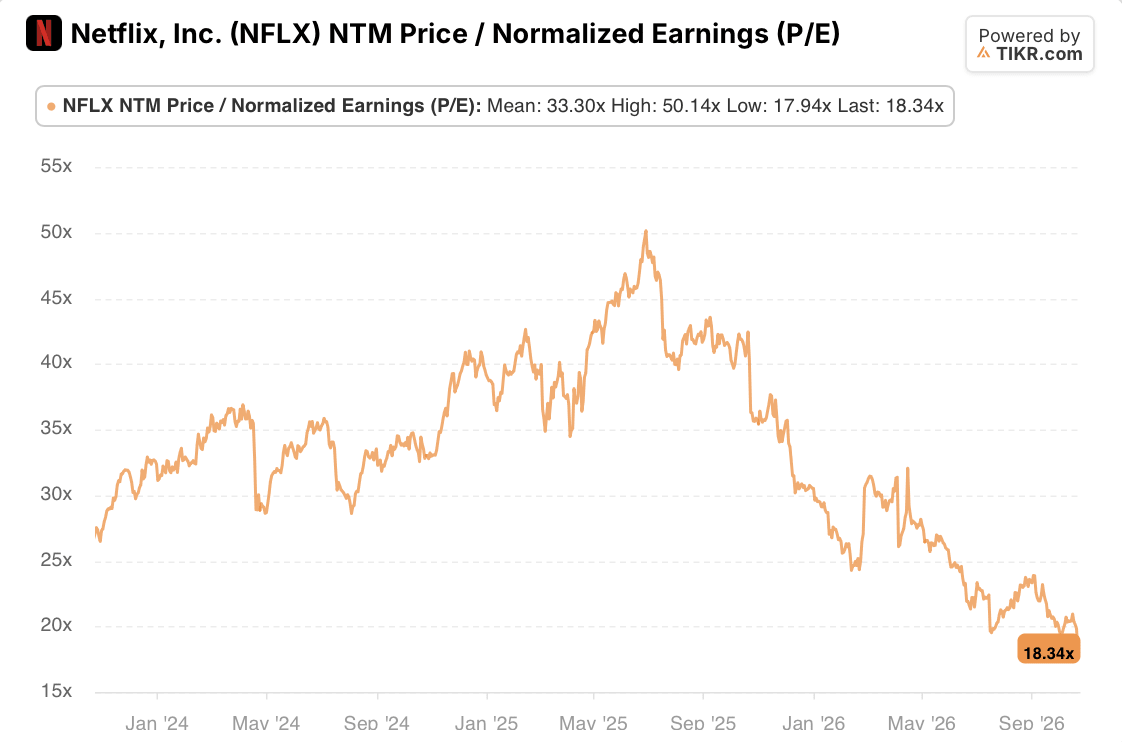
The bear case is that the multiple fell for a reason. Per Reuters, the fourth-quarter guide implies a fourth straight quarter of slower revenue growth. The ad business also missed its own target, and a 5.6% EPS gain for 2027 is thin support for an 18x multiple. It still costs more than Walt Disney at 14.76x and Comcast (CMCSA) at 6.26x on the same basis.
Both cases can be true at once, which is why I’d let January decide. If Netflix guides 2027 to double-digit revenue growth with a wider margin, as CFO Spence Neumann said it aims to, that $3.77 estimate looks too low and 18.34x looks cheap. If it points to single-digit revenue growth instead, the 5.6% estimate holds, and so does the case that 18.34x is a fair price for the business Netflix has become.
So What Is Netflix Stock Actually Worth?
TIKR lets you forecast the future price of any stock in less than a minute. Just enter a few assumptions into TIKR’s valuation model and see what NFLX stock could be worth. Start from Wall Street consensus estimates, or adjust the inputs to reflect your own view of the business. It’s free to use.
Disclaimer:
Please note that the articles on TIKR are not intended to serve as investment or financial advice from TIKR or our content team, nor are they recommendations to buy or sell any stocks. We create our content based on TIKR Terminal’s investment data and analysts’ estimates. Our analysis might not include recent company news or important updates. TIKR has no position in any of the stocks mentioned. Thank you for reading, and happy investing!