Key Takeaways
- Elon Musk says Terafab, the chip fab Tesla and SpaceX are building in Texas, will rank in the top 20 of country GDP from a single building, as it reportedly courts about 10 Korean suppliers.
- The real prize is guaranteed chip supply, which Intel’s Pushkar Ranade says a company gets by owning its own fab, and that makes Terafab the strongest case for combining Tesla and SpaceX.
- Musk puts Terafab’s cost at tens of billions of dollars through early 2028, on top of the roughly $20 billion Tesla guides to spend in 2026 and the $20.9 billion SpaceX spent in 2025.
- The top-20 claim depends on Terafab’s full goal of 1 million wafers a month, about a decade away, and Tesla’s 2027 capex guidance in late January will show how much of the bill Tesla is taking on.
Elon Musk wants Tesla (TSLA) and SpaceX (SPCX) to make their own chips, and he just put a number on what that’s worth. (Sort of.)
In an exclusive, Korean trade outlet TheElec reported that Terafab, the fab the two companies are building in Grimes County, Texas, is in talks with about 10 Korean chip suppliers, and more than half of them have signed nondisclosure agreements. HPSP has reportedly agreed to supply an annealing tool for the R&D line. And former Intel (INTC) staff overseeing Terafab have reportedly brought Intel’s own suppliers into the project.
Musk’s reaction on X, on Oct. 20? “The value of Terafab’s output will place it in the top 20 of country GDP in a single building.”
That’s quite a building.
TIKR tracks 44 analysts on Tesla. How many say “Buy”?
See the full breakdown of Buy, Hold, and Sell ratings on Tesla, along with Wall Street’s revenue and earnings estimates, all in one place. More than 500,000 investors use TIKR to research stocks like this one. See Tesla’s Analyst Ratings
The “top 20” math needs a decade
The world’s 20th-largest economy produces [roughly $1 trillion] a year. Terafab reportedly aims for 1 million wafers a month within 10 years, which works out to 12 million wafers a year. Divide the first number by the second, and each wafer would have to carry about [$83,000] of output.
Whether that adds up depends on what Musk counts as output: a raw wafer, or the AI chips cut from it. He didn’t say.
Either way, the claim only works once the fab is fully built out. The first phase, 100,000 wafers a month, is reportedly expected before 2030. On the Dwarkesh Podcast, Intel’s Pushkar Ranade explained why it can’t come much sooner: new tools take about 18 months to arrive, and once you build a new fab on top of that, you’re at roughly the end of the decade.
The bill shows up years earlier
On Tesla’s third-quarter call, Musk said Terafab would cost “tens of billions” through early 2028 and “north of $100 billion” over the long run. How much SpaceX pays is still undecided.
Tesla’s spending was already high before any of that. Its capex rose from $6.5 billion in 2021 to $11.3 billion in 2024, then dipped to $8.5 billion in 2025.
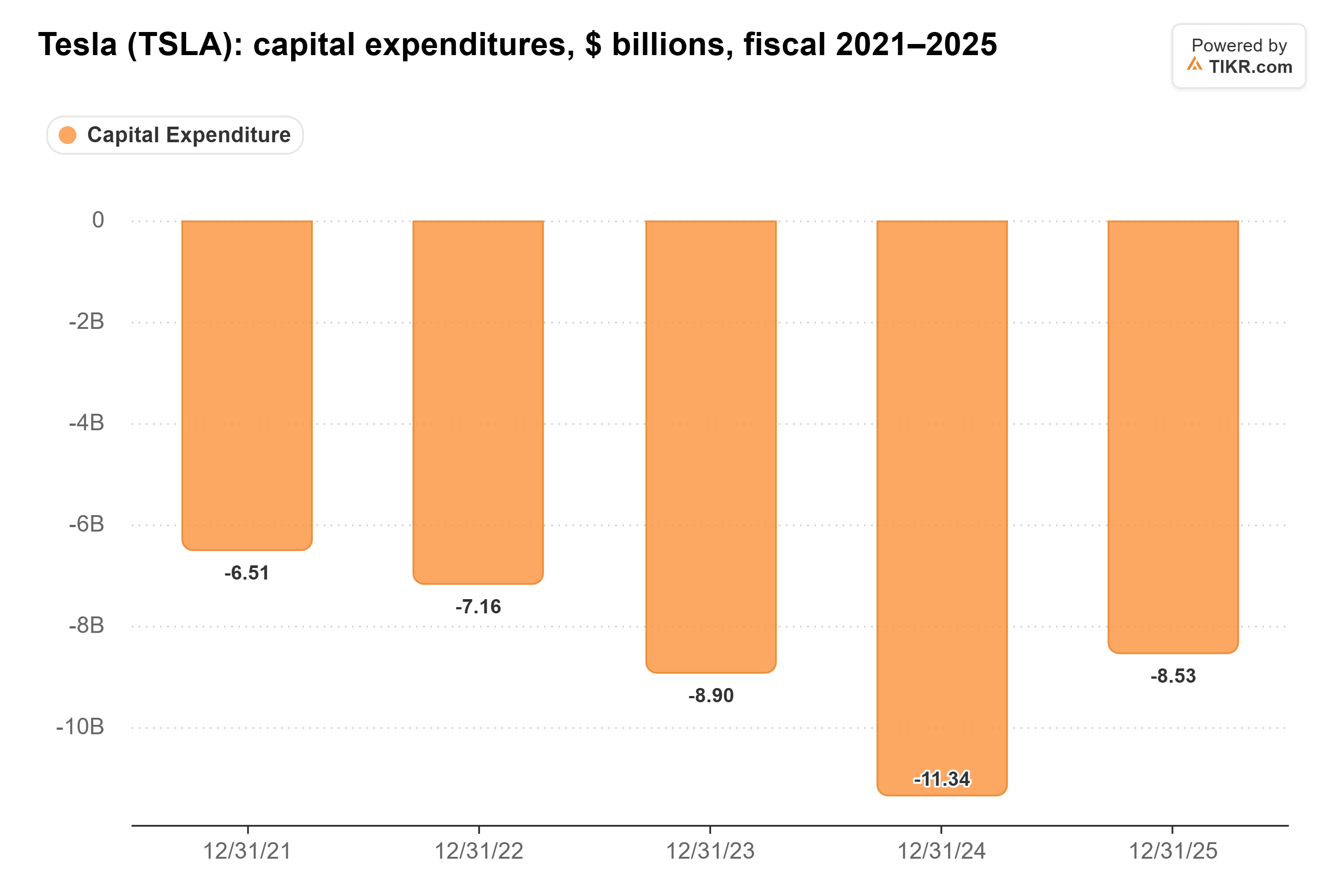
And it guides to about $20 billion for 2026, even after trimming that budget from over $25 billion.
SpaceX is the other half of any combined company, and it spends even more. Its capex nearly doubled, from $11.2 billion in 2024 to $20.9 billion in 2025.
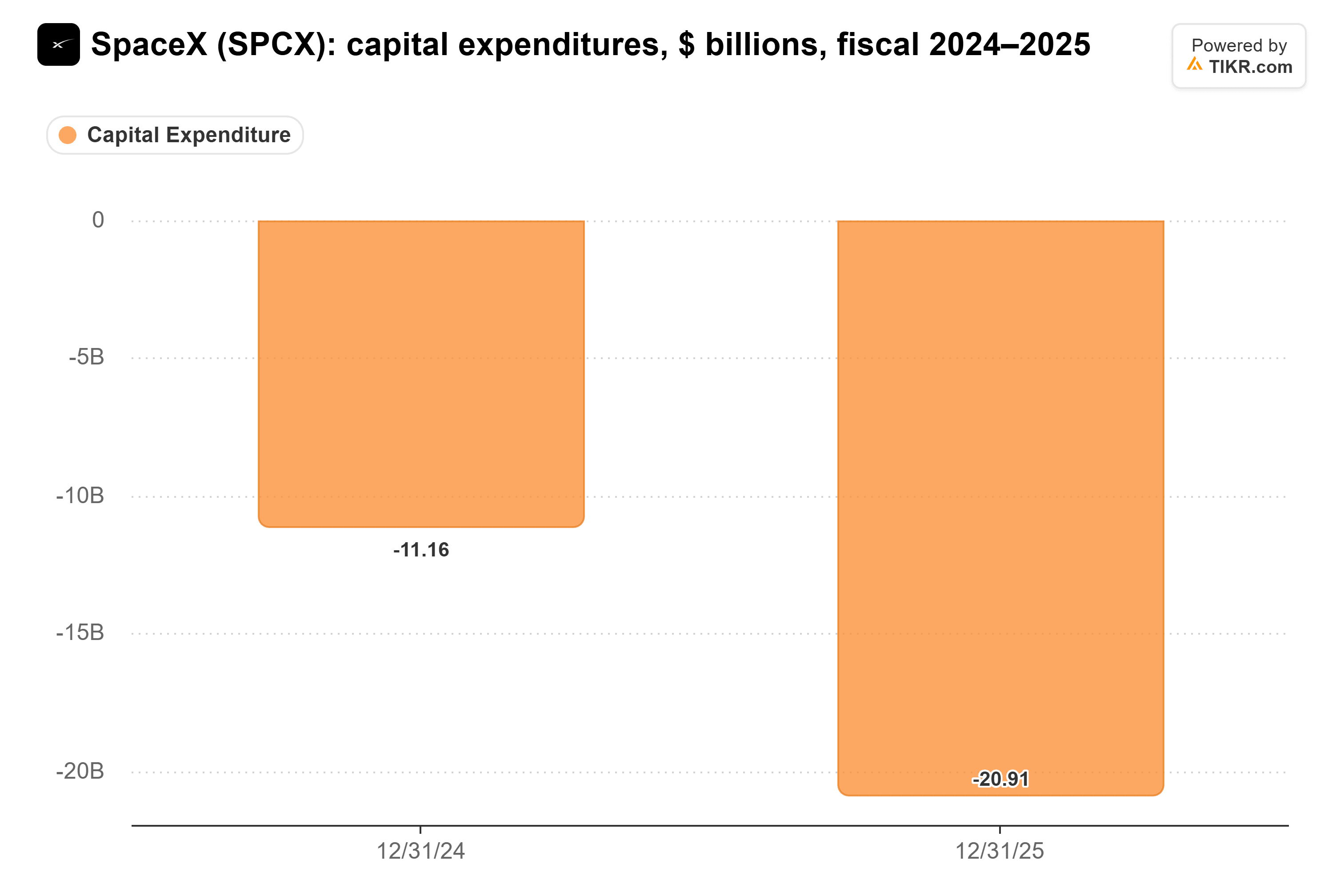
Neither company has given Terafab its own line in its spending yet. Tesla had $45.4 billion of cash and investments at Sept. 30, but analysts expect free cash flow of negative $9.9 billion in 2027 and negative $7.9 billion in 2028, and that’s before a big Terafab bill.
Guaranteed supply is the prize
Ranade’s description of the fab is the most useful one so far. He summed up Musk’s thinking as “We either build the Terafab or we don’t have the chips.”
He was also blunt that tool shortages mean “the net amount of silicon in the world won’t increase.” What a new fab’s owner gets is “guaranteed supply in a way that they wouldn’t have if they’re working with another person’s foundry.”
That supply is what ties Terafab to the Tesla-SpaceX merger, which special committees at both companies are now weighing. Chad Anderson, an early SpaceX investor, told Bloomberg Tech that a combined company would be “the company that owns everything from chip fabrication all the way through intelligence.”
Two companies sharing one fab’s output, and arguing over one fab’s bill, is messy. One owner makes both questions simpler.
Top 20 can wait
So will a single Terafab building really out-produce all but 19 countries? Maybe, a decade from now, at full capacity, depending on how Musk counts output. No investor should bank on that today.
My take: Terafab is the strongest industrial case yet for combining Tesla and SpaceX. Guaranteed chip supply matters to both companies, and a bill this size is easier to carry on one balance sheet. I just wouldn’t pay anything today for the “top 20” line.
Of course, the special committees haven’t agreed on any terms. Tesla’s 2027 capex guidance, due with its fourth-quarter results in late January, will be the first real look at how much of Terafab Tesla is paying for.
So what is Tesla stock actually worth?
TIKR lets you forecast the future price of any stock in less than a minute. Just enter a few assumptions into TIKR’s valuation model and see what Tesla could be worth. Start from Wall Street consensus estimates, or adjust the inputs to reflect your own view of the business. It’s free to use.
Disclaimer:
Please note that the articles on TIKR are not intended to serve as investment or financial advice from TIKR or our content team, nor are they recommendations to buy or sell any stocks. We create our content based on TIKR Terminal’s investment data and analysts’ estimates. Our analysis might not include recent company news or important updates. TIKR has no position in any of the stocks mentioned. Thank you for reading, and happy investing!