Microsoft (MSFT) is offering buyouts to roughly 60,000 employees, about 27% of its 223,000-person workforce. Chief People Officer Amy Coleman announced the Voluntary Exit Offer on October 26. It’s open to eligible staff in participating teams in the U.S., Canada, the U.K. and India at level 70 and below. CNBC reported the 60,000 figure, citing a person familiar with the matter.
That figure is eligibility, not job cuts. Microsoft hasn’t said how many people it expects to accept, what the package will cost, or what it hopes to save, and employees have until December to decide. The company also told GeekWire the offer isn’t a sign it needs fewer people.
How This Differs From Microsoft’s Spring Buyout
- Wider net: The April retirement program reached about 8,750 U.S. employees whose age plus years of service totaled at least 70. This offer has no age or tenure test, and performance isn’t a factor.
- Four countries: It covers the U.S., Canada, the U.K. and India, but only in teams that chose to take part.
- Lower expected uptake: Microsoft told GeekWire it expects a much smaller share than the roughly 30% who took the retirement offer.
- An initial cost estimate for the first round: Microsoft initially expected a $900 million charge for the retirement program, but its July 29 results cited lower-than-expected expenses for it, without giving a final figure. The package offered up to 39 weeks of salary and up to five years of continued healthcare access, with only the first year fully subsidized.
Microsoft Already Runs Leaner Than It Did in 2021
Microsoft’s two main operating expense lines, R&D and selling, general and admin, totaled $70.23 billion in fiscal 2026, which ended June 30. That’s 21.2% of the year’s $331.8 billion revenue, down from 27.3% in fiscal 2021.
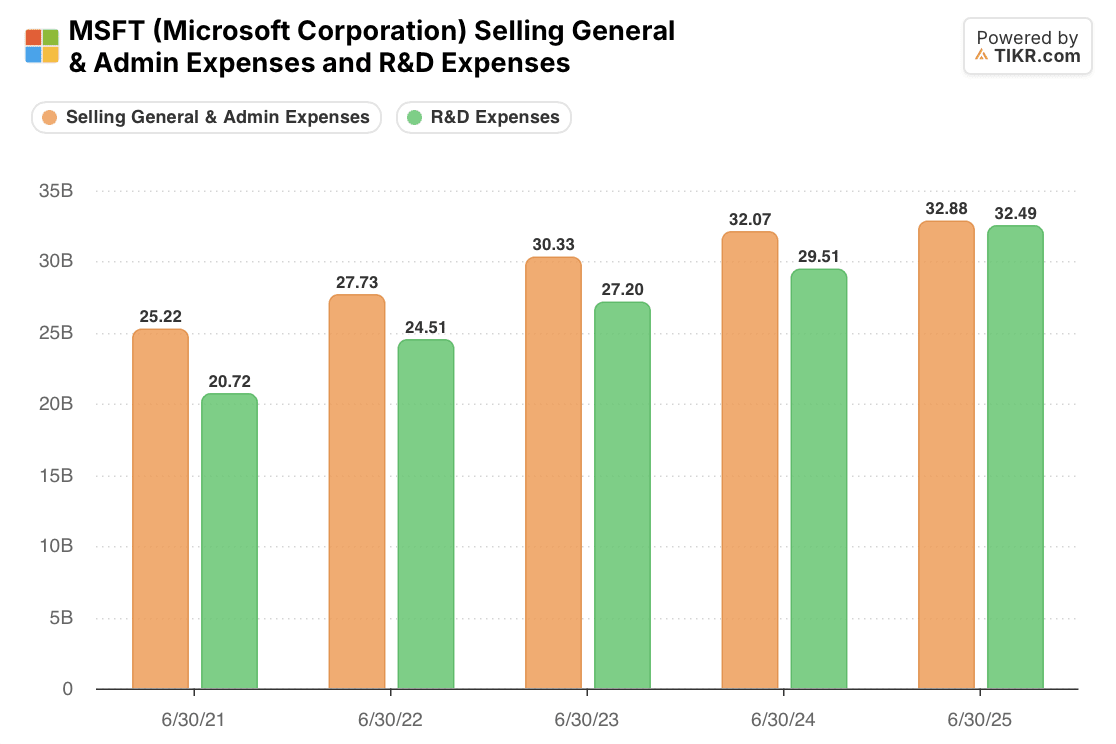
Revenue nearly doubled over those five years. Operating expenses grew 53%, and headcount rose 23%, from 181,000 to 223,000. Revenue per employee climbed from about $929,000 to about $1.49 million.
That’s where the margin gains came from. EBIT margin rose from 41.6% to 46.8%, while gross margin slipped from 68.9% to 67.9% as AI infrastructure costs flowed through cost of revenue. All of Microsoft’s operating margin expansion came from operating expenses shrinking against sales. A buyout is another turn of that same screw.

TIKR Tracks 57 Analysts on Microsoft. How Many Say “Buy”?
See the full breakdown of Buy, Hold, and Sell ratings on Microsoft, along with Wall Street’s revenue and earnings estimates, all in one place. More than 500,000 investors use TIKR to research stocks like this one. See Microsoft’s Analyst Ratings
How Much Could Microsoft Save?
Less than the headline implies. Say 10% of eligible employees accept: that’s 6,000 departures, about 2.7% of the workforce. For scale, a 2.7% reduction in R&D and SG&A would save about $1.9 billion annually, equivalent to roughly 0.6 percentage points of operating margin on fiscal 2026 revenue. But 6,000 departures would not necessarily produce that reduction: savings depend on compensation, which functions lose staff and whether those positions are replaced.
The bigger point is direction. CFO Amy Hood said in April that headcount would fall again in fiscal 2027, and Microsoft’s workforce already shrank from 228,000 to 223,000 over fiscal 2026. With gross margin under pressure from AI depreciation, keeping opex growth below revenue growth is the main way Microsoft defends a 46.8% operating margin. This offer lets it do that without picking names.
Why Microsoft’s October 28 Report Matters More Than the Memo
Microsoft reports fiscal Q1 2027 results after the close on Wednesday, October 28. The first thing to look for is a charge. Hood put a number on the retirement program within a week of announcing it, and a figure for this offer would be the first real clue to how many departures Microsoft is budgeting for.
The second is the operating expense line. An unchanged full-year opex outlook would not rule out savings: they could offset the exit charge or additional spending elsewhere. A lower outlook would strengthen the margin case, but management would need to explain how much of the change comes from recurring buyout savings. I’d treat the opex guide, not the 60,000, as the number that answers the headline’s question.
So What Is Microsoft Stock Actually Worth?
TIKR lets you forecast the future price of any stock in less than a minute. Just enter a few assumptions into TIKR’s valuation model and see what MSFT stock could be worth. Start from Wall Street consensus estimates, or adjust the inputs to reflect your own view of the business. It’s free to use.
Value Microsoft Corporation for free→
Disclaimer:
Please note that the articles on TIKR are not intended to serve as investment or financial advice from TIKR or our content team, nor are they recommendations to buy or sell any stocks. We create our content based on TIKR Terminal’s investment data and analysts’ estimates. Our analysis might not include recent company news or important updates. TIKR has no position in any of the stocks mentioned. Thank you for reading, and happy investing!