Key Takeaways
- On Oct. 8, Elon Musk replied “True” to an X post saying Starlink will become a must-have for airlines and those without it will lose customers.
- United Airlines has Starlink on just under 600 aircraft and expects it on its whole fleet by the end of 2027, according to Jefferies. Delta’s Amazon Leo installs start in 2028.
- Fast in-flight Wi-Fi is becoming a must-have. Delta is betting it doesn’t have to come from Starlink, and its biggest risk is falling behind United on timing.
- Airline contracts give SpaceX a sticky enterprise business. But analysts’ revenue estimates, which climb from $45.3 billion in 2026 to $201 billion in 2028, rest on much bigger businesses.
Elon Musk has a warning for every airline that skips Starlink, the satellite internet business inside SpaceX (SPCX): your passengers will leave.
Or at least, that’s the warning he signed off on. On Oct. 8, the SpaceX fan account @SPCX100T posted:
“Starlink will become a must-have for airlines. Those without it will lose customers to competitors. $SPCX”
Musk’s reply? “True.”
It’s hard to read that one word without thinking of Delta Air Lines (DAL).
United got the memo early
United Airlines (UAL) has put Starlink on just under 600 of its aircraft. That’s 300 regional jets and 300 mainline planes, according to an Oct. 12 note from Jefferies analyst Sheila Kahyaoglu, written after she met the airline’s vice president of technology. United expects half its mainline fleet to have Starlink by the end of this year and its whole fleet by the end of 2027.
Kahyaoglu called that “a significant head start vs. US peers.” Southwest Airlines (LUV) was set to start installing Starlink in summer 2026, and American Airlines (AAL) starts in the first quarter of 2027. Delta’s rollout doesn’t begin until 2028, and it’s on Amazon Leo.
Her explanation of why this matters is pretty much the whole case for the “must-have” line Musk endorsed:
“US customers are prioritizing a premium travel experience rather than a commoditized product, w/ UAL identifying next-gen WiFi in addition to the mobile app seat-back entertainment & new interiors as tools to attract the incremental premium customer.”
(SpaceX’s S-1 also lists United by name among Starlink’s enterprise customers.)
Delta takes the under
Delta signed with Amazon (AMZN) for its Leo satellite service. It’s one of the only major airlines to do so.
Musk hasn’t let it go. In May, he said Delta wanted passengers to log in through its own Delta Sync portal. He posted that “Delta wanted to make it painful, difficult, and expensive for their customers,” and Delta called the claim inaccurate. Then in late September, unverified remarks attributed to Delta CEO Ed Bastian surfaced on X, and Musk posted that Bastian “will lose his job over this.”
Bastian answered on CNBC’s Squawk Box after Delta’s latest earnings report: “I’m a big fan of Starlink.” And Musk’s prediction about his job? “I don’t pay any attention.”
Then he made his case for Delta: “The reality is, Delta is the global pioneer in launching free and fast Wi-Fi as the industry standard.”
So Bastian agrees with half of Musk’s post.
Here’s how I see it: fast Wi-Fi is already a must-have, and both CEOs are selling it. Delta is betting that Amazon’s satellites can do the job. Its real risk is timing. Until 2028, a premium flyer choosing between United and Delta is choosing between Starlink now and a Leo rollout that hasn’t started.
Small potatoes for SpaceX, but sticky
SpaceX shareholders should keep the airline business in proportion. Aviation is one of eight industries the S-1 lists for Starlink’s enterprise business. And Starlink is one part of a company that brought in $18.7 billion of revenue in 2025, $11.4 billion of it from its Connectivity segment.
Analysts expect the whole company to get much bigger from here. Consensus has SpaceX’s revenue going from $45.3 billion in 2026 to $117 billion in 2027 and $201 billion in 2028, more than four times as much in two years.
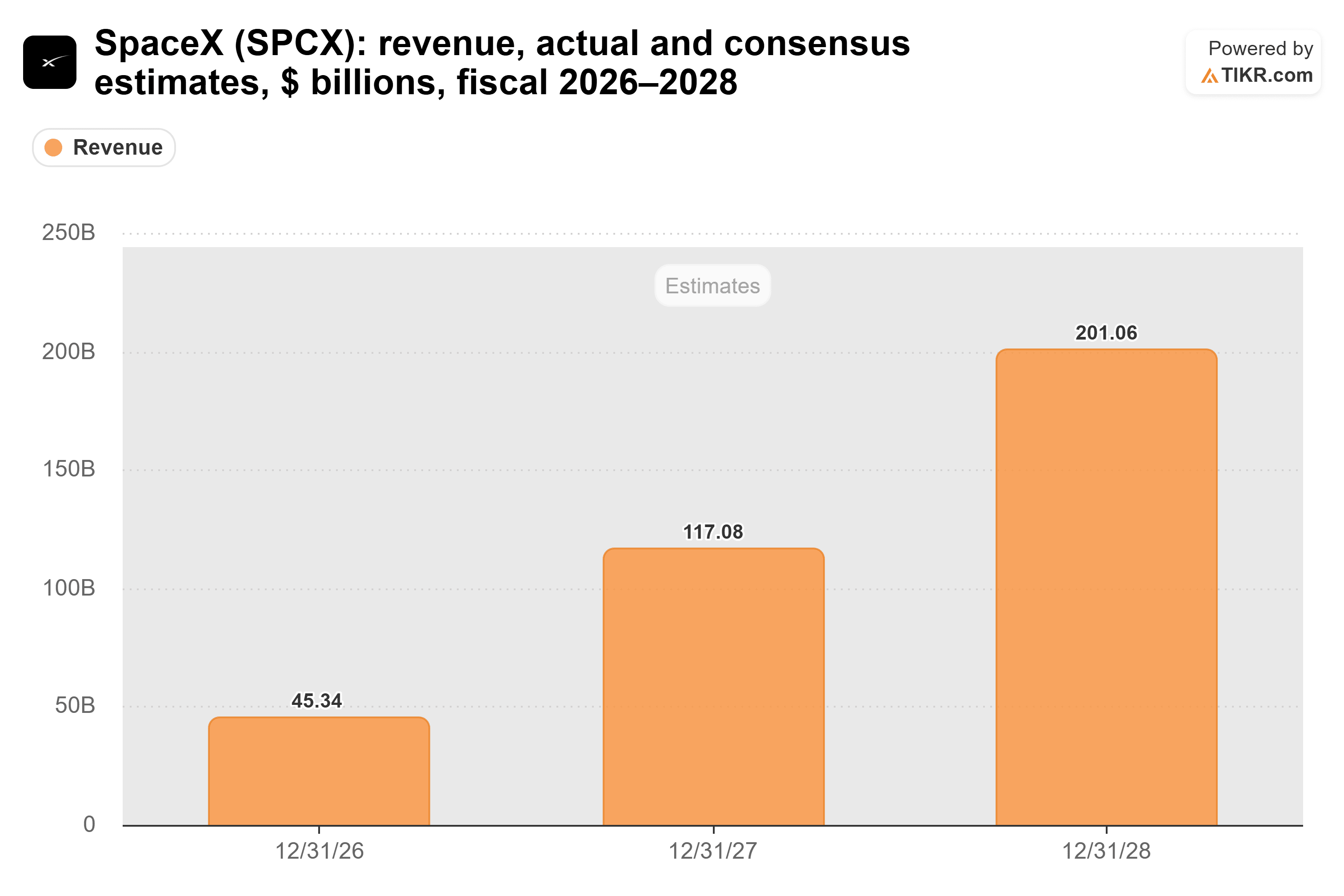
Growth like that has to come from businesses much bigger than airplane Wi-Fi. One is AI, where Yorkville Ives partner Dan Ives points to SpaceX’s “contracted backlog.” Another is wireless: in early October, SpaceX said it had bought a nationwide low-band spectrum portfolio, which puts Starlink up against the big US carriers. United was already a SpaceX customer, so its rollout shouldn’t move those estimates much.
United matters more for staying power. Musk’s claim is that once one airline has Starlink, its rivals have to follow. My guess is that an airline that has put Starlink on its whole fleet keeps it for a long time, though United hasn’t said how long its contract runs.
The upshot
Is Starlink a “must-have for airlines”? Fast Wi-Fi is, and United will have Starlink on its whole fleet before Delta installs its first Leo system. That gap is where Musk’s warning hits hardest. For SpaceX, airlines add a durable group of enterprise customers, but they won’t decide whether the company hits those revenue estimates.
Of course, Amazon Leo hasn’t flown on a Delta jet yet. If it matches Starlink when it arrives in 2028, Delta’s bet on the under will look a lot smarter than Musk thinks. The nearer test is whether United gets Starlink on half its mainline fleet by the end of this year.
So what is SpaceX stock actually worth?
TIKR lets you forecast the future price of any stock in less than a minute. Just enter a few assumptions into TIKR’s valuation model and see what SpaceX could be worth. Start from Wall Street consensus estimates, or adjust the inputs to reflect your own view of the business. It’s free to use.
Disclaimer:
Please note that the articles on TIKR are not intended to serve as investment or financial advice from TIKR or our content team, nor are they recommendations to buy or sell any stocks. We create our content based on TIKR Terminal’s investment data and analysts’ estimates. Our analysis might not include recent company news or important updates. TIKR has no position in any of the stocks mentioned. Thank you for reading, and happy investing!