Key Takeaways
- Microsoft reports fiscal first-quarter results on Oct. 28. Hyperscaler stocks have fallen roughly a quarter since early May, Schwab’s Liz Ann Sonders says, on worries about how the AI build-out will be paid for.
- Microsoft’s operating cash flow beat its cash capex by $67 billion in fiscal 2026, though that measure leaves out finance-lease repayments and the leases it has signed for later years.
- That cushion is getting thinner: capex took nearly two-thirds of operating cash in fiscal 2026, up from about a third in fiscal 2023.
- At 27x forward earnings, below its five-year average of 29x, the stock isn’t priced for trouble, and quarterly free cash flow is the number to watch on Wednesday.
Microsoft (MSFT) reports its fiscal first-quarter results after the close on Wednesday, Oct. 28, and this time the most important number might be on the cash flow statement. Hyperscaler stocks are down roughly a quarter since early May, by Schwab’s count, and investors now seem more worried about how all this AI spending gets paid for than about demand.
Why Hyperscaler Stocks Are Sliding
Charles Schwab chief investment strategist Liz Ann Sonders summed it up on X on Monday: “Worries about how AI buildout will be financed remain main drag on equities, particularly visible among hyperscalers.” She linked the hyperscaler index’s drop since early May to that worry, as tech borrowing costs rose sharply.
Companies that have nothing else to lean on are getting shut out. Elon Musk wrote on X that “debt markets have almost entirely shut off access to money for any company that doesn’t have substantial revenue independent of AI data centers.”
Microsoft has plenty of that revenue. This week we find out whether it still brings in enough cash to pay for the build-out without help from the debt markets.
TIKR Tracks 57 Analysts on Microsoft. How Many Say “Buy”?
See the full breakdown of Buy, Hold, and Sell ratings on Microsoft, along with Wall Street’s revenue and earnings estimates, all in one place. More than 500,000 investors use TIKR to research stocks like this one. See Microsoft’s Analyst Ratings
The Cash Still Covers the Build-Out… For Now
Microsoft’s operating cash flow has stayed ahead of its capex, even as capex roughly quadrupled from fiscal 2023 to fiscal 2026 (years to June):
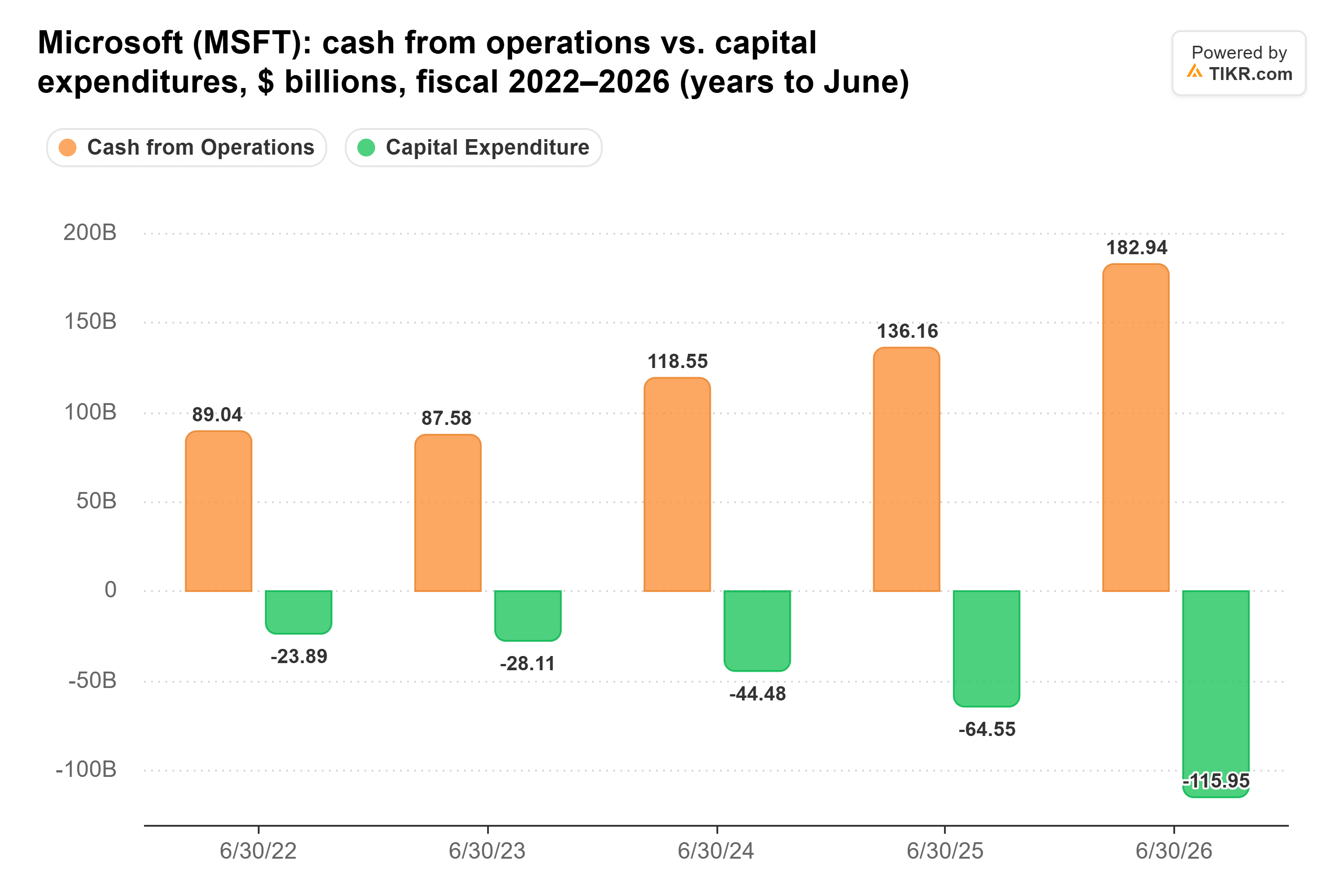
In fiscal 2026, Microsoft brought in $182.9 billion of operating cash and spent $115.9 billion on capex, which left $67.0 billion. That’s a big cushion. But capex took nearly two-thirds of operating cash, compared with about a third in fiscal 2023. Last year operating cash flow rose $46.8 billion and capex rose $51.4 billion.
There’s also $28.1 billion of data center finance leases on top of that. Microsoft counts new finance leases in its headline capex, but standard free cash flow doesn’t: their principal is repaid under financing activities, and only the interest runs through operating cash. From fiscal 2027, more future data center leases will be classed as operating leases instead, and those payments come out of operating cash. So capex will look lighter on Wednesday, while more of the lease bill shows up in free cash flow.
What Wednesday Has to Show
Microsoft guided to more than $50 billion of capex for the September quarter, finance leases included. Azure will probably drive the stock’s first move, against a guide of about 45% growth in constant currency, because that growth is what the spending buys. The cash flow statement shows whether Microsoft is still paying for it on its own.
Microsoft’s own recent quarters are the benchmarks, with one catch: all of them predate the lease change. Free cash flow was $25.7 billion in the September 2025 quarter, $5.9 billion in December and $19.6 billion in June. Analysts expect $34.6 billion for all of fiscal 2027, under $9 billion a quarter on average, and management has said it expects free cash flow to stay positive. A result near $25.7 billion, with more lease payments now running through operating cash, would make that consensus look cautious. One near $5.9 billion would put it in question.
None of this makes Microsoft a credit risk. It ended June with $76.8 billion of cash and short-term investments, well above its $46.1 billion of bonds. Marathon Asset Management CEO Bruce Richards said on Bloomberg Talks on Monday that he’d lean into hyperscaler debt because “their spreads trade wide relative to IG and it’s good risk.”
Leases are a much bigger commitment than the bonds, though. At June 30, Microsoft owed $114.4 billion on leases already running, interest included, plus $329.1 billion on leases, mostly for data centers, that start between fiscal 2027 and 2033 (some still subject to contractual conditions).
What 27x Says About Microsoft Stock
Microsoft trades at 27x forward earnings. That’s below its five-year average of 29x, though well up from its low of 19x in late June:
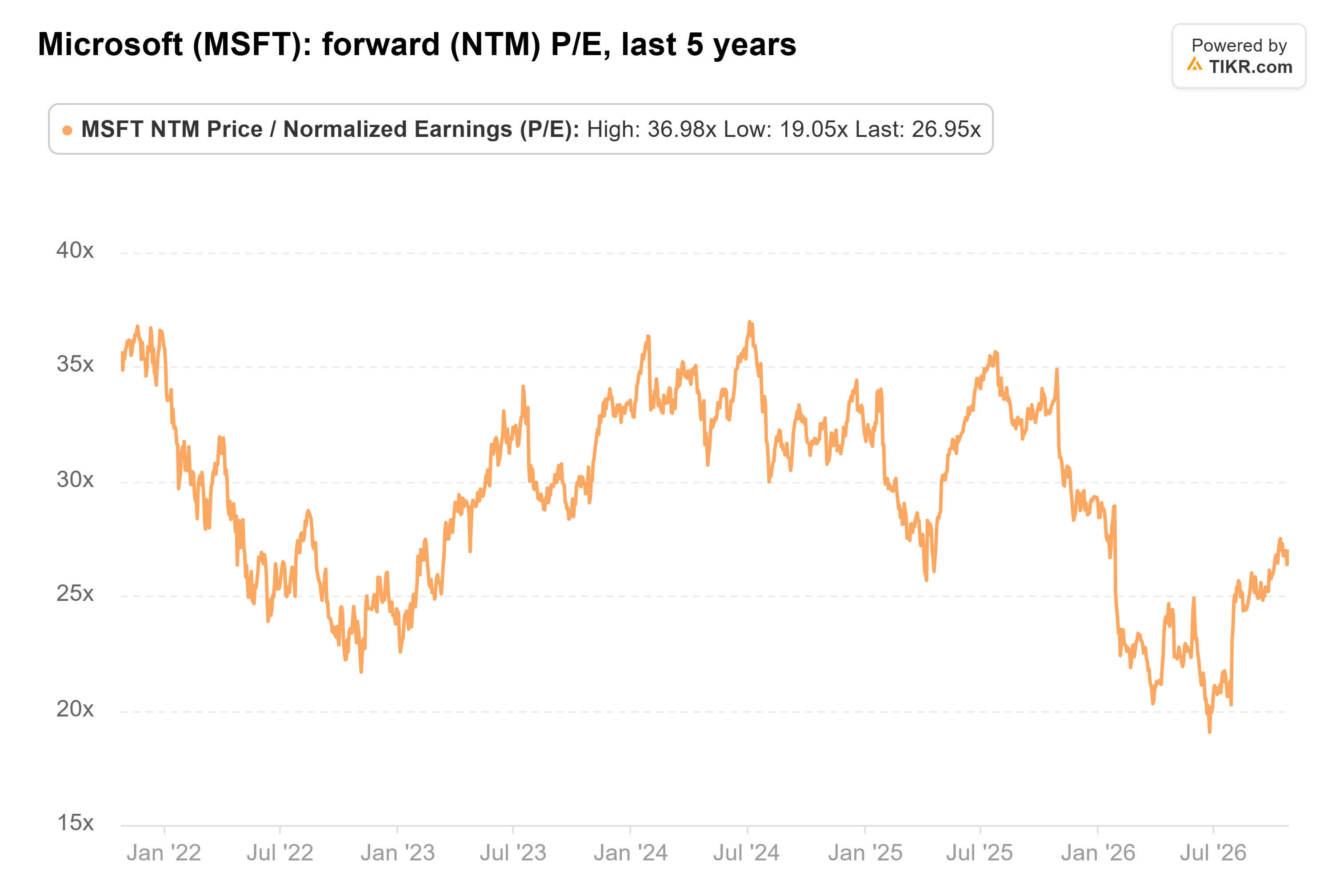
Microsoft can still pay for most of its AI build-out with its own cash, and 27x doesn’t price in any doubt about that. Under the new lease treatment, the capex line on Wednesday will flatter the spending, so I’d judge the quarter on free cash flow. If it stays comfortably positive with more lease payments running through operating cash and capex still above $50 billion, the financing fear dragging on the group mostly doesn’t apply to Microsoft. Mostly, because $329.1 billion of leases still to start is a kind of borrowing too.
The December-quarter capex guide matters just as much. That’s the quarter free cash flow fell to $5.9 billion last year.
So what is Microsoft stock actually worth?
TIKR lets you forecast the future price of any stock in less than a minute. Just enter a few assumptions into TIKR’s valuation model and see what Microsoft could be worth. Start from Wall Street consensus estimates, or adjust the inputs to reflect your own view of the business. It’s free to use.
Disclaimer:
Please note that the articles on TIKR are not intended to serve as investment or financial advice from TIKR or our content team, nor are they recommendations to buy or sell any stocks. We create our content based on TIKR Terminal’s investment data and analysts’ estimates. Our analysis might not include recent company news or important updates. TIKR has no position in any of the stocks mentioned. Thank you for reading, and happy investing!