
Key Takeaways
- Meta’s capex reached $30.12 billion in the June 2026 quarter against $31.86 billion of operating cash flow, leaving $1.75 billion of free cash flow on TIKR’s measure, down from $9.02 billion a year earlier.
- TIKR’s total debt measure, including lease liabilities, stood at $112.32 billion against $90.26 billion of cash and marketable securities.
- Capex is guided to $130 billion to $145 billion for 2026, leaving roughly $79 billion to $94 billion of spending for the second half and increasing the pressure on operating cash flow, the balance sheet, and new revenue lines such as compute and business agents.
Operating cash flow grew 25% while free cash flow shrank 81%. Compare Meta’s cash flow and capex on TIKR for free →
Meta Platforms Spent Nearly Every Dollar of Its Cash Flow in the June Quarter
Mark Zuckerberg opened Meta’s July 29 earnings call with 3.6 billion daily users and a business growing revenue 28%. Later in the prepared remarks, CFO Susan Li read out the line that carried the quarter: “Free cash flow was $784 million.”
Meta’s own measure folds finance lease principal into capex. TIKR’s capex line is slightly narrower, which is why its free cash flow reads $1.75 billion. Either way, almost nothing was left.

The cash engine is not the problem. Operating cash flow rose from $25.56 billion to $31.86 billion in a year, and ad revenue grew 27%. Spending grew far faster. Capex went from $16.54 billion to $30.12 billion, up 82%, and absorbed about 95% of operating cash flow, against 33% in the September 2024 quarter.
The trailing four quarters tell the same story. Capex totaled $89.33 billion against $52.17 billion in the four quarters before, while operating cash flow rose 27% to $130.30 billion. Free cash flow slipped from $50.14 billion to $40.98 billion, and the June quarter did most of that damage.
Management says this is deliberate. Li described Meta as “demand constrained,” with “numerous ROI-positive places” to put compute if it had more. The first half used about $50.9 billion of capex on Meta’s measure. Against a $130 billion to $145 billion guide, that leaves roughly $79 billion to $94 billion for the second half, or about $40 billion to $47 billion a quarter.
The Balance Sheet Now Does Work That Free Cash Flow Used To Do
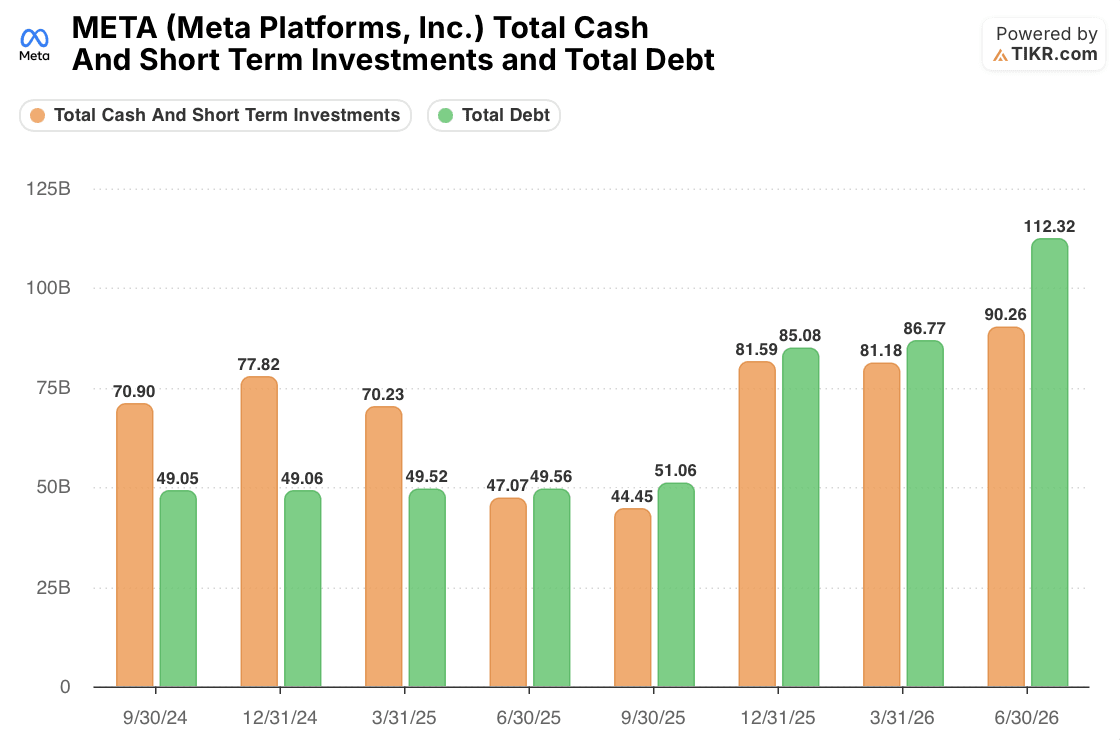
The gap is being filled with borrowing. Total debt rose from $49.56 billion in June 2025 to $112.32 billion, while cash climbed from $47.07 billion to $90.26 billion. That moves the calculated net position from about $2.5 billion of net debt to about $22 billion. TIKR’s debt measure runs higher than the $83.7 billion Meta cited on the call, so the exact net figure depends on definition. The climb does not.
Financing also sits beyond the balance sheet. Meta holds a 20% stake in the Hyperion data center venture, whose bonds are off its books, and announced a BlackRock partnership for a one-gigawatt El Paso site. A Reuters column this week noted that the $27 billion of Hyperion-linked notes traded at 91 cents on the dollar on Monday. The columnist called a Meta default highly unlikely, and the signal is about the cost of capital, not solvency.
The payoff case is real but early. Zuckerberg said Meta is getting compute offers “at a significant premium,” and Family of Apps other revenue passed $1 billion, up 73%. That is still about 2% of quarterly revenue, a calculation from the $60.8 billion total. Zuckerberg also called it “foolish” to sell all the compute for a short-term profit.
The evidence supports a narrow judgment. Meta’s core business still generates more cash every year, but it has moved from funding its build-out alone to relying partly on lenders and partners, and the new revenue lines have to scale before capex peaks. The main risk is a second half where spending outruns roughly $32 billion a quarter of operating cash flow and debt keeps climbing.
The September quarter report is the next test. Capex well above $30.12 billion alongside operating cash flow near $32 billion would put free cash flow negative for the first time in this eight-quarter series.
Debt more than doubled in a year, and Meta’s next capex figure is the test. Monitor Meta’s cash and debt on TIKR for free →
So what is Meta Platforms, Inc. stock actually worth?
TIKR lets you forecast the future price of any stock in less than a minute. Just enter a few assumptions into TIKR’s valuation model and see what META stock could be worth. Start from Wall Street consensus estimates, or adjust the inputs to reflect your own view of the business. It’s free to use.
Value Meta Platforms, Inc. for free→
Disclaimer:
Please note that the articles on TIKR are not intended to serve as investment or financial advice from TIKR or our content team, nor are they recommendations to buy or sell any stocks. We create our content based on TIKR Terminal’s investment data and analysts’ estimates. Our analysis might not include recent company news or important updates. TIKR has no position in any of the stocks mentioned. Thank you for reading, and happy investing!