Key Stats for Johnson & Johnson Stock
- Current Price: $270.24
- Target Price (Mid): ~$279
- Street Target: ~$273
- Potential Total Return: ~3%
- Annualized IRR: ~1% / year
Now Live: Discover how much upside your favorite stocks could have using TIKR’s new Valuation Model (It’s free) >>>
What Happened?
Johnson & Johnson (JNJ) first unveiled its ambition to build a soft-tissue surgery robot almost six years ago. On July 22, 2026, the FDA finally cleared it, granting De Novo authorization to OTTAVA, the first table-integrated soft-tissue surgical system approved in the United States. The stock, already up about 29% in 2026, rose to a record closing high of $273.41 on August 19 and now trades around $270.
J&J has cleared its biggest MedTech milestone in years, yet the stock sits at an all-time high with a Street mean target that barely clears the current price. The approval is real, and the pipeline behind it is deep. Whether a buyer at these levels is paying for growth that has not arrived yet is the harder question.
Why a Table-Integrated Robot Is J&J’s Real Swing at Intuitive
For more than 20 years, one company has owned soft-tissue robotics. Intuitive Surgical has placed thousands of da Vinci systems worldwide and remains the clear market leader. Medtronic’s Hugo entered in late 2025, and now J&J has arrived with a genuinely different design.
OTTAVA does not sit on a cart or hang from a boom. Its four arms fold into a standard operating table, which J&J says cuts the system’s footprint by 30% to 50% versus rival platforms. On the August 3 investor call, OTTAVA program president Rocco De Bernardis said that in five of the six sites in the FORTE study, the robot ran in operating rooms that previously could not fit one, including a room measuring just 243 square feet. He relayed a comment from nursing staff who kept asking “when does the robot arrive?” because it was already set up and out of the way.
R&D head Neda Cvijetic described “twin motion,” a feature that moves the table and arms together mid-procedure so surgeons can shift a patient without undocking and repositioning the robot. That targets a workflow surgeons often lose when moving from handheld to robotic surgery. J&J is also launching with instruments built for specific pain points: the team noted that 83% of surgeons experience at least one inadvertent suture cut per month, and pitched a dual-mode needle driver to address it.
De Bernardis said FORTE hit its primary safety and effectiveness endpoints and achieved 100% procedural completion across all 30 gastric bypass patients, with no conversion to a non-robotic approach. OTTAVA was authorized for 10 upper-abdominal general surgery procedures, and a second trial in inguinal hernia repair is already running.
J.P. Morgan’s Robbie Marcus called the smaller footprint interesting but wrote he expected Intuitive to see only a “very modest” share loss over time. A category-defining product against an entrenched incumbent is why the launch matters, and why it will take years to judge.

See historical and forward estimates for Johnson & Johnson stock (It’s free!) >>>
The Number Management Wants Investors to Hold Onto
Worldwide Chairman of MedTech Tim Schmid told analysts that fewer than 8% of relevant soft-tissue procedures worldwide are performed robotically today, and that J&J is “absolutely adamant that this will be a financially material program for Johnson & Johnson by the end of the decade.” That is the frame: not a 2026 revenue event, but a decade-long penetration story in a still-mostly-manual market.
Schmid was disciplined about the ramp, describing a phased launch starting with select high-volume centers before expanding indications and moving into Japan and Western Europe. Specific placement and revenue targets were deferred to the company’s Enterprise Business Review on December 8, which becomes the next real checkpoint for modeling OTTAVA’s contribution.
Second-quarter revenue hit a record $25.31 billion, up 6.6% year over year, with adjusted EPS of $2.90, beating the Street’s $2.85. The recently announced $5.5 billion talc settlement, still conditioned on 95% claimant participation, has largely lifted a decade-long overhang.
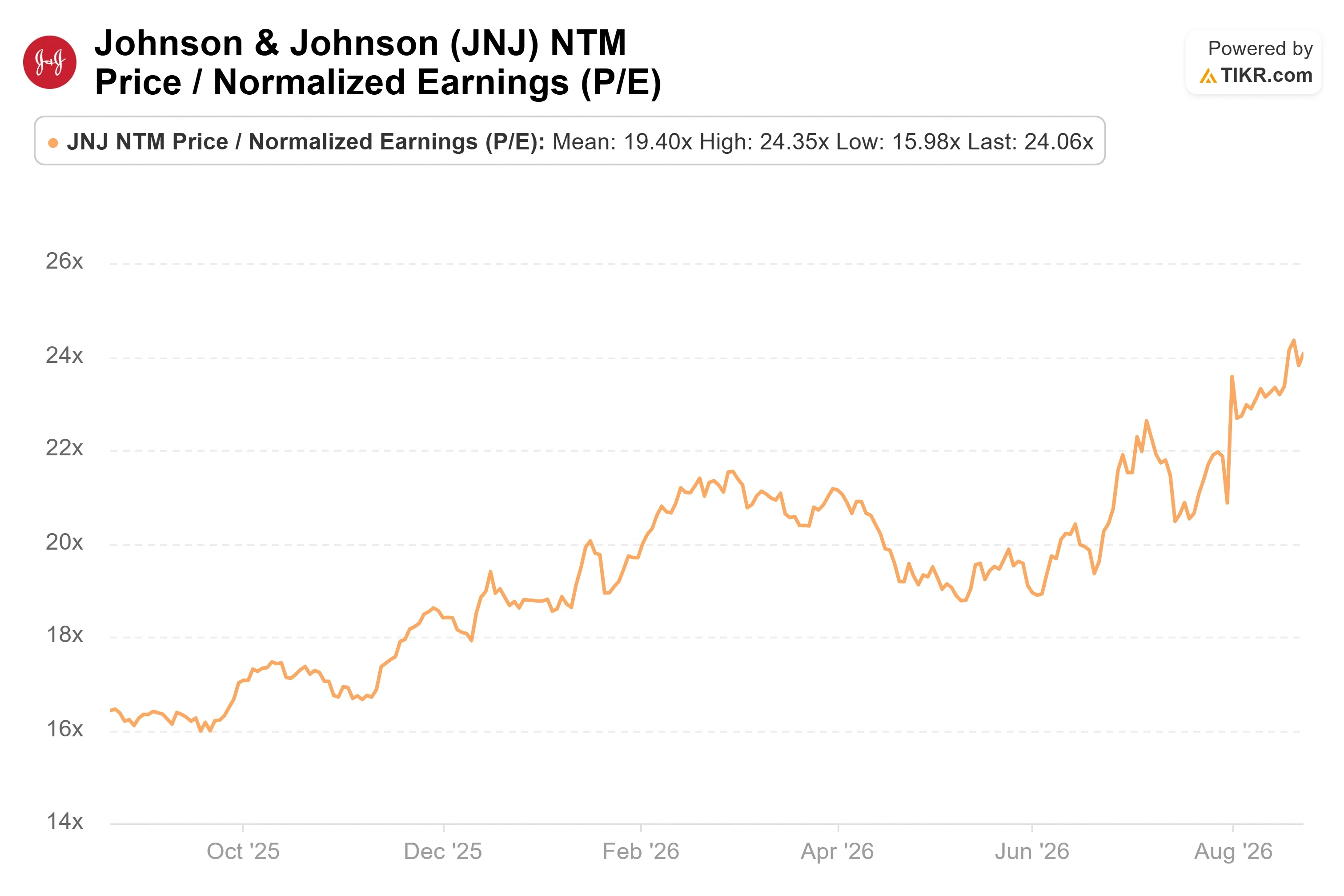
J&J trades at about 24 times forward earnings, a level it has rarely held, and its NTM dividend yield has compressed to 2.0% from 3.3% a year ago purely because the stock climbed. Against peers on NTM EV/EBITDA, J&J sits at 18.5x versus Merck at 17.1x, Pfizer at 8.9x, and Bristol-Myers Squibb at 8.5x. Only Eli Lilly, growing far faster, is richer at 23.1x. A mid-single-digit grower trading near the top of its own range is the friction a new buyer has to accept.
See how Johnson & Johnson performs against its peers in TIKR (It’s free!) >>>
TIKR Advanced Model Analysis
- Current Price: $270.24
- Target Price (Mid): ~$279
- Potential Total Return: ~3%
- Annualized IRR: ~1% / year

See analysts’ growth forecasts and price targets for Johnson & Johnson stock (It’s free!) >>>
Using TIKR’s mid-case assumptions, JNJ reaches a target of around $279, realized at the end of 2030. From today’s level, that is roughly a 3% total return and about 1% annualized over 4.4 years. This is the mid case, and it is the honest one to lead with after a 29% run.
The revenue drivers are the pharma pipeline past STELARA, led by oncology and newer immunology launches, and the MedTech recovery that OTTAVA now extends into robotics. The margin driver is operating leverage as higher-value launches scale, with net income margin modeled near 27%. The real risk is not in any single scenario price but in the multiple itself. It sits near the top of JNJ’s historical range, so if it normalizes toward the peer group faster than the model assumes, those thin returns turn negative.
The bullish path is straightforward: OTTAVA and the drug pipeline compound faster than consensus while the market keeps paying a premium multiple, and the high case reaches roughly $422. That requires JNJ to keep executing and to hold a rich valuation at the same time, which is a lot to ask at today’s price. The mid case is the more realistic base, and it already assumes modest multiple compression to land near $279.
Conclusion
The clean catalyst is on December 8. J&J has promised placement and revenue details for OTTAVA at its Enterprise Business Review, the first date the market can attach numbers to Schmid’s “financially material by the end of the decade” claim. Q3 earnings land first on October 13. Good looks like continued double-digit growth excluding STELARA and early OTTAVA momentum in MedTech surgery; bad looks like a guidance walk-back or signs the phased launch is slipping. At today’s price, the business has already earned its rerating. What it has not done is leave a new buyer much room, and December is where that changes, or it does not.
See what stocks billionaire investors are buying so you can follow the smart money with TIKR.
Should You Invest in Johnson & Johnson?
The only way to really know is to look at the numbers yourself. TIKR gives you free access to the same institutional-quality financial data that professional analysts use to answer exactly that question.
Pull up Johnson & Johnson, and you’ll see years of historical financials, what Wall Street analysts expect for revenue and earnings in the quarters ahead, how valuation multiples have moved over time, and whether price targets are trending up or down.
You can build a free watchlist to track Johnson & Johnson alongside every other stock on your radar. No credit card required. Just the data you need to decide for yourself.
Analyze Johnson & Johnson on TIKR Free →
Looking for New Opportunities?
- See what stocks billionaire investors are buying so you can follow the smart money.
- Analyze stocks in as little as 5 minutes with TIKR’s all-in-one, easy-to-use platform.
- The more rocks you overturn… the more opportunities you’ll uncover. Search 100K+ global stocks, global top investor holdings, and more with TIKR.
Disclaimer:
Please note that the articles on TIKR are not intended to serve as investment or financial advice from TIKR or our content team, nor are they recommendations to buy or sell any stocks. We create our content based on TIKR Terminal’s investment data and analysts’ estimates. Our analysis might not include recent company news or important updates. TIKR has no position in any stocks mentioned. Thank you for reading, and happy investing!