
Key Takeaways
- Nvidia CEO Jensen Huang said he wouldn’t be surprised if yearly spending to build and refresh AI infrastructure reached about $10 trillion. He says the world has been spending about $1 trillion a year on IT build-outs, so that’s roughly 10 times as much.
- Old capacity gets replaced every few years, so Nvidia’s market keeps renewing itself, which leaves room to grow even if new construction slows.
- Analysts expect Nvidia’s revenue to climb from $216 billion in the year ended January 2026 to $903 billion in the year ending January 2029, though paying for the build-out is the main risk.
- Nvidia trades at 18x forward earnings, near its lowest level in three years and well below its three-year average of 30x.
Data center construction is about to speed up again, and Nvidia (NVDA) CEO Jensen Huang thinks the spending behind it has much further to run.
SemiAnalysis now expects yearly additions to data center IT capacity outside China to more than double next year, to about 51 gigawatts from 25 gigawatts this year. In September, it was forecasting 43 gigawatts. (Huang has said every two gigawatts is worth about $80 billion to Nvidia, so that’s a lot of chips.)
On a recent episode of the BG2 podcast, Huang went much bigger:
“if you told me that the annual capacity building, infrastructure building, refreshing combination of new and old refreshes runs around $10 trillion, I’m not even a little bit surprised.”
He puts the whole world’s yearly IT build-out at about $1 trillion, so that’s 10 times as much.
TIKR tracks 62 analysts on Nvidia. How many say “Buy”?
See the full breakdown of Buy, Hold, and Sell ratings on Nvidia, along with Wall Street’s revenue and earnings estimates, all in one place. More than 500,000 investors use TIKR to research stocks like this one. See Nvidia’s Analyst Ratings
The refresh is the point
Huang’s argument is that this market never finishes. Every year more capacity gets built, and every five years or so some of the old equipment gets written off, switched off and replaced. On top of that, he said the industry still has to build a few trillion dollars of computing infrastructure.
That’s why the $10 trillion figure matters to Nvidia shareholders. If data centers need new chips every few years, Nvidia’s sales don’t depend on construction running flat out forever. A slowdown in new building still leaves the replacement cycle.
For scale, Morgan Stanley’s Nikolaj Lippmann said on the firm’s Thoughts on the Market podcast that its global framework suggests “annual capital spending could rise from roughly $2.5 trillion to about $5-6 trillion as companies build out global AI.” Huang’s number is well above even the top of that range. (His number includes refreshes and comes with no date attached.)
Analysts already expect a lot
Wall Street expects Nvidia’s revenue to nearly double this fiscal year and keep climbing for three years after that.
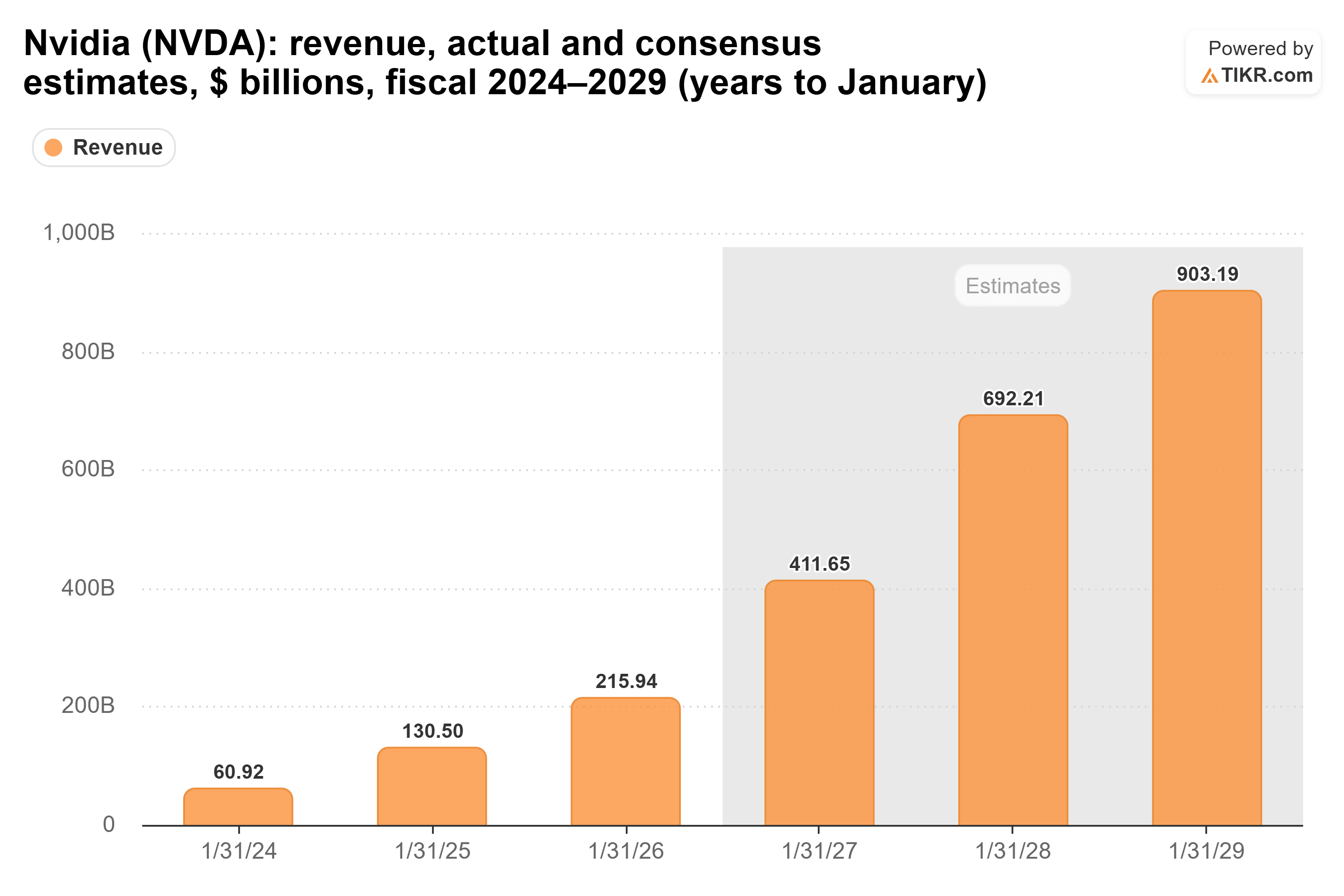
Even the $1.1 trillion analysts expect for the year ending January 2030 (only eight of them make that call) would be about a ninth of Huang’s $10 trillion. And SemiAnalysis’s higher forecast for 2027 gives them no reason to cut.
Money is the catch
Earlier this month, Broadcom (AVGO) CEO Hock Tan said capital may be a bigger limit on the AI build-out than chip shortages, as Jim Cramer recounted on Mad Money. Worries about how data centers get financed helped drive last week’s tech sell-off.
That hits Broadcom as hard as Nvidia: customers who can’t raise the cash can’t buy the chips.
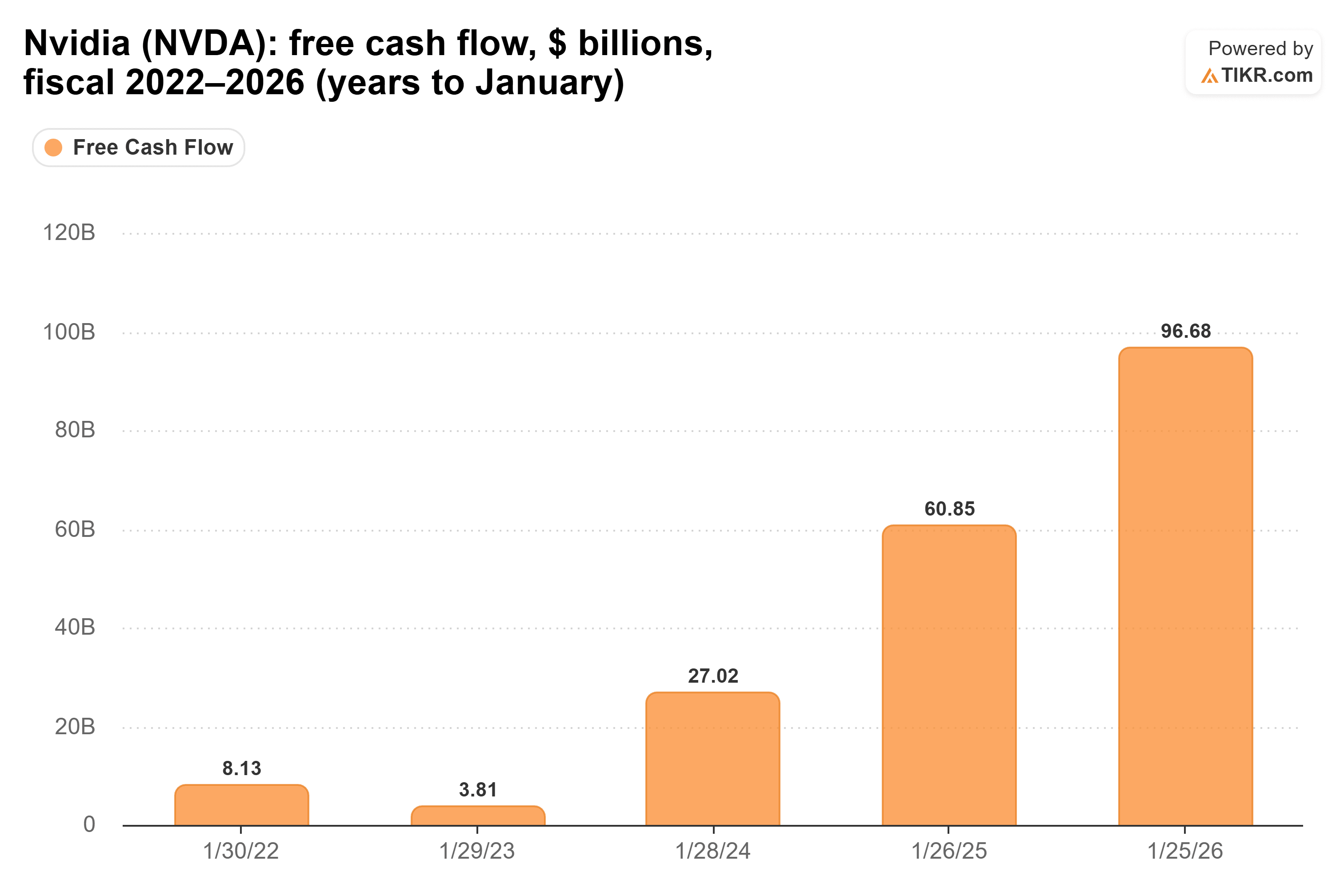
Nvidia’s own funding isn’t the problem, though. Its free cash flow went from $3.8 billion in the year ended January 2023 to $96.7 billion in the year ended January 2026.
Priced for a lot less
Even with all that growth, Nvidia trades at 18x forward earnings, near the bottom of its three-year range…
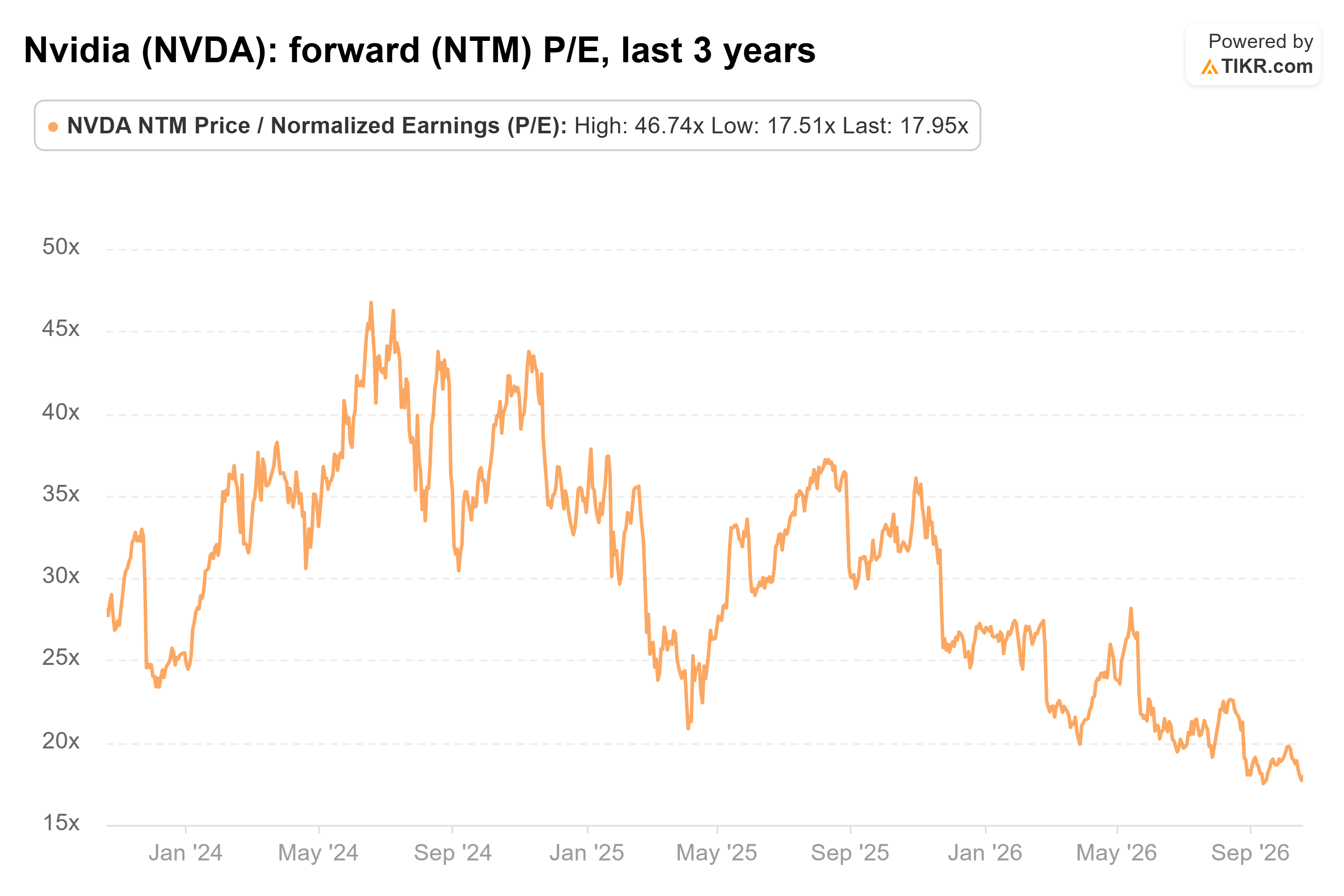
…and far below its 30.3x average over that stretch, never mind its 46.7x peak in June 2024.
My take: Huang doesn’t need to hit $10 trillion for Nvidia to look cheap. If the refresh cycle works the way he describes, a fraction of that spending would still support the growth analysts already expect. Meanwhile, the stock trades well below where it has been for most of the last three years.
Of course, the build-out has to actually show up. Altimeter Capital’s Brad Gerstner guessed in September that the industry would add closer to 25 gigawatts next year, no faster than this year. If credit stays tight, he could be right.
So what is Nvidia stock actually worth?
TIKR lets you forecast the future price of any stock in less than a minute. Just enter a few assumptions into TIKR’s valuation model and see what Nvidia could be worth. Start from Wall Street consensus estimates, or adjust the inputs to reflect your own view of the business. It’s free to use.
Disclaimer:
Please note that the articles on TIKR are not intended to serve as investment or financial advice from TIKR or our content team, nor are they recommendations to buy or sell any stocks. We create our content based on TIKR Terminal’s investment data and analysts’ estimates. Our analysis might not include recent company news or important updates. TIKR has no position in any of the stocks mentioned. Thank you for reading, and happy investing!