Key Stats for IBM Stock
- Weekly Performance: -3%
- 52-Week Range: $215 to $325
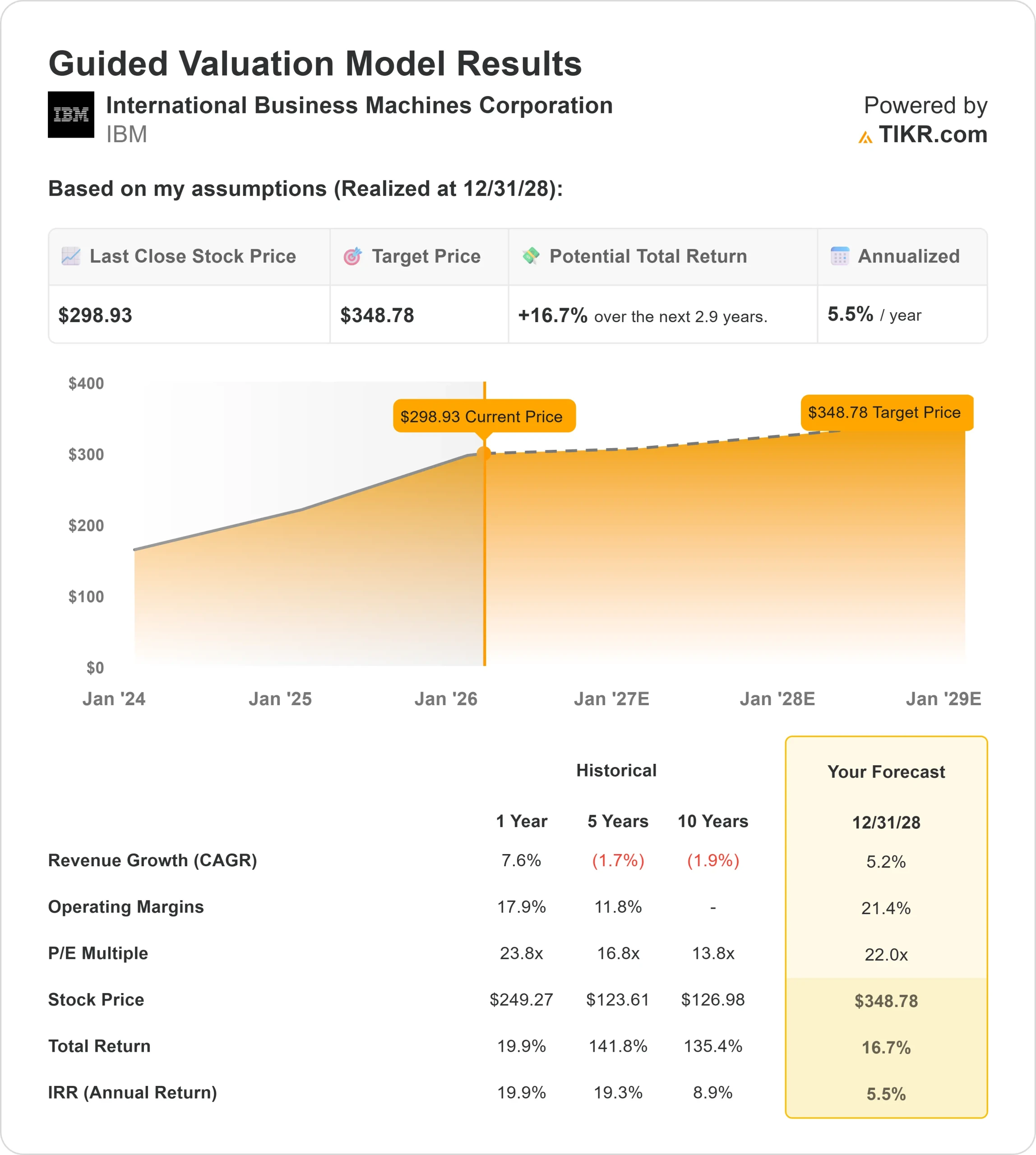
- Valuation Model Target Price: $349
- Implied Upside: 17%
Value your favorite stocks like International Business Machines with 5 years of analysts’ forecasts using TIKR’s new Valuation Model (It’s free) >>>
What Happened?
International Business Machines Corporation stock fell about 3% this week, ending near $299 per share, as shares pulled back following a strong multi-month run and recent highs. The move reflected short-term profit-taking and positioning adjustments rather than any deterioration in IBM’s underlying business.
The stock moved lower as investors locked in gains near recent highs amid softer broader tech sentiment during the week.
With shares trading close to their $325 52-week high, some investors reduced exposure despite the absence of negative company-specific headlines, helping limit downside and allowing the stock to stabilize into the end of the week.
The price action pointed to consolidation rather than a shift in investor confidence.
This week’s earnings follow-through added context to the move. IBM reported 9% revenue growth in Q4, its strongest in over three years, alongside $14.7 billion in full-year free cash flow, the highest level of cash generation in more than a decade.
Software growth accelerated to 11%, Infrastructure rose 17%, and the company disclosed that its GenAI book of business exceeded $12.5 billion, reinforcing the view that IBM entered 2026 with improving momentum.
CEO Arvind Krishna described the year as a milestone, saying, “We exceeded all of our target metrics for revenue growth, profitability and free cash flow that we laid out at our Investor Day.”
Recent institutional filings showed active rebalancing rather than broad selling. Wells Trecaso Financial Group cut its IBM stake by 42.4% in Q3, while Altrius Capital Management trimmed its position by 17.7%.
Offsetting those moves, Prasad Wealth Partners initiated a new position, Flagship Harbor Advisors increased its stake by 31.7%, Savant Capital raised holdings by 4.1%, and ABN AMRO added 19,578 shares.
Larger disclosures also showed Norges Bank establishing a roughly $2.01 billion position and Vanguard increasing its stake to more than 95 million shares, leaving institutional ownership at about 58.96%, framing last week’s decline as rotation-driven rather than conviction-driven.
See analysts’ growth forecasts and price targets for International Business Machines (It’s free) >>>
Is IBM Undervalued?
Under valuation assumptions, the stock is modeled using:
- Revenue Growth (CAGR): 5.2%
- Operating Margins: 21.4%
- Exit P/E Multiple: 22x
Revenue growth reflects steady expansion driven by software and consulting rather than legacy infrastructure, with hybrid cloud, automation, and AI platforms accounting for a growing share of IBM’s revenue mix.
Analyst assumptions continue to point to growth supported by recurring software revenue, enterprise AI adoption through watsonx, and consulting demand tied to large-scale AI deployment and modernization projects rather than cyclical hardware upgrades.

This supports the view that future returns depend more on margin durability, software mix shift, and monetization of AI-enabled services than on rapid top-line acceleration.
Based on these inputs, the valuation model estimates a target price of $349, implying about 17% total upside, indicating the stock appears undervalued at current prices.
Results over the next year hinge on execution across several higher-impact areas. Software growth remains central, as expanding automation, data platforms, and transaction-based services drive operating leverage and recurring revenue visibility.
AI adoption across large enterprise clients could further support growth, particularly as IBM integrates watsonx, Red Hat AI, and consulting offerings into mission-critical workflows without requiring a broad hardware refresh.
At the same time, continued productivity gains, disciplined capital allocation, and strong free cash flow generation support margin expansion and shareholder returns.
At current levels, IBM appears undervalued, with future performance driven by software-led margin expansion, enterprise AI monetization, and execution consistency rather than aggressive revenue growth.
Estimate a company’s fair value instantly (Free with TIKR) >>>
Value Any Stock in Under 60 Seconds (It’s Free)
With TIKR’s new Valuation Model tool, you can estimate a stock’s potential share price in under a minute.
All it takes is three simple inputs:
- Revenue Growth
- Operating Margins
- Exit P/E Multiple
From there, TIKR calculates the potential share price and total returns under Bull, Base, and Bear scenarios so you can quickly see whether a stock looks undervalued or overvalued.
If you’re not sure what to enter, TIKR automatically fills in each input using analysts’ consensus estimates, giving you a quick, reliable starting point.
See a stock’s true value in under 60 seconds (Free with TIKR) >>>