
The Boeing Company (BA) is close to clearing the last regulatory hurdle on its biggest 737. The FAA is set to approve the 737 MAX 10 as soon as next week, three people familiar with the matter told Reuters. The approval would follow a key safety review that the agency’s Type-Certification Board completed on Friday, October 16. Approval hasn’t been granted yet, and the FAA said only that safety dictates the timeline.
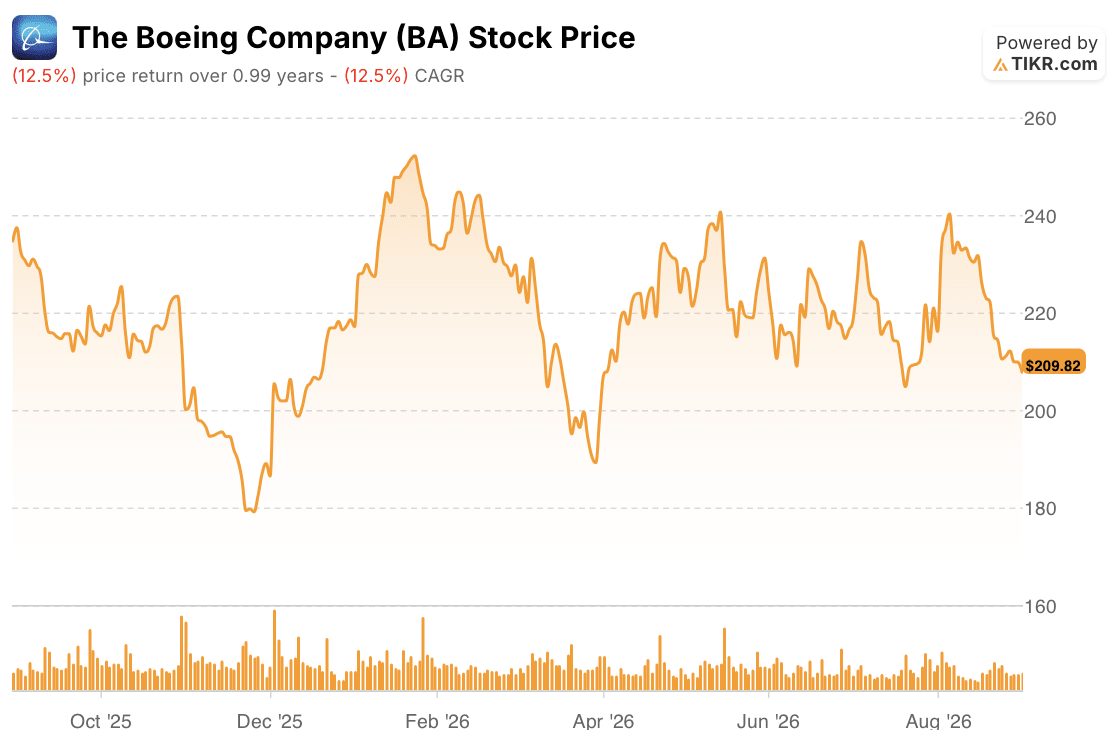
Boeing stock closed Friday at $190.21. That was up 0.8% on the day but about 25% below its late-January peak near $252.
Why the MAX 10 Matters to Boeing
The MAX 10 is Boeing’s answer to the A321neo from Airbus (AIR), the jet that has owned the top of the single-aisle market. CEO Kelly Ortberg has said it makes up about 30% of the 737 backlog. The 737 carried Boeing’s third quarter, accounting for 124 of 161 commercial deliveries, or 77%.
The last delay was short:
- Boeing disclosed a go-around software glitch on September 26.
- The FAA paused certification two days later.
- The FAA’s review board ruled on October 2 that the glitch wasn’t a safety issue.
The stock fell 6.9% on September 28 and still sits below its pre-glitch close of $198.
The Street Lowered Its Floor, Not Its Rating
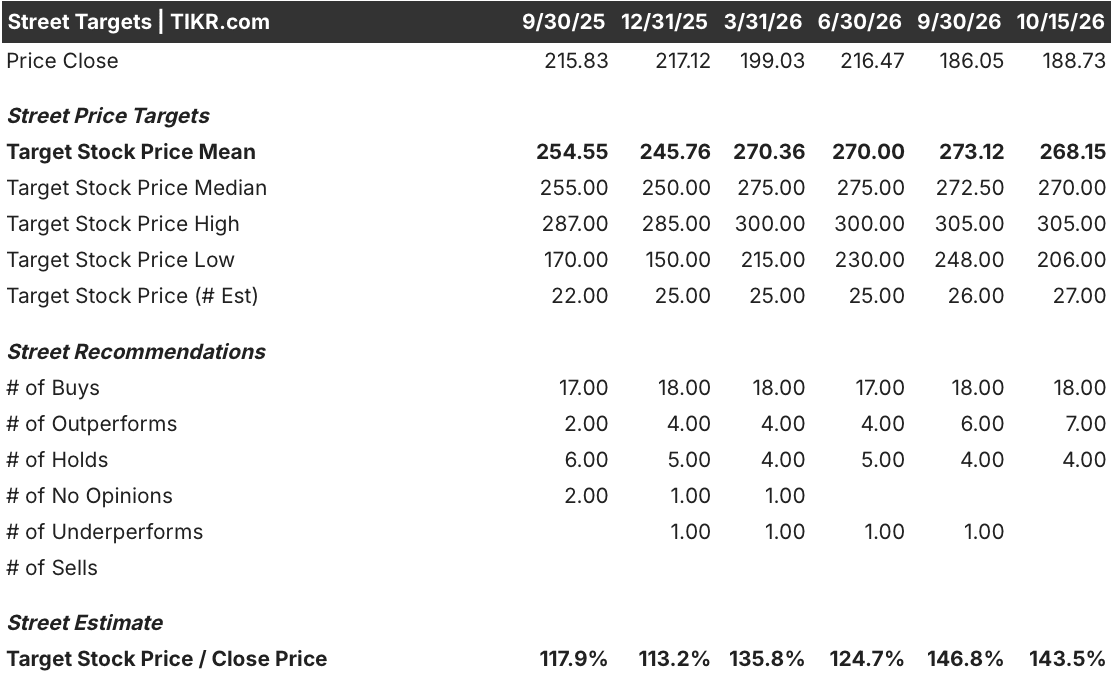
Analysts didn’t get more bullish as certification got closer. The mean target slipped from $273 at the end of September to $268 on October 15. Over the same two weeks, the low target fell from $248 to $206. Morgan Stanley cut its target to $225 from $250 on Friday and kept its Equal Weight rating, a day after RBC cut to $235 from $265.
The ratings held up: 18 buys, 7 outperforms and 4 holds, and the last underperform has dropped off since September. The mean target still sits about 41% above Friday’s close. RBC kept its Outperform even as it cut, citing defense budget uncertainty beyond fiscal 2027 as a headwind.
Boeing’s Cash Arrives After the Certificate
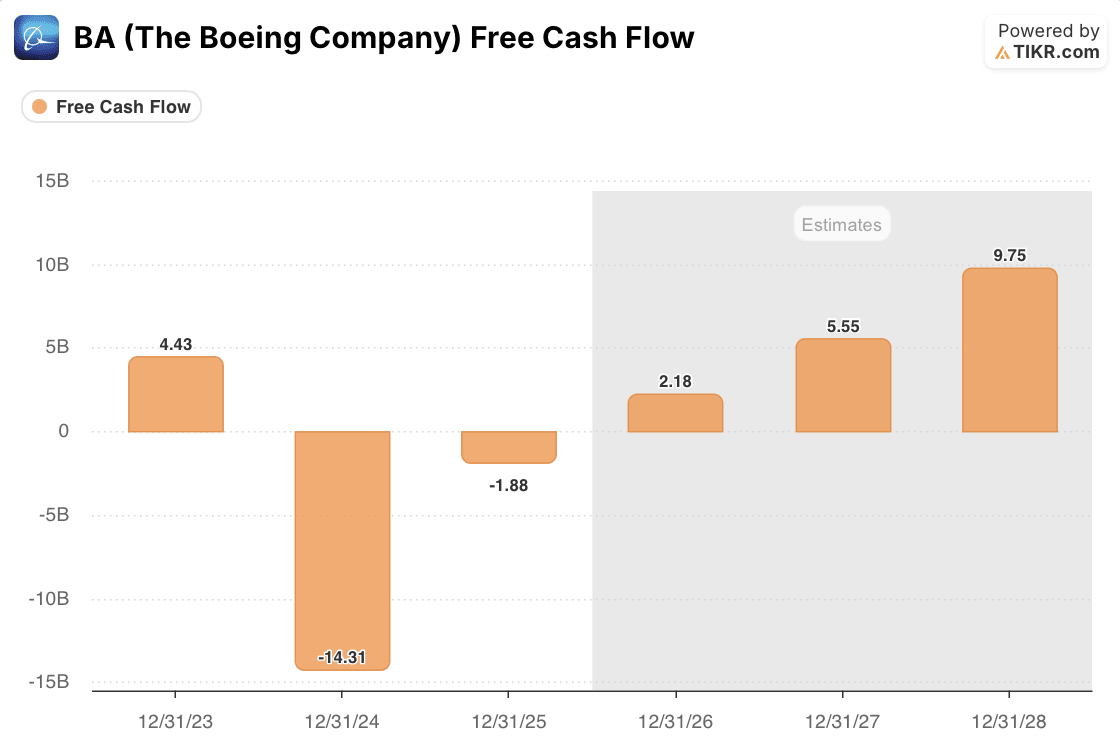
Free cash flow shows where the timing problem sits. Consensus has Boeing at $2.18 billion in 2026, $5.55 billion in 2027 and $9.75 billion in 2028. That 2028 figure is about 4.5 times this year’s.
The 2028 figure needs MAX 10s leaving the factory, and the first ones don’t reach customers until 2027. Alaska Air (ALK) expects its first one next spring.
The factory is the constraint. In September, Ortberg said the 737 line runs at 47 a month but isn’t stable there yet, with wings the bottleneck. He added that going to 52 a month needs the new North Line in Everett. CFO Jay Malave said old excess advances will still weigh on 2027 cash.
More deliveries also help GE Aerospace (GE), whose CFM venture with Safran builds the LEAP-1B engine on every MAX.
Boeing’s October 27 Call Matters More Than the Certificate
Approval now looks like a matter of days, so the certificate itself won’t tell investors much. Boeing reports third-quarter results on Tuesday, October 27. Two things on that call decide the next leg:
- whether management holds its $1 billion to $3 billion 2026 free cash flow guidance
- when the North Line, in low-rate initial production since July, starts supporting rate 52
A timetable for that ramp would show whether the production behind that $9.75 billion 2028 estimate is on track. Without one, I’d expect the stock to keep trading closer to the Street’s $206 low than its $268 mean.
Want to see how Boeing’s target range and cash flow estimates move after October 27? Pull up the same Street Targets table and free cash flow estimates on TIKR for free. Learn more here.
So what is Boeing stock actually worth?
TIKR lets you forecast the future price of any stock in less than a minute. Just enter a few assumptions into TIKR’s valuation model and see what BA stock could be worth. Start from Wall Street consensus estimates, or adjust the inputs to reflect your own view of the business. It’s free to use.
Value The Boeing Company for free→
Disclaimer:
Please note that the articles on TIKR are not intended to serve as investment or financial advice from TIKR or our content team, nor are they recommendations to buy or sell any stocks. We create our content based on TIKR Terminal’s investment data and analysts’ estimates. Our analysis might not include recent company news or important updates. TIKR has no position in any of the stocks mentioned. Thank you for reading, and happy investing!