


Key Takeaways
- Realty Income yields 6.1%, and UPS yields 7.0%, so $10,000 pays $610 a year in Realty Income or $700 in UPS today.
- Realty Income’s dividend used 75% of its AFFO in fiscal 2025, and UPS’s took 99% of its free cash flow over the twelve months to June 2026.
- UPS grew its dividend 10.2% a year from fiscal 2020 to fiscal 2025, but just 0.6% in fiscal 2025.
- At each dividend’s current pace, UPS pays about $243 more than Realty Income over 10 years on a $10,000 stake.
Put $10,000 into United Parcel Service (UPS) today, and you’d collect $700 a year in dividends, on a 7.0% yield. UPS has momentum, too: in July, it raised its 2026 outlook after finishing its planned cut of Amazon volume.
The same $10,000 in Realty Income (O) pays $610 a year on a 6.1% yield, and its outlook is rising as well. In August, it raised its 2026 AFFO per share guidance to $4.44 to $4.45.
If I could only hold one of them for the next 10 years, which would it be?
| Metric | Realty Income (O) | UPS |
|---|---|---|
| Dividend yield | 6.1% | 7.0% |
| Dividend growth, fiscal 2020 to 2025 | 2.9% a year | 10.2% a year |
| Payout ratio, last reported | AFFO payout ratio: 75% (fiscal 2025) | Cash dividend payout ratio: 99% (TTM to June 30, 2026) |
| Payout ratio, forward (fiscal 2026 consensus) | AFFO payout ratio: 73% | Cash dividend payout ratio: 96% |
| Net debt / EBITDA (LTM) | 5.74x | 1.63x |
| Interest coverage (LTM) | 2.35x | 7.56x |
| Valuation (NTM) | 12.1x price/AFFO | 12.1x P/E |
Source: TIKR, Oct. 9, 2026.
Realty Income’s raises are small but well covered
Realty Income is putting most of its new money into industrial property. In the second quarter of 2026, industrial made up about 65% of its global real estate investments.
The dividend has plenty of room, too. AFFO per share rose every year, from $2.88 in fiscal 2016 to $4.28 in fiscal 2025, and it grew faster than the dividend did, so the AFFO payout ratio fell from 83.0% to a comfortable 75.2%. Fiscal 2026 consensus puts it at 73%…
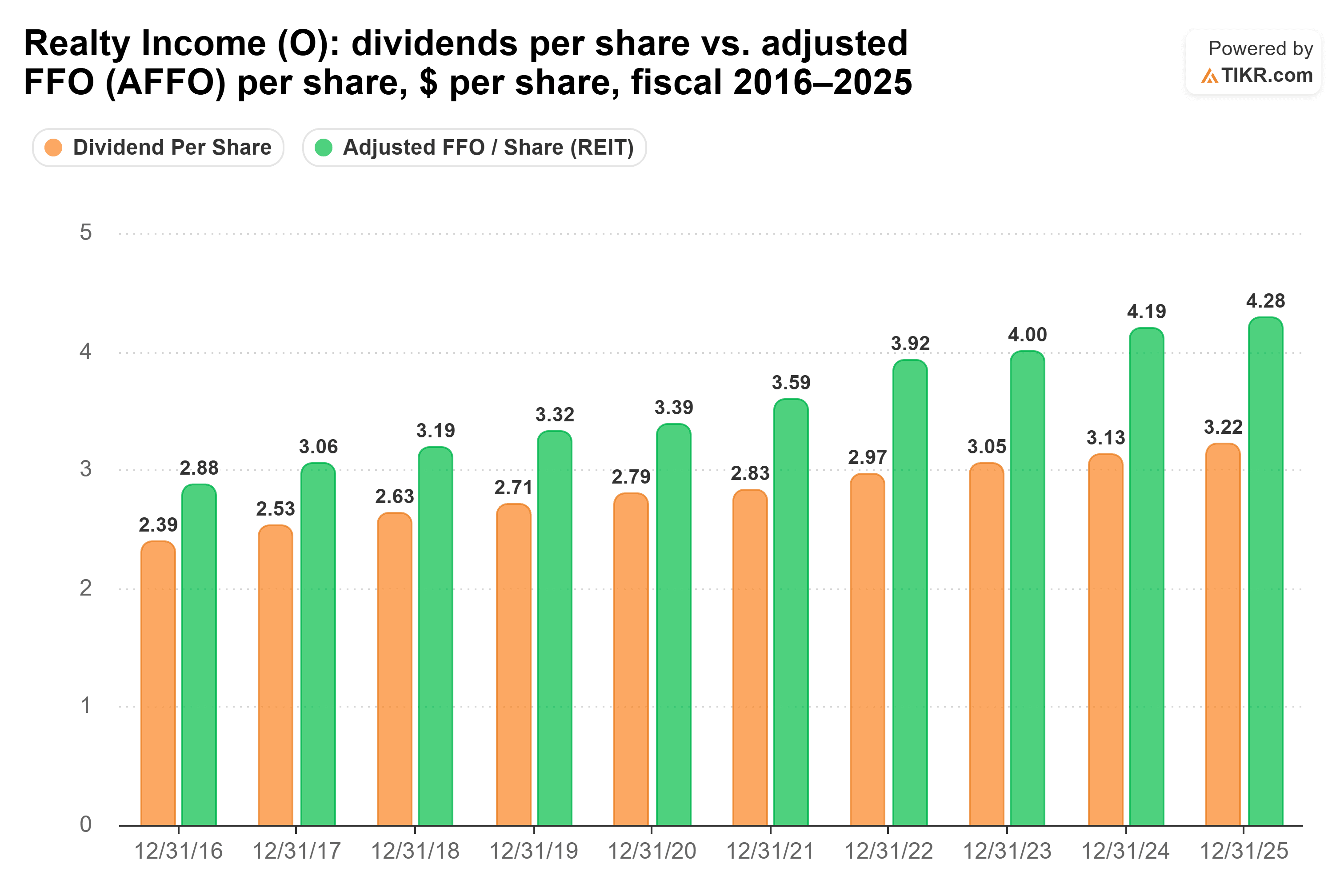
Where Realty Income gives ground is pace. Its dividend grew 2.9% a year from fiscal 2020 to fiscal 2025, from $2.79 to $3.22 a share, though the company has “increased our dividend for over 31 consecutive years.”
The catch is the debt load. Net debt is 5.74x EBITDA, and EBIT covers interest just 2.35x over the last twelve months.
UPS pays more, with almost nothing to spare
UPS flips that picture: a bigger check that has grown faster, with far less cash behind it.
The business is picking up. Revenue rose 7.6% to $22.8 billion in Q2 2026 from Q2 2025, and adjusted operating profit rose 12% to $2.1 billion.
The dividend grew 10.2% a year from fiscal 2020 to fiscal 2025 ($4.04 to $6.56 a share). Most of that came in one step, as dividends paid jumped from $3.44 billion in fiscal 2021 to $5.11 billion in fiscal 2022. In fiscal 2025, the dividend rose 0.6%.
Coverage is razor-thin. UPS paid $5.41 billion in dividends out of $5.46 billion of free cash flow over the twelve months to June 30, 2026, a 99% cash dividend payout ratio. Fiscal 2026 consensus puts it at a still-stretched 96%. Free cash flow fell short of the dividend in fiscal 2023 and again in fiscal 2025, when it was $4.77 billion against $5.40 billion paid…

UPS expects about $5.5 billion of free cash flow in 2026 against about $5.4 billion of dividends. That leaves almost nothing for raises.
So which dividend wins?
Realty Income is my pick, the one dividend stock I’d hold for the next 10 years.
If you go by the past five years’ growth rates, UPS looks like the easy call. At those rates, $10,000 would pay about $11,253 over the decade, against about $6,964 from Realty Income. The catch is that UPS’s 10.2% rate rests on one big step in fiscal 2022, and with 99% of free cash flow already going to the dividend, I don’t see room to repeat it.
Now let each dividend keep growing at its most recent pace, with UPS up 0.6% and Realty Income up 2.9% in fiscal 2025, and the gap nearly closes. Over 10 years, UPS pays about $7,196, and Realty Income about $6,953, and Realty Income’s yearly check would pass UPS’s in about 2033. For roughly the same income, I’d rather own the dividend that uses 75% of its AFFO than the one using 99% of its free cash flow.
UPS’s case is a real one. Its 7.0% yield is the bigger check today, and its balance sheet is far stronger, at 1.63x net debt to EBITDA against Realty Income’s 5.74x. Still, for a dividend I can’t sell for 10 years, I want the one with room to spare.
Of course, UPS has only just finished its network overhaul. If its free cash flow climbs well past the $5.5 billion it expects for 2026, its dividend could start growing again, and the math would tilt back its way.
So what is Realty Income stock actually worth?
TIKR lets you forecast the future price of any stock in less than a minute. Just enter a few assumptions into TIKR’s valuation model and see what Realty Income could be worth. Start from Wall Street consensus estimates, or adjust the inputs to reflect your own view of the business. It’s free to use.
Disclaimer:
Please note that the articles on TIKR are not intended to serve as investment or financial advice from TIKR or our content team, nor are they recommendations to buy or sell any stocks. We create our content based on TIKR Terminal’s investment data and analysts’ estimates. Our analysis might not include recent company news or important updates. TIKR has no position in any of the stocks mentioned. Thank you for reading, and happy investing!


