
Key Stats for DUOL Stock
- Past two weeks performance: +12.3%
- 52-week range: $88 to $353
- Valuation model target price: $214
- Implied upside: 46.5% over 2.4 years
Value your favorite stocks like DUOL with 5 years of analysts’ forecasts using TIKR’s new Valuation Model (It’s free) >>>
A Strong Quarter, a Soft Guide, and a Rating Upgrade
Duolingo (DUOL) delivered another quarter of accelerating engagement, even as the market focused on a cautious guide. Revenue rose 18% to $298.5 million, beating the $295.6 million estimate. Adjusted EPS reached $0.66 against a $0.60 consensus. Daily active users surged 23% to 58.7 million, actually accelerating from the first quarter.

The wrinkle came in the outlook. Management guided third-quarter revenue to roughly $302 million, implying 11.1% growth, below the roughly $304 million analysts modeled. That soft guide initially weighed on shares, even though management raised full-year adjusted EBITDA margin guidance to about 26.5% and reaffirmed 15% to 18% full-year revenue growth.
Sentiment shifted quickly after that. Shares gained after D.A. Davidson upgraded its rating and hiked its price target. That move helped push Duolingo stock up double digits over the following days.
On the strategic side, Duolingo acquired London-based animation studio Animade on August 13. The deal expands in-house design capabilities for character animation and interactive experiences. If Duolingo stock keeps climbing on this combination of user growth and product investment, the soft Q3 guide may look overly cautious in hindsight.
See analysts’ growth forecasts and price targets for DUOL (It’s free) >>>
Is DUOL Stock Undervalued?
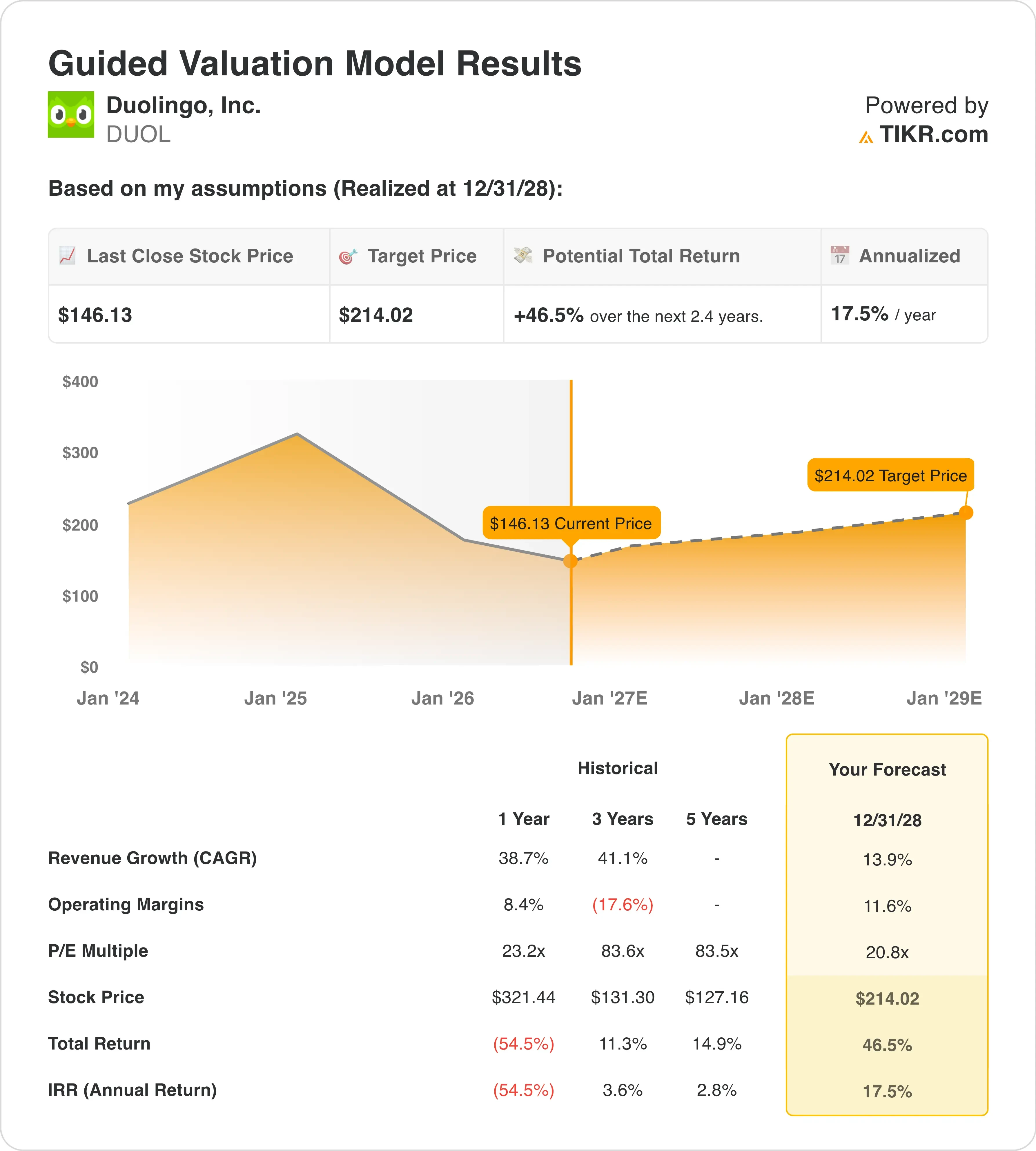
Under valuation model assumptions realized through 12/31/28, the stock is modeled using:
- Revenue Growth (CAGR): 13.9%
- Operating Margins: 11.6%
- Exit P/E Multiple: 20.8x
Based on these inputs, the model estimates a target price of $214, implying 46.5% total upside from the current share price of $146 and an annualized return of 17.5% over the next 2.4 years.
A 17.5% annualized return places Duolingo firmly in the genuinely undervalued category. That’s notable for a stock that traded above $350 within the past year. The pullback to $146 reflects concerns about slowing bookings growth and AI disruption risk, but the model suggests the market may be underpricing Duolingo’s ability to keep growing.
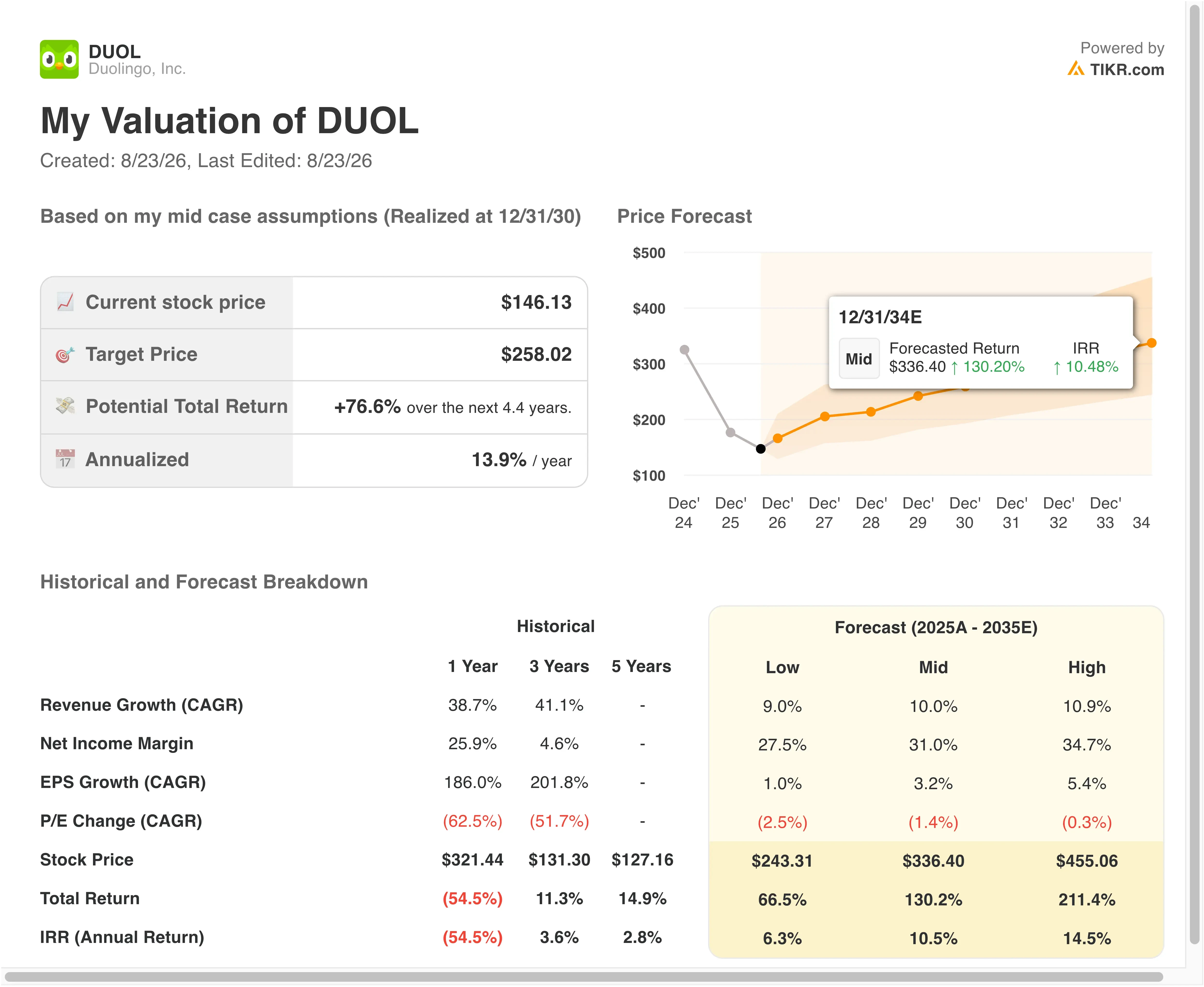
The 13.9% revenue growth assumption sits below Duolingo’s trailing growth of roughly 39%, reflecting deliberate deceleration as the company matures. Operating margin assumptions of 11.6% imply real improvement, supported by the raised full-year EBITDA guidance management just delivered.
Compared to its own trading history, Duolingo’s current 20.8x forward P/E sits well below the 83x multiple the stock carried three years ago. That gap stands out because the underlying business has grown significantly larger and more profitable since then. Peer comparisons below add more context on where that premium fits.
Run your own scenario and see the forecast change (Free with TIKR) >>>
How Duolingo Stacks Up Against Coursera
Duolingo’s closest public comparison in edtech is Coursera (COUR), though the two serve different learning categories. Coursera posted second-quarter revenue growth of 60% to $298.6 million, largely boosted by its recently closed Udemy acquisition. On an organic basis, growth runs considerably slower, closer to the mid-single digits guided before the deal closed.
Profitability tells a clearer story than headline growth. Coursera posted a GAAP net loss of $80.4 million last quarter, with an adjusted EBITDA margin of 14.3%. Duolingo’s net income margin runs closer to 26% on an LTM basis. That gap shows Duolingo converting revenue into profit far more efficiently than its acquisition-fueled peer.

Valuation reflects that profitability gap too. Duolingo trades at roughly 20.8x forward earnings, while Coursera remains in a heavier integration phase following the Udemy deal. A direct multiple comparison stays less meaningful until the combined entity’s organic growth becomes clearer.
User engagement is where Duolingo’s moat shows up most clearly. Daily active user growth of 23% reflects a habit-forming consumer product, while Coursera’s growth leans increasingly enterprise-driven. The two companies compete for different parts of the online learning market, but Duolingo monetizes its user base far more efficiently today.
What’s Driving DUOL Stock Going Forward?
The next earnings report in early November tests whether Duolingo can beat its own conservative Q3 guide of roughly $302 million. A beat, paired with daily active user growth staying above 20%, would likely validate the recent rally.
The Animade acquisition adds a new growth lever worth watching. By bringing animation capabilities in-house, Duolingo can potentially ship new characters and interactive lessons faster, both historically strong drivers of engagement.
Subscription trends remain the financial backbone of the growth story. Subscription revenue rose 22% to $258 million last quarter, and paid subscriber growth of 17% suggests the premium Duolingo Max tier keeps resonating despite AI disruption concerns.
Competitive risks still loom in the background. Duolingo has successfully integrated AI features into its own premium offering so far, but investors will keep watching whether standalone AI language tools start pulling users away instead.
Should You Invest in Duolingo?
The only way to really know is to look at the numbers yourself. TIKR gives you free access to the same institutional-quality financial data that professional analysts use to answer exactly that question.
Pull up DUOL, and you’ll see years of historical financials, what Wall Street analysts expect for revenue and earnings in the quarters ahead, how valuation multiples have moved over time, and whether price targets are trending up or down.
You can build a free watchlist to track DUOL alongside every other stock on your radar. No credit card required. Just the data you need to decide for yourself.
Analyze DUOL stock on TIKR Free→
Disclaimer:
Please note that the articles on TIKR are not intended to serve as investment or financial advice from TIKR or our content team, nor are they recommendations to buy or sell any stocks. We create our content based on TIKR Terminal’s investment data and analysts’ estimates. Our analysis might not include recent company news or important updates. TIKR has no position in any stocks mentioned. Thank you for reading, and happy investing!