


- Past two weeks performance: Consolidating
- 52-week range: $143 to $286
- Valuation model target price: $234
- Implied upside: 18.2% over 2.3 years
Key Stats for DASH Stock
Build your own DoorDash price target with TIKR’s Guided Valuation Model (It’s free) >>>
Growth Keeps Climbing, But Sentiment Hasn’t Followed
DoorDash (DASH) has barely moved over the past two weeks. Shares sit near $197, about 31% below the 52-week high of $286. But the business itself has kept accelerating.

Q2 results in early August showed why. Revenue rose about 36% year over year to roughly $4.45 billion, and adjusted EBITDA jumped 40% to $914 million, a 20.5% margin. Organic order value grew 23%, and management reaffirmed full-year EPS guidance near $2.54 on about $17.9 billion of revenue.
What has changed is where DoorDash shows up. The company just became SKIMS’ first on-demand delivery partner, offering more than 23,000 apparel styles from 17 stores with delivery in under an hour. That follows a pattern DoorDash has run for years, since it keeps stretching its logistics network into retail and grocery through deals like its recent Locally partnership.
Reuters also reported this week that hedge funds increased short bets against consumer names in August, DoorDash included. That looks more like broad macro caution than a signal about execution. CEO Tony Xu told investors on the Q2 call that expanding order frequency and new categories are driving durable margin gains, not short-term boosts. If DASH stock keeps compounding order volume this fast, the gap between price and fundamentals could close quickly.
See analysts’ growth forecasts and price targets for DASH (It’s free) >>>
Where DoorDash Stock Stands on Valuation
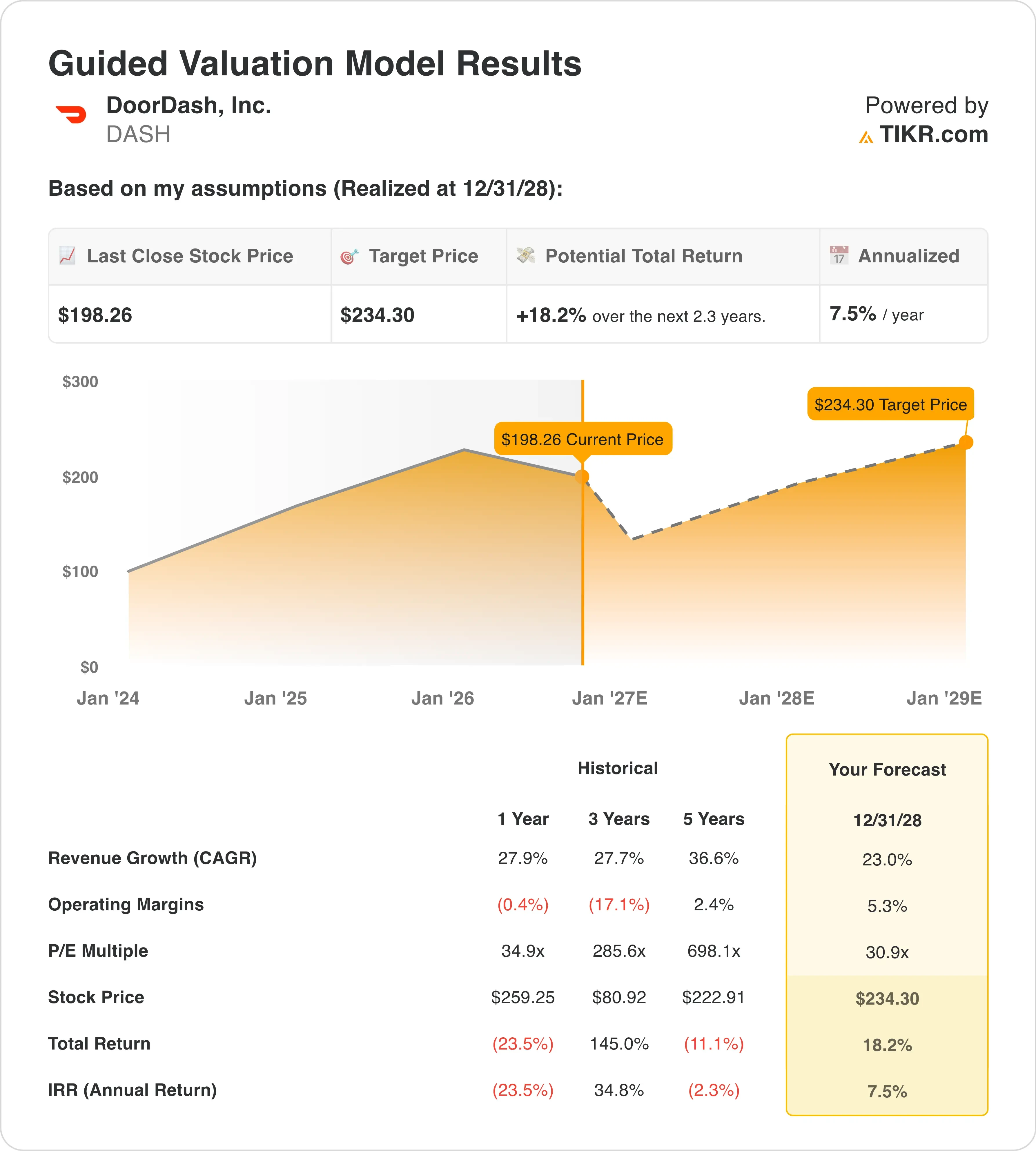
Under valuation model assumptions realized through 12/31/28, the stock is modeled using:
- Revenue Growth (CAGR): 23.0%
- Operating Margins: 5.3%
- Exit P/E Multiple: 30.9x
Based on these inputs, the model estimates a $234 target price, implying 18.2% total upside from the current share price and a 7.5% annualized return over the next 2.3 years.
That annualized figure sits in moderately attractive territory. It is not cheap, but it is not stretched either. DoorDash’s operating margin stays in the low single digits today because the company keeps reinvesting in new categories rather than harvesting profit from its core marketplace.
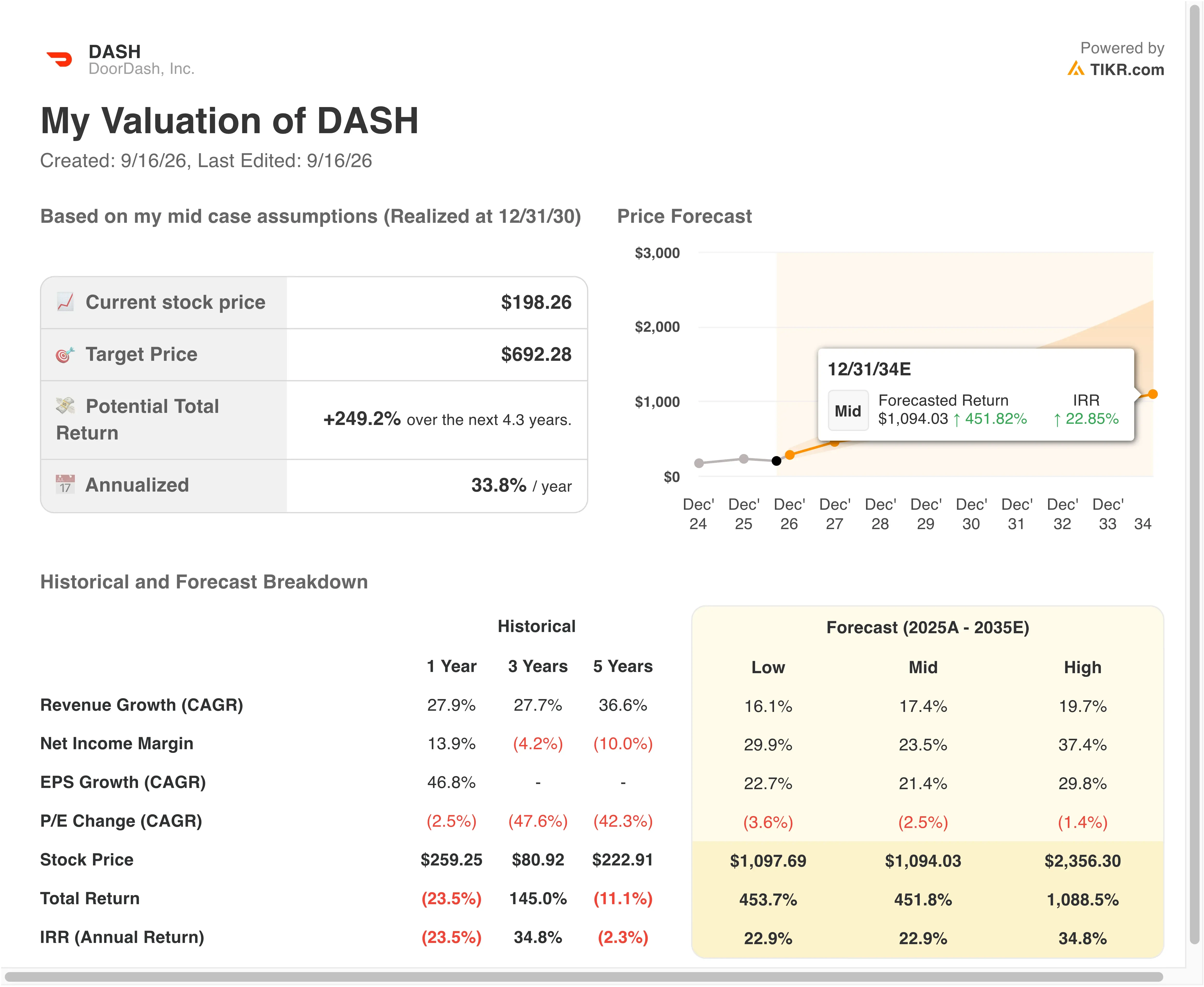
Revenue growth of 23% remains the standout number, and it compares favorably against most large-cap consumer names. Margins are the real swing factor here, since every point of operating leverage DoorDash captures could push that annualized return closer to the 15% mark that signals a clear bargain.
A near 31x forward multiple is not cheap on its own. Yet it is not extreme either, given the growth rate. Investors are paying a premium for category leadership, and the model suggests that premium is roughly fair.
How DoorDash Stacks Up Against Uber
DoorDash’s closest rival is Uber (UBER), though the two now run on very different economics. DoorDash’s trailing gross margin sits at 52.2%, well above Uber’s roughly 38.5% gross margin last fiscal year. That gap exists because Uber’s revenue spans mobility, freight, and delivery, while DoorDash runs a tighter, higher-margin marketplace.
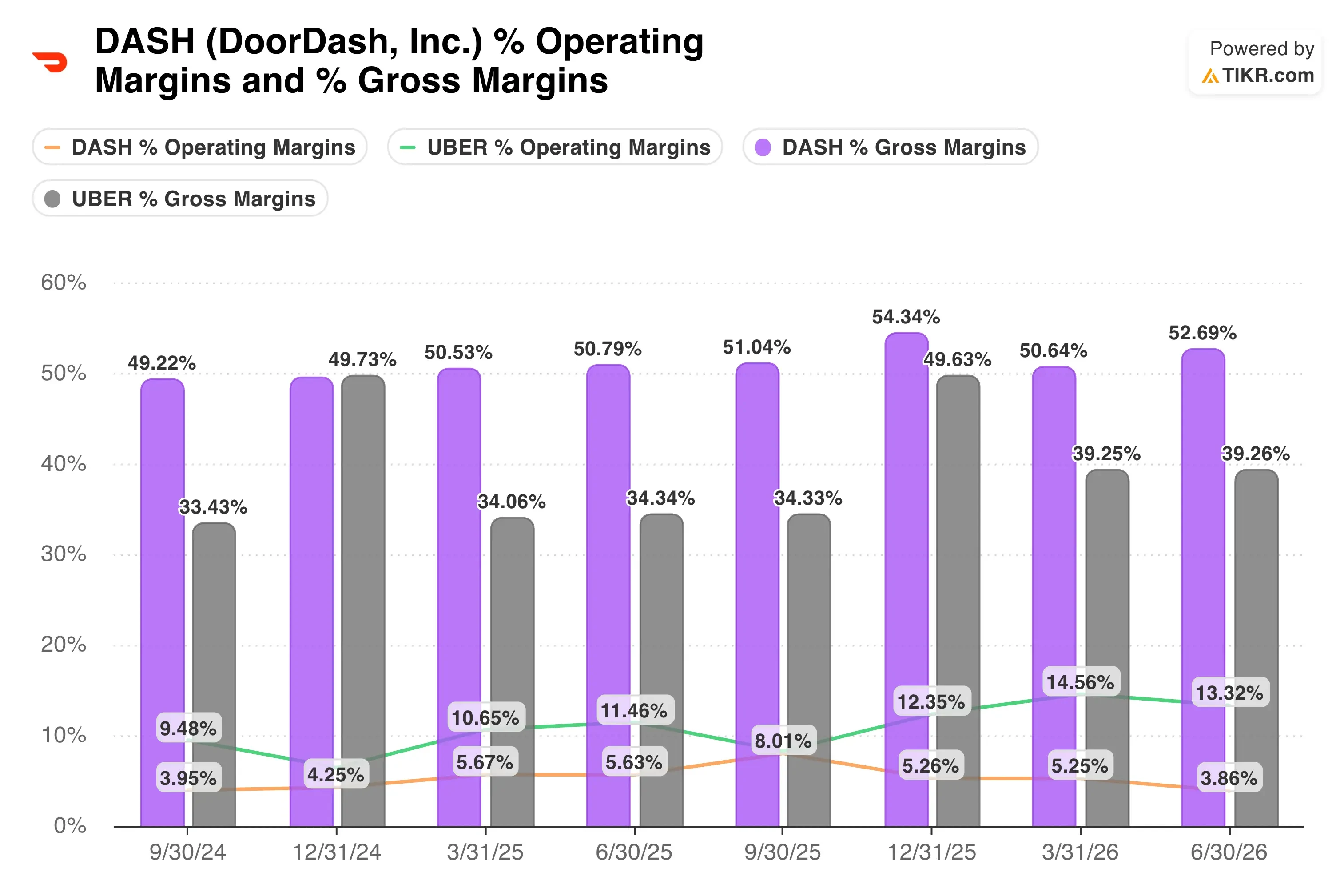
Growth also favors DoorDash. Its forward two-year revenue growth of 25.3% outpaces Uber’s low-teens rate, since Uber’s mobility business has already scaled and grows more slowly now. Uber’s profitability is further along, though, with an operating margin near 10.7% on about $52 billion of revenue, compared with DoorDash’s trailing operating margin of 5.5%.
Grubhub has continued losing ground domestically, and DoorDash now controls more than half of U.S. food delivery orders. That scale gives DoorDash real leverage with restaurants and drivers, so it matters far more than any single quarter’s growth rate.
The comparison comes down to stage of the cycle. Uber is the mature, already-profitable compounder. DoorDash is still converting share into margin, and the model implies the market is paying for that future expansion rather than today’s profitability.
What’s Driving DASH Stock Going Forward?
The clearest near-term catalyst is Q3 earnings, expected around November 4. Investors will watch whether the SKIMS partnership and broader retail push start showing up in order volume, since that diversification underpins the long-term margin story.
The Nevada reincorporation, approved by shareholders in late August, is mostly a legal shift rather than an operational one. Still, it reflects a broader trend of companies reconsidering Delaware, and it could modestly change how DoorDash handles future governance decisions.
Robotics delivery is another thread worth watching. DoorDash has expanded partnerships with Serve Robotics and Waymo, testing autonomous delivery in select markets. These programs remain small today, but they could lower delivery costs meaningfully if they scale.
Finally, the short positioning Reuters flagged in August deserves attention. It does not change DoorDash’s fundamentals, but it could add near-term volatility even as the underlying business keeps growing.
Track DoorDash’s next earnings date and forecast your own scenario (Free with TIKR) >>>
Should You Invest in DoorDash?
The only way to really know is to look at the numbers yourself. TIKR gives you free access to the same institutional-quality financial data that professional analysts use to answer exactly that question.
Pull up DASH, and you’ll see years of historical financials, what Wall Street analysts expect for revenue and earnings in the quarters ahead, how valuation multiples have moved over time, and whether price targets are trending up or down.
You can build a free watchlist to track DASH alongside every other stock on your radar. No credit card required. Just the data you need to decide for yourself.
Analyze DASH stock on TIKR Free→
Disclaimer:
Please note that the articles on TIKR are not intended to serve as investment or financial advice from TIKR or our content team, nor are they recommendations to buy or sell any stocks. We create our content based on TIKR Terminal’s investment data and analysts’ estimates. Our analysis might not include recent company news or important updates. TIKR has no position in any stocks mentioned. Thank you for reading, and happy investing!


