

Key Takeaways
- Chevron generated $18.1 billion of free cash flow in the second quarter of 2026, and Realty Income announced its 115th consecutive quarterly dividend increase in June 2026.
- Chevron’s dividend took 51% of its free cash flow over the twelve months to June 30, 2026, and Realty Income’s took 75% of its AFFO in fiscal 2025.
- Chevron carries far less debt, at 0.56x net debt/EBITDA against 5.74x for Realty Income.
- Realty Income’s move toward private capital, with public equity down to 18% of its 2026 investment volume so far, is the plan to watch.
Chevron (CVX) generated $18.1 billion of free cash flow in the second quarter of 2026, up from $4.9 billion in the same quarter a year earlier. Production rose 20% on the Hess acquisition and growth in the Permian.
A very different kind of dividend payer had a strong summer too. Realty Income (O) announced its 115th consecutive quarterly dividend increase in June 2026, then raised its 2026 AFFO per share guidance to $4.44 to $4.45.
Both dividends are the kind you’d buy and forget about. But if you could hold only one for the next 20 years, which would it be?
| Metric | Chevron (CVX) | Realty Income (O) |
|---|---|---|
| Dividend yield | 3.4% | 6.1% |
| Dividend growth, fiscal 2020–2025 | 5.8% a year | 2.9% a year |
| Record, in the company’s words | Raised for the 39th consecutive year | Raised for over 31 consecutive years |
| Coverage, last reported | 51% cash dividend payout ratio (TTM to June 30, 2026) | 75% AFFO payout ratio (fiscal 2025) |
| Net debt/EBITDA (LTM) | 0.56x | 5.74x |
| Interest coverage (LTM) | 18.93x | 2.35x |
Source: TIKR, Oct. 9, 2026; dividend records from each company.
Chevron’s cash comes in waves
Chevron is growing, and the Hess deal is a big reason why. Net production reached 4,070 MBOED in the second quarter of 2026, up 20% from the second quarter of 2025, and the company paid down $8.4 billion of debt in the quarter. CEO Michael Wirth says the new barrels more than fund the extra payout: “The Hess assets are generating strong free cash flow, which has been roughly double the incremental dividends and accretive to shareholders on a per-share basis.”
Over the twelve months to June 30, 2026, Chevron paid $13.86 billion in dividends out of $27.01 billion of free cash flow. That’s a well-covered 51%. The longer record is bumpier, though…

Free cash flow fell short of the dividend in fiscal 2016, 2017, and 2020, and the cash dividend payout ratio was a stretched 78% in fiscal 2024 and 77% in fiscal 2025. Chevron raised the dividend anyway, and on its May earnings call it said: “We’ve grown it for the 39th consecutive year.” What lets it keep raising through the lean years is a balance sheet with net debt at just 0.56x EBITDA.
Oil itself is the risk Chevron can’t fully control. Prices swing, and the Middle East conflict has already curtailed its production in the Partitioned Zone, the shared territory between Saudi Arabia and Kuwait.
Realty Income’s check barely flinches
Chevron’s cash rises and falls with oil. Realty Income’s AFFO per share has grown every year for a decade. It rose 3.8% to $1.09 in the second quarter of 2026, compared with the second quarter of 2025, and occupancy was 98.8% at June 30, 2026.
In fiscal 2025, the $3.22-a-share dividend took 75% of $4.28 in AFFO per share. As a REIT, it buys property as its business, so AFFO is its measure. The chart shows AFFO above the dividend in every year…
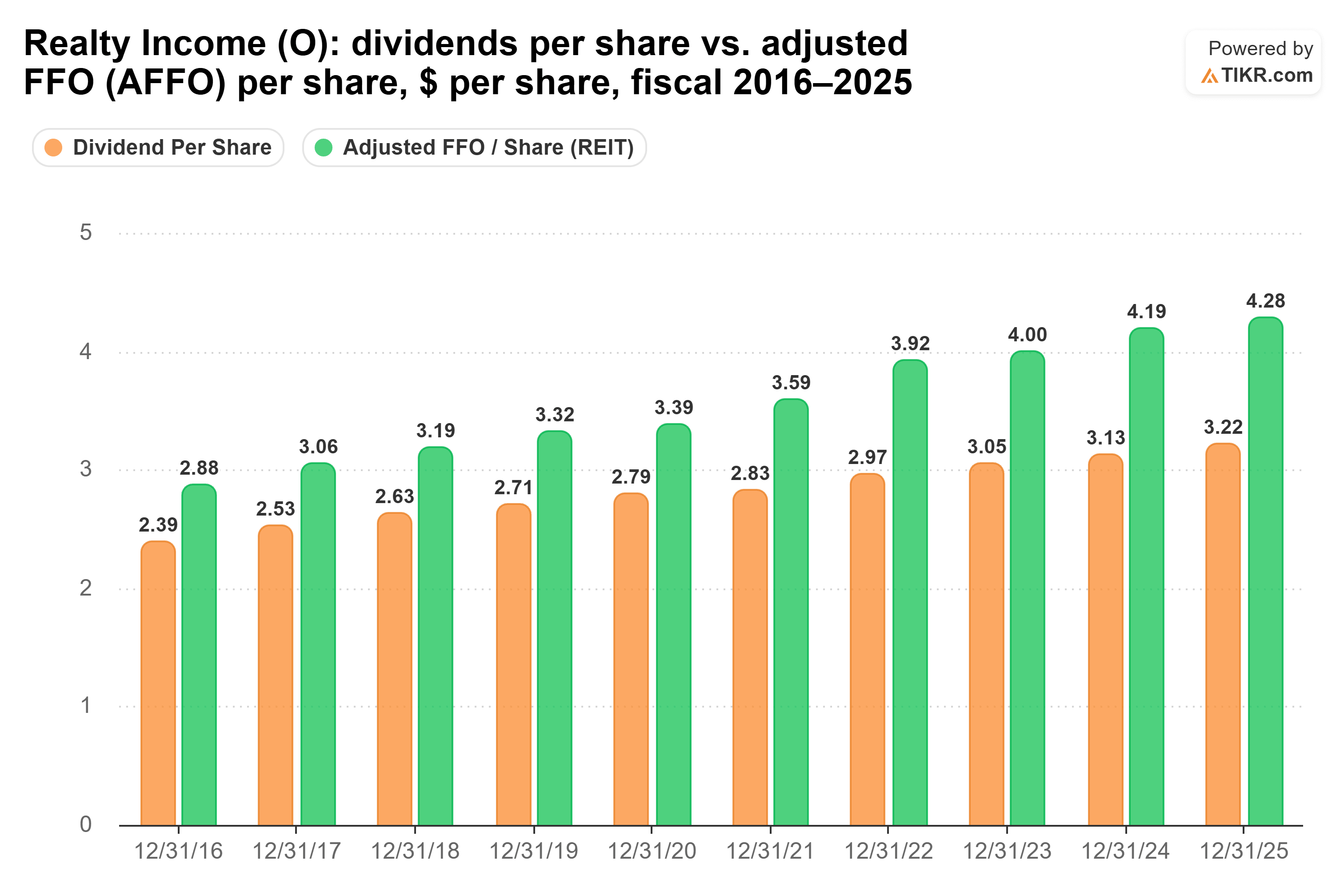
…and the payout ratio fell from 83.0% in fiscal 2016 to 75.2% in fiscal 2025, so the cushion has grown.
The risk is debt. Net debt runs at 5.74x EBITDA and interest coverage at a thin 2.35x, and the company relies on capital markets to fund its growth. Management is working to reduce that reliance. Public equity has funded just 18% of its investment volume so far in 2026, compared with an average of 47% over the past three years.
So which dividend wins?
If I can hold only one dividend stock for the next 20 years, it’s Realty Income.
Over two decades, what I care about most is whether the cash covers the check every year, and Realty Income’s AFFO has done that in each of the last ten. Its 2.9% growth rate leaves plenty of room to keep going, and it pays more along the way. At each company’s 5-year rate, $10,000 would pay about $16,239 over 20 years in Realty Income against about $12,240 in Chevron, and Chevron’s income wouldn’t catch up until around 2048. By year 20, Realty Income’s check would be about $1,052, a 10.5% yield on your original cash.
Chevron has a strong case of its own. It has the longer streak, a nearly debt-free balance sheet, a 51% payout ratio today, and production that’s still growing. It’s just that its free cash flow fell short of the dividend three times in ten years, and I’d rather own the dividend whose cash covered it every year, 2020 included.
Of course, Realty Income still has to keep its deals funded while carrying that debt. If its shift to private capital stalls, its dividend growth could slow with it.
So what is Realty Income stock actually worth?
TIKR lets you forecast the future price of any stock in less than a minute. Just enter a few assumptions into TIKR’s valuation model and see what Realty Income could be worth. Start from Wall Street consensus estimates, or adjust the inputs to reflect your own view of the business. It’s free to use.
Disclaimer:
Please note that the articles on TIKR are not intended to serve as investment or financial advice from TIKR or our content team, nor are they recommendations to buy or sell any stocks. We create our content based on TIKR Terminal’s investment data and analysts’ estimates. Our analysis might not include recent company news or important updates. TIKR has no position in any of the stocks mentioned. Thank you for reading, and happy investing!


