


Key Takeaways
- Kraft Heinz yields 7.2%, and Pfizer 6.3%, and Kraft Heinz paid $1.60 per share in both fiscal 2020 and fiscal 2025.
- Pfizer’s dividend took 89% of its free cash flow over the twelve months to June 2026, against 50% at Kraft Heinz.
- Pfizer raised its 2026 revenue guidance, while Kraft Heinz expects its adjusted operating income to fall 16% to 18% in 2026.
- Pfizer’s CEO says the dividend will be maintained through the company’s patent losses, with raises coming only after them.
If you’re buying a dividend stock to hold for a decade, a 7% yield is hard to walk past.
Kraft Heinz (KHC) yields 7.2% today, and Pfizer (PFE) isn’t far behind at 6.3%. Their second-quarter results in early August told very different stories. Pfizer raised its 2026 revenue guidance. Kraft Heinz booked $7.4 billion of non-cash impairment losses and guided its profit lower.
So if you could hold only one for the next 10 years, which one gets the money?
| Metric | Pfizer (PFE) | Kraft Heinz (KHC) |
|---|---|---|
| Dividend yield | 6.3% | 7.2% |
| Annual dividend | $1.72 | $1.60 |
| Dividend growth, fiscal 2020 to 2025 | 2.5% a year | 0.0% a year |
| Cash dividend payout ratio (TTM to June 2026) | 89% | 50% |
| Net debt/EBITDA | 1.97x | 2.71x |
| Interest coverage (EBIT/interest) | 6.98x | 4.93x |
Source: TIKR and StockAnalysis, Oct. 9, 2026. Debt and interest figures are the last twelve months.
Pfizer’s business is growing, but its dividend is stretched
Pfizer’s revenue rose 3% to $15.0 billion in the second quarter of 2026, or 1% on an operational basis, and management raised its 2026 revenue guidance to a range of $60.5 billion to $62.5 billion.
The cash behind the dividend tells a much tighter story. Over the twelve months to June 28, 2026, dividends took a stretched 89% of Pfizer’s free cash flow, or $9.79 billion out of $10.98 billion. The longer trend is rougher still, with free cash flow sliding from $29.9 billion in fiscal 2021 to $9.08 billion in fiscal 2025, which fell short of the $9.77 billion Pfizer paid out that year…

Pfizer paid $0.86 a share in the first six months of 2026, the same pace as its $1.72 for fiscal 2025.
Albert Bourla, Pfizer’s chairman and CEO, said on the Aug. 4 call that he wanted “once and for all to make that clear to all that the dividend will be maintained.” He also said growth would resume only after Pfizer’s patent losses, which hit revenue through 2028. With coverage at 89%, “maintained” is the honest word: there’s little room for raises until then.
Kraft Heinz has cash to spare
Kraft Heinz has the opposite problem, because its business is shrinking. Net sales fell 1.4% to $6.3 billion in the second quarter of 2026, and management expects adjusted operating income to drop 16% to 18% in 2026 in constant currency as it spends about $700 million more on its brands, mostly on marketing.
The cash is holding up better, though. Over the twelve months to June 27, dividends took a well-covered 50% of free cash flow, and the ratio has come down every year, from 66.3% in fiscal 2023 to 51.8% in fiscal 2025…
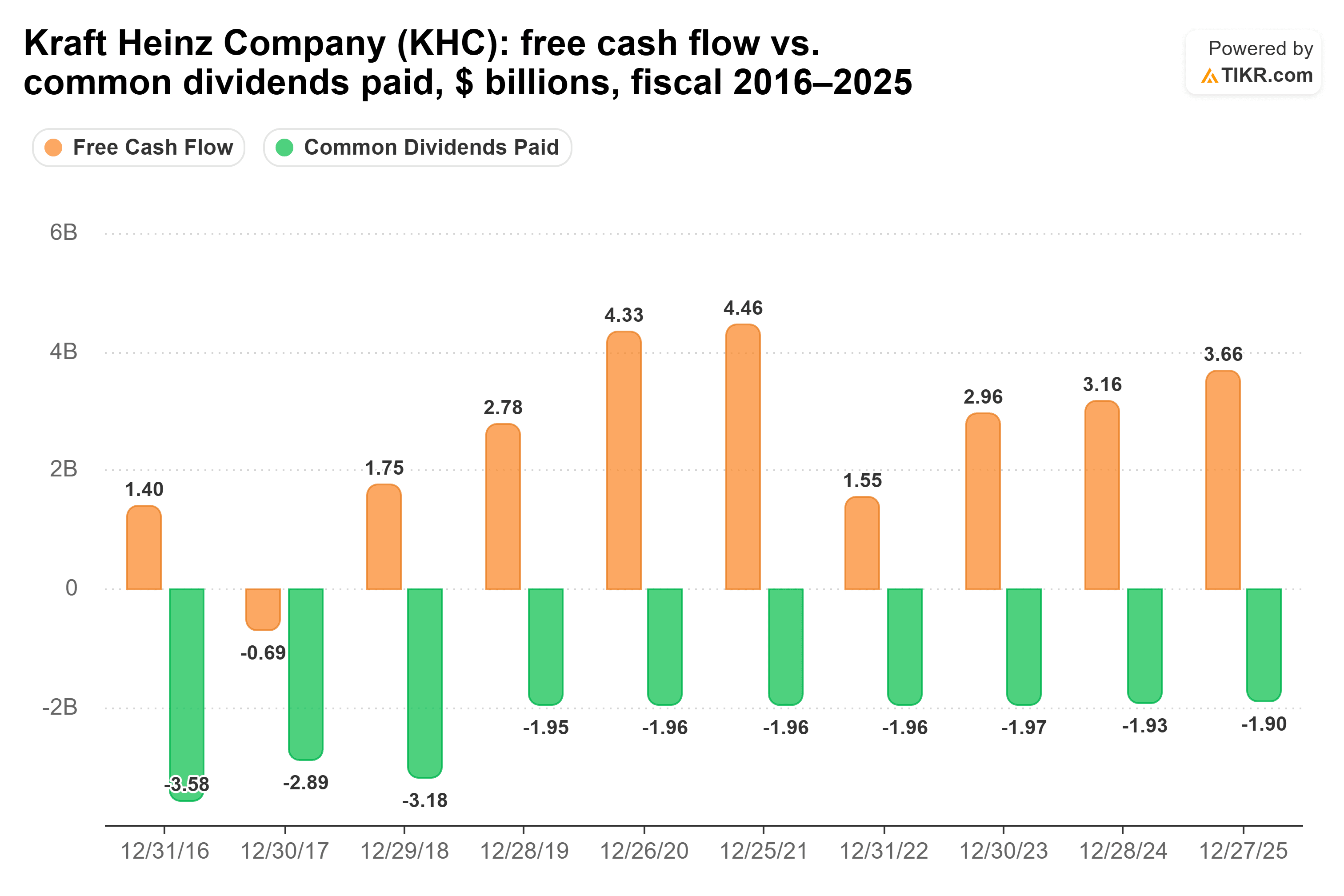
The early bars are a reminder that this dividend has been cut before. Dividends paid fell from $3.18 billion in fiscal 2018 to $1.95 billion in fiscal 2019.
Management called its priorities “sustaining the dividend and protecting our investment-grade credit profile.” The main risk is costs: Kraft Heinz expects 4% to 5% inflation in 2027, and it carries more debt than Pfizer.
So which dividend wins?
For the next 10 years, my dividend dollars go to Kraft Heinz.
Run the numbers at today’s yields and each company’s 5-year growth rate, and Kraft Heinz comes out slightly ahead. A $10,000 stake in it pays about $7,200 over the decade, against about $7,059 in Pfizer, and even at that pace Pfizer’s yearly income wouldn’t pass Kraft Heinz’s until about 2032, too late to close the gap.
The math also gives Pfizer a generous assumption, since it has the dividend growing 2.5% a year while its CEO is promising to hold it steady until the patent losses pass. Hold it flat and Pfizer’s $630 a year comes to $6,300 over 10 years. Kraft Heinz only has to keep paying $1.60 a share, which free cash flow covers twice over.
None of this means Pfizer’s dividend is in trouble. Its revenue is growing, it carries less debt (1.97x net debt to EBITDA) and covers its interest more comfortably (6.98x), and management sees high single-digit yearly revenue growth from the end of 2028 through 2033.
By TIKR’s count, Pfizer has also paid higher dividends per share for 15 fiscal years in a row. It’s just that, over this 10-year window, I’d rather own the bigger check with room to spare today than wait for Pfizer’s growth to come back.
Of course, Kraft Heinz has to keep its cash flow up while it spends more on its brands. Its next quarterly report will show whether that’s working.
So what is Kraft Heinz stock actually worth?
TIKR lets you forecast the future price of any stock in less than a minute. Just enter a few assumptions into TIKR’s valuation model and see what Kraft Heinz could be worth. Start from Wall Street consensus estimates, or adjust the inputs to reflect your own view of the business. It’s free to use.
Disclaimer:
Please note that the articles on TIKR are not intended to serve as investment or financial advice from TIKR or our content team, nor are they recommendations to buy or sell any stocks. We create our content based on TIKR Terminal’s investment data and analysts’ estimates. Our analysis might not include recent company news or important updates. TIKR has no position in any of the stocks mentioned. Thank you for reading, and happy investing!


