


Key Stats for Bloom Energy Stock
- Current Price: $221.31
- Target Price (Mid): ~$1,140
- Street Target: ~$285
- Potential Total Return: ~417%
- Annualized IRR: ~48% / year
Now Live: Discover how much upside your favorite stocks could have using TIKR’s new Valuation Model (It’s free) >>>
What Happened?
Bloom Energy (BE) closed at $221.31 on October 16, down 21.1% from its $280.50 close on October 9. Several firms raised targets during the slide:
- Roth Capital moved to $260 from $225 on October 13.
- Baird’s Ben Kallo raised his target to $351 from $310, about 23% above the $285.43 Street mean.
- Truist moved to $240 from $218 on October 16 and kept its Hold rating.
The Street high, though, fell to $380 from $390 between September 30 and October 16. Bloom reports third-quarter results on October 22 after the close, per its investor relations materials.

See historical and forward estimates for Bloom Energy stock (It’s free!) >>>
Jupiter’s Emissions Cap Leaves One Question Open
The selling was not limited to Bloom. Benzinga tied the October 15 drop in data center stocks to rate worries and AI infrastructure concerns. Those concerns included a Gartner report warning that over 80% of neocloud providers could be at risk by 2030. No Bloom press release during the week explains the size of its decline. On its Q2 call, Bloom said over a dozen U.S. neoclouds, AI labs, and colocation operators have validated and approved its systems.
Project Jupiter, the New Mexico AI campus anchored by Oracle (ORCL), is the company-specific worry:
- September 24: Oracle sent the developer a force majeure notice. The gas pipeline meant to feed the site has slipped to February 1, 2027.
- October 13: Oracle reaffirmed that Bloom remains the primary power source.
- October 15: Oracle and microgrid developer Yucca Growth Infrastructure proposed an enforceable cap on the fuel cells’ operating output. It would cut permitted emissions by about 35%, with the campus’s IT capacity unchanged.
The October 15 release does not say whether installed fuel cell capacity changes, and the air permit was still pending as of that date. Enverus estimates the Jupiter contract, including an expansion option, is nearly half of its own estimate of Bloom’s product backlog. That is not a company figure.
The Q2 Call Already Answered the Delay Question
Morgan Stanley’s David Arcaro asked on the July 28 call how exposed Bloom is to project delays. Without naming any project, CFO Simon Edwards said customers can redeploy equipment to other projects, adding, “But ultimately, the financier is on the hook to take delivery of the equipment from Bloom.” Founder, Chairman and CEO K.R. Sridhar went further: “The 2026 revenue guidance is not dependent on any single project.”
In financed deals, the financier buys and owns the servers. A slipped site then shifts timing risk to that buyer, as long as the servers can move elsewhere. Bloom has not said whether Jupiter is financed that way, and October 22 tests the claim while the permit is pending.
Cash sets a lower bar. Edwards said “you should kind of think about $375 million plus as being our new baseline” for 2026 operating cash flow, while noting this is not formal guidance. Bloom generated $300.04 million in the first half, per its cash flow statement.
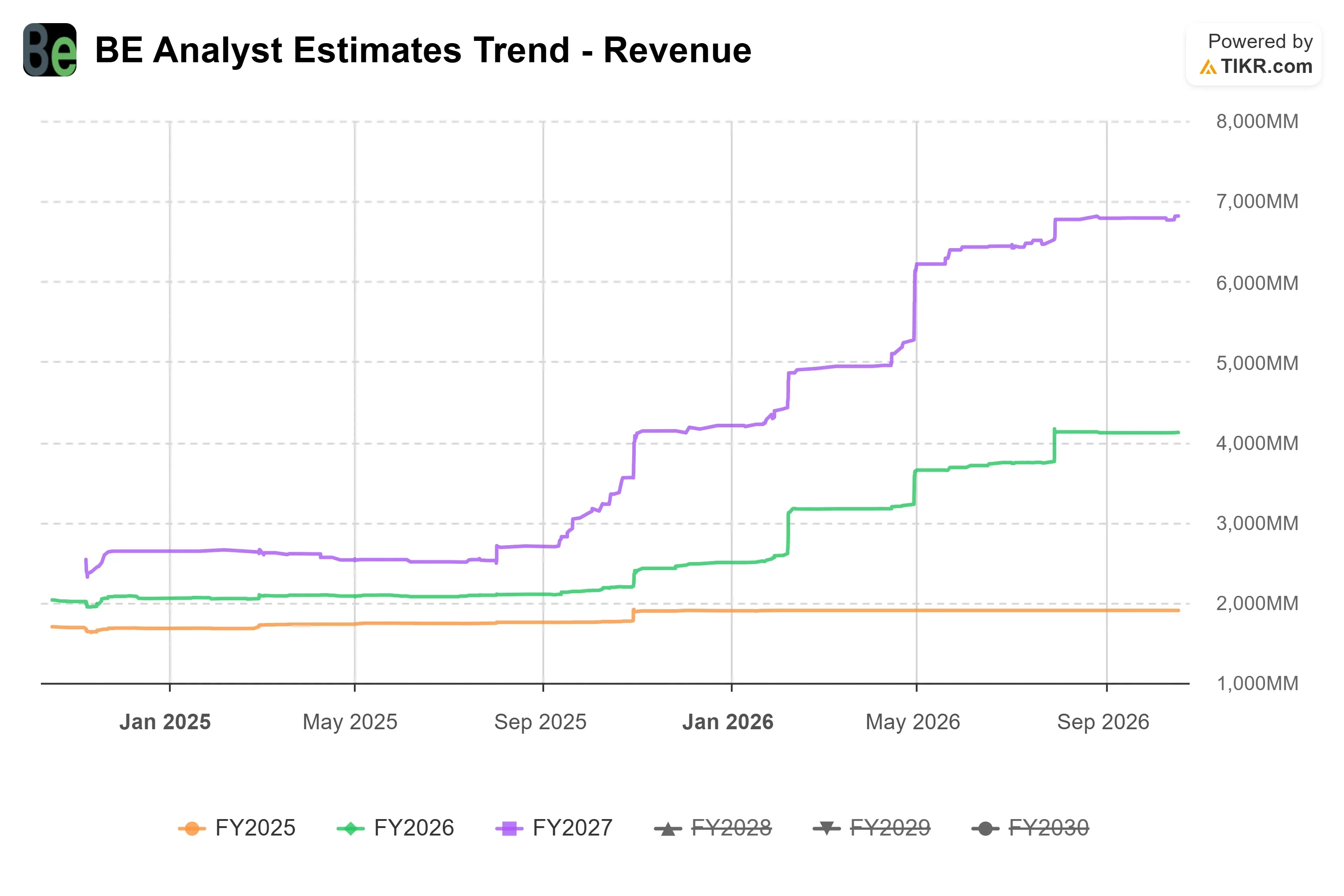
Revenue asks more. The $3.9 billion to $4.2 billion guide requires about $2.08 billion to $2.38 billion in the second half, against Q3 consensus near $1.07 billion.
See how Bloom Energy performs against its peers in TIKR (It’s free!) >>>
TIKR Advanced Model Analysis
- Current Price: $221.31
- Target Price (Mid): ~$1,140
- Potential Total Return: ~417%
- Annualized IRR: ~48% / year

See analysts’ growth forecasts and price targets for Bloom Energy stock (It’s free!) >>>
The mid case is the only case on the card for the 2030 horizon, and the card does not show its 2030 inputs. Street consensus, from eight analysts for 2030, has revenue rising from $2,023.99 million in 2025 to around $14.1 billion. That is a CAGR near 35%, with EBITDA margin rising from 13.4% to around 34%.
The target is roughly 88x the Street’s 2030 normalized EPS estimate of $12.97, so it needs both the growth and a premium multiple. The model is a scenario.
- Main risk: campus delivery delays.
- Upside: Bloom adds capacity faster than consensus assumes, the scenario Baird modeled.
- Downside: over the next 12 months, the Street’s lowest target of $97 sits about 56% below the October 16 close.
Conclusion
October 22 decides which side was right. Three results would back the analysts who raised targets:
- Q3 revenue at or above the roughly $1.07 billion consensus
- A full-year guide held at $3.9 billion to $4.2 billion or higher
- Operating cash flow on pace for $375 million plus
A guide cut, or any sign that Jupiter delays are reaching 2026 deliveries, would back the sellers.
See what stocks billionaire investors are buying so you can follow the smart money with TIKR.
So what is Bloom Energy stock actually worth?
TIKR lets you forecast the future price of any stock in less than a minute. Just enter a few assumptions into TIKR’s valuation model and see what Bloom Energy could be worth. Start from Wall Street consensus estimates, or adjust the inputs to reflect your own view of the business. It’s free to use.
Analyze Bloom Energy on TIKR Free →
Disclaimer:
Please note that the articles on TIKR are not intended to serve as investment or financial advice from TIKR or our content team, nor are they recommendations to buy or sell any stocks. We create our content based on TIKR Terminal’s investment data and analysts’ estimates. Our analysis might not include recent company news or important updates. TIKR has no position in any stocks mentioned. Thank you for reading, and happy investing!


