
Key Stats for CAT Stock
- Past week’s performance: 1.5%
- 52-week range: $405 to $1,073
- Valuation model target price: $979
- Implied upside: 16.3% over 2.4 years
See how Caterpillar’s record backlog could shape its own price target with TIKR (It’s free) >>>
Powering Through: Inside Caterpillar’s AI-Fueled Earnings Beat
Caterpillar (CAT) posted a blowout Q2 that pushed sales past $20 billion for the first time in company history. Revenue climbed 24% to $20.5 billion, and adjusted earnings per share jumped to $8.17, well above the $6.20 analysts expected. The equipment maker credited broad demand across construction, power, and mining. Investors welcomed the results, though the stock’s weekly gain stayed modest after some profit-taking followed the initial pop.
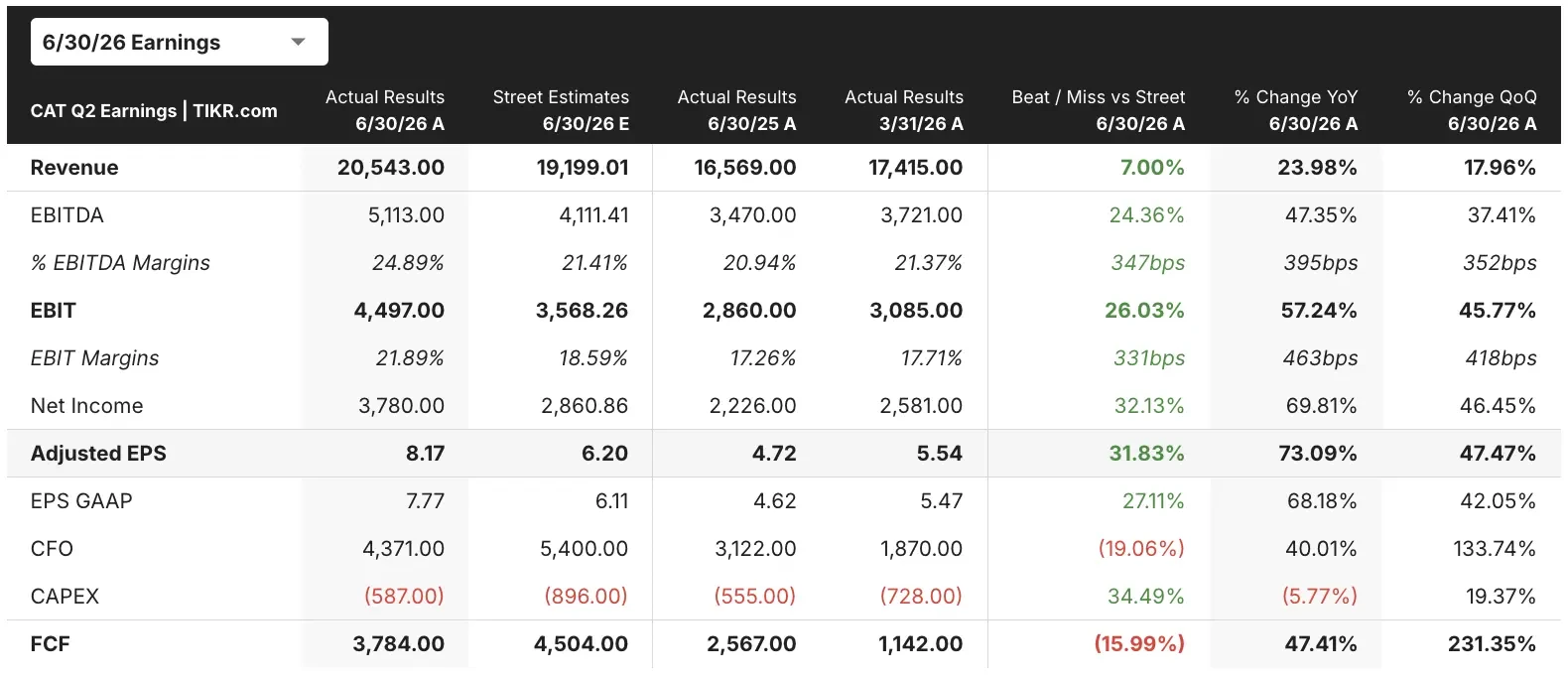
A big part of the story is artificial intelligence. Power generation sales tied to data centers climbed sharply, since hyperscalers keep building out infrastructure that needs backup and prime power. Caterpillar’s Power and Energy segment, which supplies generators and turbines for these projects, grew 17% during the quarter. Because demand is outpacing production, the company’s order backlog swelled to a record $72 billion, up $9 billion from the prior quarter.
Management responded by raising its full-year outlook. Caterpillar now expects 2026 sales and revenue growth in the mid to high teens, up from its earlier low double-digit forecast. Executives also trimmed their tariff cost estimate to roughly $2.2 billion, near the low end of the prior range. Adjusted operating margin expanded to 21.9%, showing that higher volumes and favorable pricing are dropping straight to the bottom line.
CEO Joe Creed credited the results to what he called “the breadth and duration of our record backlog.” He added that in conversations with customers, demand tied to AI-powered infrastructure isn’t slowing down. Analysts will now watch whether Caterpillar can convert that backlog into deliveries without straining capacity. If CAT stock keeps pace with its raised guidance, the current rally may still have room to run.
Backlog Meets Valuation: Is Caterpillar Still Cheap?

Under valuation model assumptions realized through 12/31/28, the stock is modeled using:
- Revenue Growth (CAGR): 12.2%
- Operating Margins: 20.3%
- Exit P/E Multiple: 24.0x
Based on these inputs, the model estimates a target price of $979, implying a 16.3% total return and an annualized return of 6.5% over the next 2.4 years.
Caterpillar’s valuation model paints a picture of steady, not spectacular, upside. A 12.2% revenue growth assumption and a 20.3% operating margin reflect continued strength in power generation and construction equipment, without assuming the AI boom accelerates much further. That combination lands the annualized return at 6.5%, inside the moderately attractive range rather than the deeply undervalued zone.

History adds useful context here. Caterpillar’s own five-year revenue growth ran near 10%, and its ten-year figure sits closer to 4%, so the model’s forward estimate already bakes in faster expansion than the company has typically delivered. The 24.0x exit multiple also sits above Caterpillar’s longer-term average, reflecting investor willingness to pay up for exposure to AI infrastructure spending.
Margins look like the bigger swing factor. Caterpillar’s adjusted operating margin already reached 21.9% last quarter, above the model’s 20.3% assumption, so there is room for the forecast to prove conservative if pricing power holds. Heavy equipment peers like Deere and Komatsu, which lean more on agriculture and mining cycles, don’t carry the same data center tailwind.
The bigger risk is timing. Backlog growth could slow once Caterpillar’s capacity expansion catches up with orders, and much of the current premium assumes it won’t.
See how Caterpillar’s margins stack up against its own history (Free with TIKR) >>>
Caterpillar vs. the Heavy Equipment Field
Caterpillar’s closest publicly traded rivals, Deere (DE) and Komatsu (KMTUY), offer a useful check on how much of the current rally is unique to Caterpillar. Deere posted second-quarter revenue growth of about 5% and continues to guide for a decline in large agriculture volumes of 15% to 20% for the year. Deere did raise its construction and forestry sales growth target to roughly 20%, showing that non-farm demand is strengthening across the industry, not just at Caterpillar.

Komatsu competes most directly with Caterpillar’s Resource Industries segment, which covers mining trucks and machinery. Caterpillar’s Resource Industries revenue grew 20% last quarter, a faster pace than Komatsu has typically posted in recent periods, partly because Caterpillar’s mining customers are also investing in AI-adjacent infrastructure like the data centers powered by the same generator technology Caterpillar sells elsewhere.
The valuation gap tells its own story. Caterpillar now trades near 24.0x forward earnings on the model’s assumptions, above where Deere typically trades given its heavier exposure to a soft agriculture cycle. That premium reflects Caterpillar’s broader diversification across construction, mining, and power generation, plus its unusual position supplying equipment for AI data centers, a category neither Deere nor Komatsu competes in meaningfully.
What’s Driving CAT Stock Going Forward?
The most important near-term catalyst is execution against the raised 2026 guidance. Caterpillar says it expects another quarter of strong growth in Q3, supported by higher volume and favorable pricing. Investors will watch whether the mid-to-high-teens sales growth forecast holds as capacity expansion ramps through the second half.
Backlog duration matters just as much as size. Fifty-nine percent of Caterpillar’s $72 billion backlog is scheduled to ship within 12 months, while some Power and Energy orders now stretch out to 2029 and 2030. That long-dated visibility gives investors more confidence in Caterpillar’s growth trajectory than a typical industrial cycle would normally allow.
Tariffs remain a swing factor worth tracking. Caterpillar expects full-year tariff costs of about $2.2 billion, excluding any additional recoveries under trade law, and management has already flagged that it isn’t assuming further relief in the back half. Any change in trade policy could move that estimate in either direction.
Finally, the durability of AI-related power demand is the central debate. Caterpillar’s own commentary suggests customers aren’t pulling back yet, but the sustainability of data center capital spending across the broader economy remains an open question that will shape how investors value the stock into 2027.
Track Caterpillar’s next earnings catalysts and build your own return scenario (Free with TIKR) >>>
Should You Invest in Caterpillar?
The only way to really know is to look at the numbers yourself. TIKR gives you free access to the same institutional-quality financial data that professional analysts use to answer exactly that question.
Pull up CAT, and you’ll see years of historical financials, what Wall Street analysts expect for revenue and earnings in the quarters ahead, how valuation multiples have moved over time, and whether price targets are trending up or down.
You can build a free watchlist to track CAT alongside every other stock on your radar. No credit card required. Just the data you need to decide for yourself.
Analyze CAT stock on TIKR Free→
Disclaimer:
Please note that the articles on TIKR are not intended to serve as investment or financial advice from TIKR or our content team, nor are they recommendations to buy or sell any stocks. We create our content based on TIKR Terminal’s investment data and analysts’ estimates. Our analysis might not include recent company news or important updates. TIKR has no position in any stocks mentioned. Thank you for reading, and happy investing!