


Key Stats for Mastercard Stock
- Current Price: $562.95
- Target Price (Mid): ~$1,030
- Street Target: ~$663
- Potential Total Return: ~83%
- Annualized IRR: ~15% / year
Now Live: Discover how much upside your favorite stocks could have using TIKR’s new Valuation Model (It’s free) >>>
What Happened?
Mastercard Incorporated (MA) did everything right last quarter, and the stock is lower than it was before the report. The company topped every consensus line in its July 30 report, and shares traded up roughly 2% that morning before reversing the move and drifting to $562.95 by the August 7 close, fractionally below where they started the year. That is the puzzle facing anyone looking at the payments network today. The business is compounding at a mid-teens rate, buyers keep hitting a ceiling, and the stock keeps stalling.
The fear here is not that something broke. It is that a stock this good should not keep stalling, and investors are trying to work out whether the pause is an opportunity or a warning.
The Overhangs the Bears Named Are Easing, Not Gone
For most of 2026, the bear case on Mastercard rested on three worries: a two-decade antitrust fight over swipe fees, a soft patch in cross-border travel tied to Middle East instability, and the risk that stablecoins would route around the card networks. All three moved the company’s way over the past two months, though none is fully closed.
On June 9, a federal judge granted preliminary approval to a revised $38 billion settlement between Visa, Mastercard, and U.S. merchants, resolving litigation that had run since 2005. This is preliminary, not final: the court noted it had received roughly 40 merchant objection letters, and final approval and potential appeals still lie ahead. Mastercard is also the secondary defendant here, behind Visa, the larger network. So the largest legal cloud over the stock now has a defined shape rather than an open-ended one, but it is not resolved.
Cross-border recovered inside the quarter. Then-CFO Sachin Mehra told investors the Middle East drag came in lighter than feared, and that greater U.S. dollar availability in Venezuela, where Mastercard is the market leader, lifted card-not-present spending. Cross-border volume grew 12% for the quarter. On stablecoins, Mastercard answered directly: on August 3, it completed its acquisition of BVNK, a payments-infrastructure firm valued at up to $1.8 billion that connects blockchain rails to traditional fiat. Rather than fight stablecoins, management is positioning the network as the layer that ties them to the banking system.
See historical and forward estimates for Mastercard stock (It’s free!) >>>
The New Transaction Pools Behind the Margins
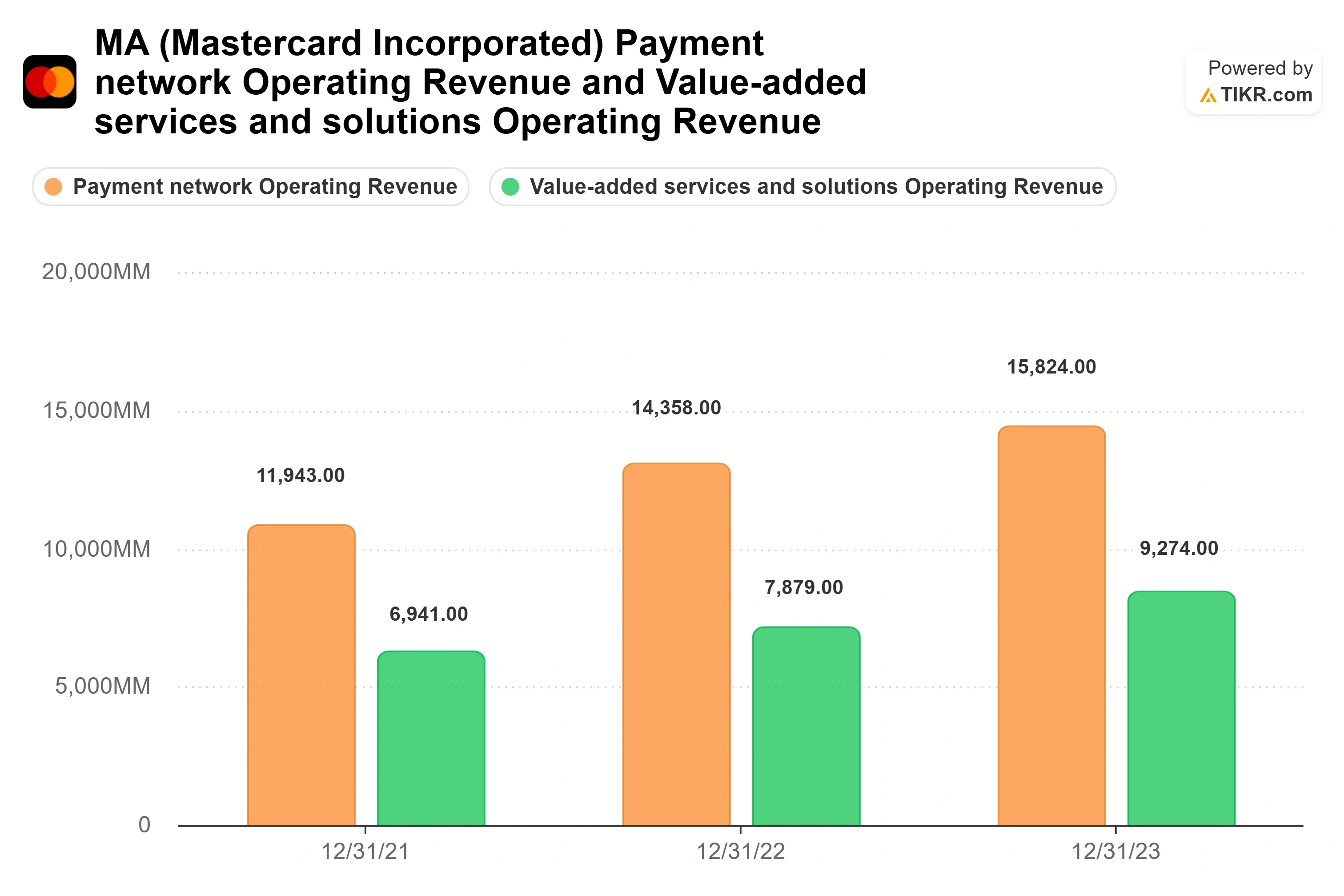
The quieter story is where Mastercard is finding growth, the market has not fully credited: new transaction pools that sit outside its existing rails. Its higher-margin services business, with roughly 60% of that revenue linked to the network, helped push adjusted operating margin to 61.1% last quarter, but the more interesting expansion is geographic.
The clearest example of a new volume came out of the United Arab Emirates. Mastercard is building the domestic switching technology for the central bank’s next-generation payments infrastructure and will serve as the international scheme on co-badged credit cards with the domestic Jaywan scheme. Those transactions are incremental to what already flows through the global switch, and management has done versions of this in South Africa while holding the same technology in reserve for Europe. Discipline shows on the other side: on that same call, Mehra was blunt about walking away from a UK credit portfolio when the economics stopped working, framing the philosophy as chasing “profitable volume, which is going to drive higher net revenue yield” rather than volume for its own sake. Mehra handed the CFO role to Ling Hai, previously head of Asia Pacific, Europe, Middle East, and Africa, effective August 3. That is a team optimizing for returns, not headline share. Cantor Fitzgerald raised its target to $695 from $650 on August 3, and the Street’s average target of roughly $663 sits about 18% above the current price.
What the Multiple Is Actually Pricing
Mastercard trades at around 26 times next-twelve-month earnings and roughly 31 times trailing earnings. The forward multiple has fallen from the mid-30s to the mid-20s over the past six quarters, even as earnings climbed, and it sits near the low end of that range today. A business still growing EPS in the high teens is being priced as though growth is fading faster than the results show. Mastercard has beaten consensus in every quarter visible in the TIKR data, yet the multiple stayed compressed, which is why shares are flat on the year while EPS rises.
The market is pricing regulatory and stablecoin risk that the last two months of news have started to unwind. Whether that discount persists is the open question, but the direction of the evidence has been one-sided.

See how Mastercard performs against its peers in TIKR (It’s free!) >>>
TIKR Advanced Model Analysis
- Current Price: $562.95
- Target Price (Mid): ~$1,030
- Potential Total Return: ~83%
- Annualized IRR: ~15% / year

See analysts’ growth forecasts and price targets for Mastercard stock (It’s free!) >>>
Using the TIKR mid-case scenario, Mastercard is valued at around $1,030 per share, implying roughly 83% total return, or about 15% annualized over the next 4.4 years. The two revenue drivers carrying that number are continued cross-border volume growth, the company’s highest-yield line, and double-digit expansion in value-added services. The margin driver is operating leverage: a 61% operating margin that widens as network-linked services scale on infrastructure that is already built. The mid-case assumes a revenue CAGR of around 10% and a net income margin of around 47%, both inside what the business delivered recently, given 14% revenue growth and margins already above that assumption last quarter.
The primary risk is regulatory. The swipe-fee settlement caps standard consumer rates and trims interchange, and legislative efforts remain live, so pricing power is the variable most exposed to policy. On the upside, if services keep compounding near the high teens and cross-border holds double digits, the mid-case looks conservative. On the downside, a genuine consumer-spending slowdown or an adverse regulatory turn would compress both volume and the multiple at once.
Conclusion
The next real test is the Q3 2026 print, expected in late October. Management guided full-year net revenue growth to the high end of the low-double-digit range and said it now expects to finish higher within that band on stronger first-half performance. The number to watch is value-added services growth: as long as it holds near the high-teens pace, the case that Mastercard is a services business wearing a card-network valuation stays intact. A deceleration toward the network’s high single-digit rate would be the first genuine crack. Until then, a stock that has beaten consensus every quarter in the data and still trades below its own pre-earnings price looks more like a discount than a verdict.
See what stocks billionaire investors are buying so you can follow the smart money with TIKR.
Should You Invest in Mastercard?
The only way to really know is to look at the numbers yourself. TIKR gives you free access to the same institutional-quality financial data that professional analysts use to answer exactly that question.
Pull up Mastercard, and you’ll see years of historical financials, what Wall Street analysts expect for revenue and earnings in the quarters ahead, how valuation multiples have moved over time, and whether price targets are trending up or down.
You can build a free watchlist to track Mastercard alongside every other stock on your radar. No credit card required. Just the data you need to decide for yourself.
Analyze Mastercard on TIKR Free →
Looking for New Opportunities?
- See what stocks billionaire investors are buying so you can follow the smart money.
- Analyze stocks in as little as 5 minutes with TIKR’s all-in-one, easy-to-use platform.
- The more rocks you overturn… the more opportunities you’ll uncover. Search 100K+ global stocks, global top investor holdings, and more with TIKR.
Disclaimer:
Please note that the articles on TIKR are not intended to serve as investment or financial advice from TIKR or our content team, nor are they recommendations to buy or sell any stocks. We create our content based on TIKR Terminal’s investment data and analysts’ estimates. Our analysis might not include recent company news or important updates. TIKR has no position in any stocks mentioned. Thank you for reading, and happy investing!


