
Key Stats for Lockheed Martin Stock
- Current Price: $587.95
- Target Price (Mid): ~$840
- Street Target: ~$630
- Potential Total Return: ~42%
- Annualized IRR: ~8% / year
Now Live: Discover how much upside your favorite stocks could have using TIKR’s new Valuation Model (It’s free) >>>
What Happened?
Lockheed Martin (LMT) spent decades unable to profit from its own efficiency. Cut a missile’s unit cost, and government accounting rules clawed the savings back at the next price review. This summer, on the munitions programs that are now its fastest-growing business, that stopped being true. It is the least-discussed reason the stock could compound from $587.95 toward the roughly $840 that TIKR’s model sees by the end of 2030, and it matters more than any single contract win.
The shares still sit about 15% below the 52-week high of $692, even after a second quarter that produced a record $230 billion backlog and a raised full-year outlook. The market has digested that quarter. What it has not priced is whether the profit math behind the next five years holds, and that math turns on margin, not demand.
The Accounting Change That Decides the Margin
Under traditional government cost-accounting rules, even a fixed-price contract could be repriced downward when a vendor’s costs fell. CEO Jim Taiclet put the disincentive in plain numbers on the Q2 earnings call: spend $10 million on robotics to cut a unit’s cost 10%, and “we get repriced down 10%. And who would invest $10 million to get their price down 10% and bleed out all of that benefit.”
The new munitions framework agreements remove that wall. When the company finds efficiencies while ramping a line, it keeps those gains in its own margin, sharing a portion back with the government only after clearing the top of a defined range. That is why the $35 billion, seven-year THAAD contract awarded in late June matters beyond its headline size: it is the first munitions framework to convert into a locked, priced contract under the new terms, and CFO Evan Scott said a PAC-3 multiyear is intended to follow on the same basis in the second half.
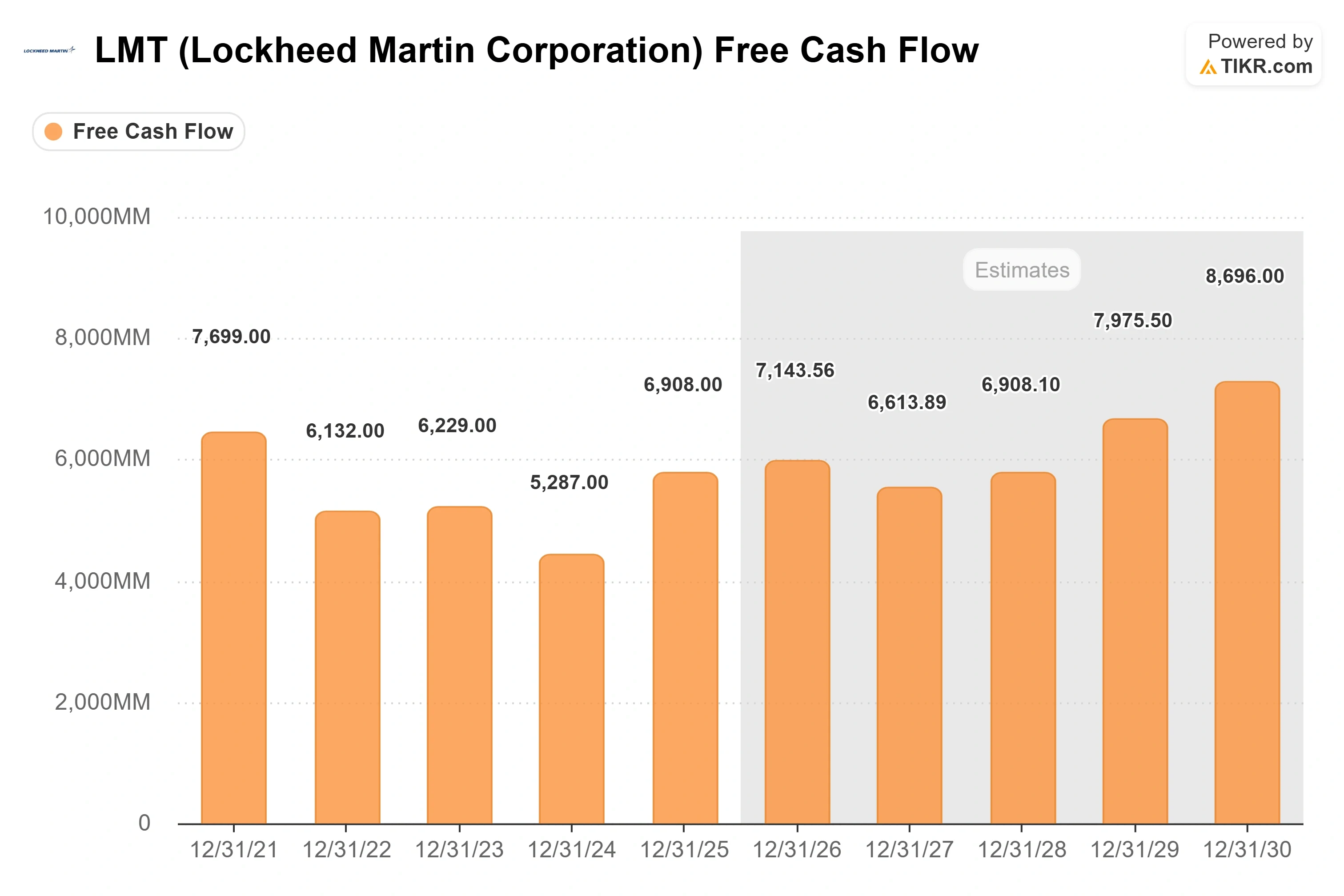
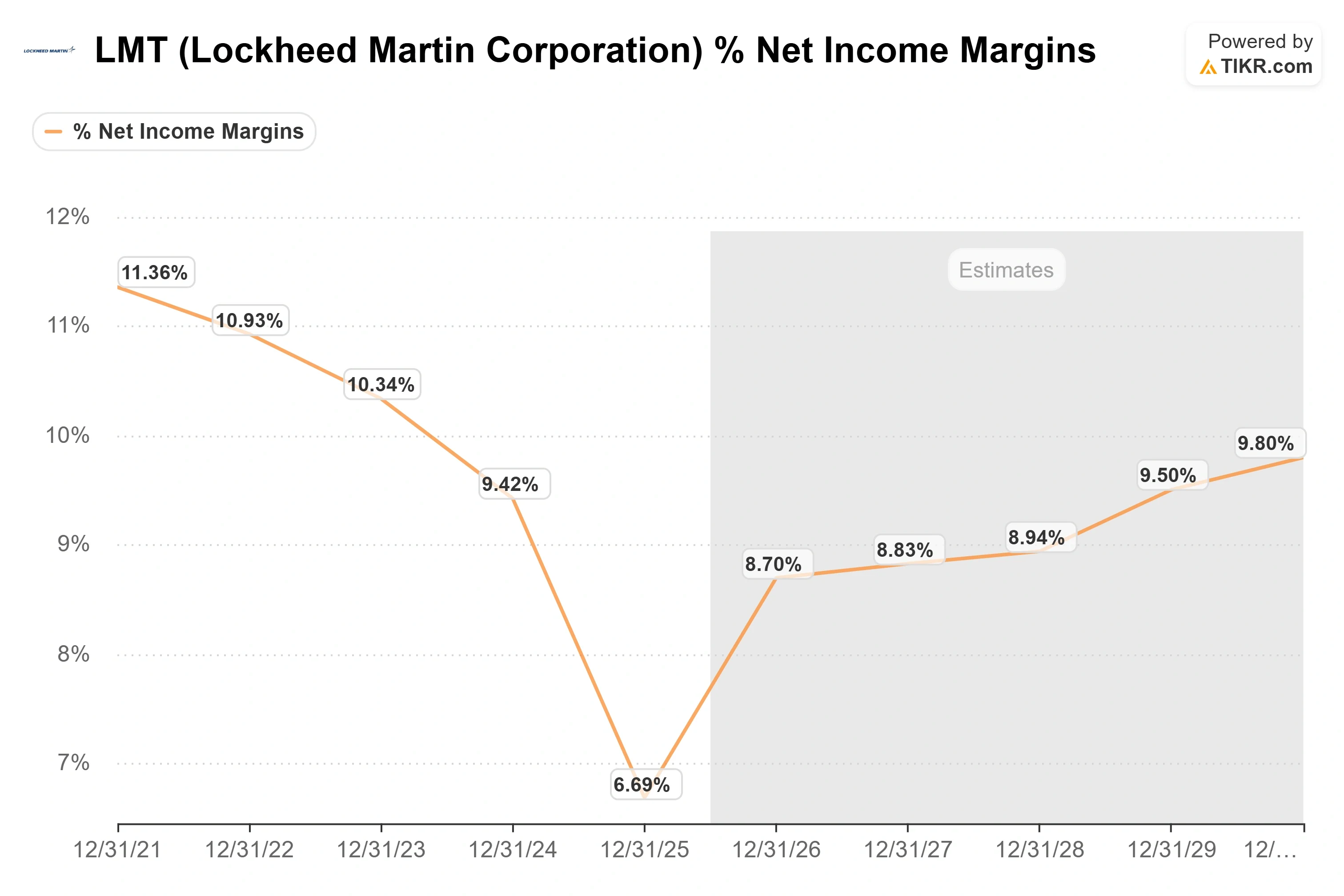
This is the mechanism the 2030 model is really betting on. TIKR’s mid case assumes net income margin recovers to around 10%, up from the 6.7% Lockheed Martin posted in a 2025, dragged down by classified-program charges. Margins do not climb that far on volume alone. They climb because the company now retains efficiency gains it never could before, on a munitions base, Scott expects to hold in the “high 13s, low 14s” at the segment level as the ramp matures. The proof that it is already working showed up in Q2: consolidated EBIT reached $2.5 billion, and free cash flow flipped from negative $150 million a year earlier to positive $2.9 billion.
See historical and forward estimates for Lockheed Martin stock (It’s free!) >>>
Where the Efficiency Actually Comes From
Taiclet pointed to the Camden, Arkansas, plant, where the newer PrSM missile line runs on automation and AI-guided robotics with a fraction of the people the older ATACMS line requires. Under the old rules, automating that line would have handed the cost savings straight back to the customer. Under the frameworks, it drops toward Lockheed Martin’s margin instead.
The same speed showed up in a counter-drone system called GRIZZLY that went from concept to live-fire in under 45 days, built by connecting existing pieces rather than inventing new ones. The point is not the gadget. It is that management is being handed room to move faster and keep what it saves, which is exactly the behavior the margin forecast assumes. The catch is funding: as prior reporting on the Pentagon’s munitions push has detailed, the frameworks only convert to full contracts once Congress appropriates the money, and Taiclet has said that timing sits outside the company’s control.
See how Lockheed Martin performs against its peers in TIKR (It’s free!) >>>
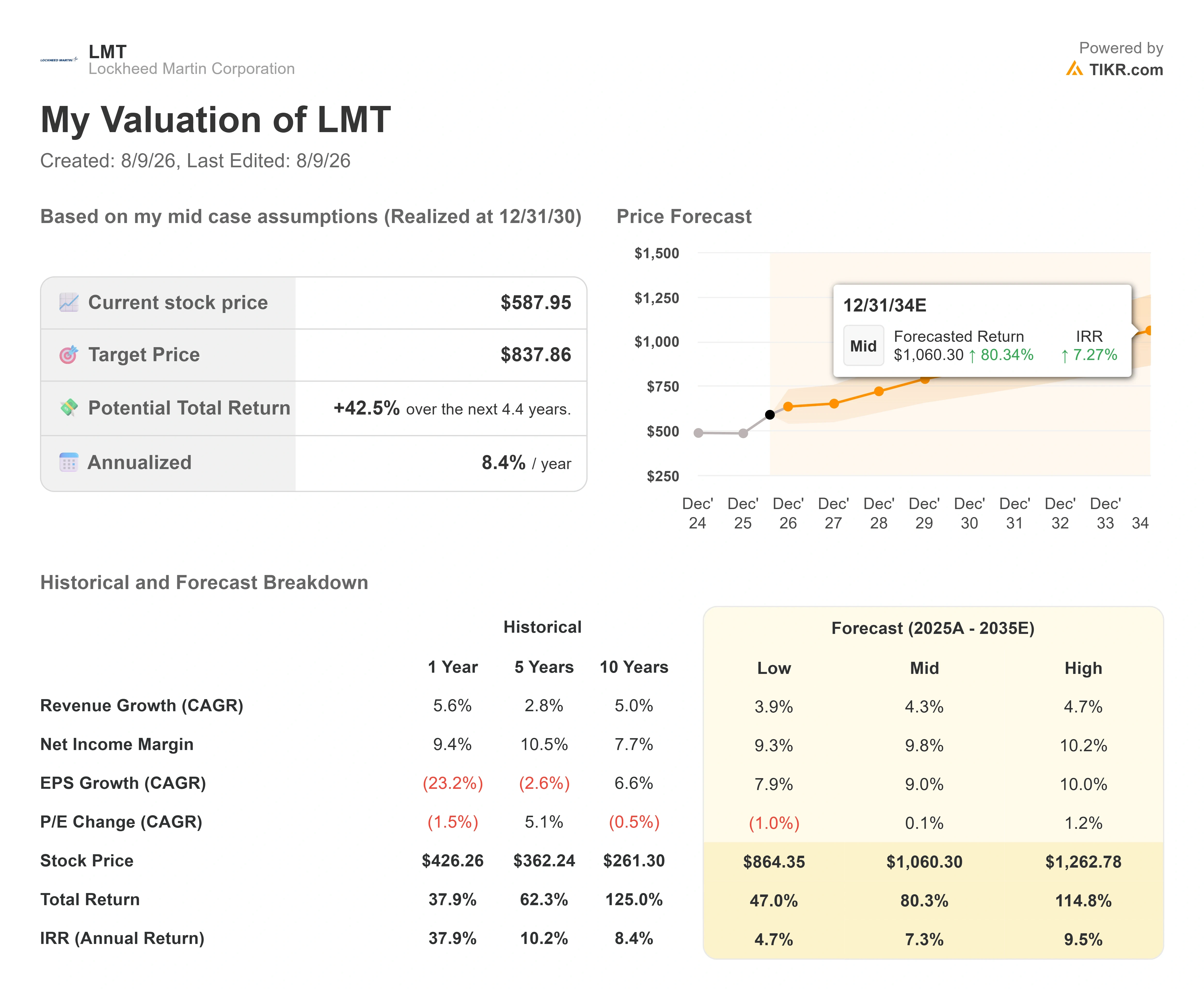
TIKR Advanced Model Analysis
- Current Price: $587.95
- Target Price (Mid): ~$840
- Potential Total Return: ~42%
- Annualized IRR: ~8% / year
See analysts’ growth forecasts and price targets for Lockheed Martin stock (It’s free!) >>>
The two revenue drivers are the munitions ramp in Missiles and Fire Control, where the framework conversions sit and where the base is guided to grow faster than any other segment, and the F-35 franchise in Aeronautics, which Taiclet expects to sustain a 156-aircraft annual production rate for years as the only in-production fifth-generation fighter in the West. The margin driver is the retained-efficiency mechanism above, carrying net margin back toward 10%. The primary risk is appropriations: these are U.S.-government-funded programs, and the frameworks only hold their value if Congress funds the fiscal 2027 munitions request, much of which sits inside a reconciliation package facing pushback.
The upside case is that margin retention plus the munitions ramp carries net margin to the model’s high-case 10.2% and pushes the return above the mid path. The downside is that a repeat of the F-16 and C-130 charges holds net margin nearer the low-case 9.3%, compressing the return toward the model’s low scenario.
Conclusion
The near-term tell is free cash flow. Management raised full-year 2026 free cash flow guidance to $7 billion to $7.2 billion, and after a first half that included a negative Q1 print from the ERP rollout, that guide is heavily back-end weighted. Watch the Q3 report in late October: full-year free cash flow still tracking toward $7 billion or better, says the framework-driven margin path is real, while another miss says the market’s discount is doing its job.
See what stocks billionaire investors are buying so you can follow the smart money with TIKR.
Should You Invest in Lockheed Martin?
The only way to really know is to look at the numbers yourself. TIKR gives you free access to the same institutional-quality financial data that professional analysts use to answer exactly that question.
Pull up Lockheed Martin, and you’ll see years of historical financials, what Wall Street analysts expect for revenue and earnings in the quarters ahead, how valuation multiples have moved over time, and whether price targets are trending up or down.
You can build a free watchlist to track Lockheed Martin alongside every other stock on your radar. No credit card required. Just the data you need to decide for yourself.
Analyze Lockheed Martin on TIKR Free →
Looking for New Opportunities?
- See what stocks billionaire investors are buying so you can follow the smart money.
- Analyze stocks in as little as 5 minutes with TIKR’s all-in-one, easy-to-use platform.
- The more rocks you overturn… the more opportunities you’ll uncover. Search 100K+ global stocks, global top investor holdings, and more with TIKR.
Disclaimer:
Please note that the articles on TIKR are not intended to serve as investment or financial advice from TIKR or our content team, nor are they recommendations to buy or sell any stocks. We create our content based on TIKR Terminal’s investment data and analysts’ estimates. Our analysis might not include recent company news or important updates. TIKR has no position in any stocks mentioned. Thank you for reading, and happy investing!