Key Stats for Caterpillar Stock
- Current Price: $985.82 (June 18, 2026 close)
- Target Price (Mid): ~$1,340
- Street Target: ~$946
- Potential Total Return: ~36%
- Annualized IRR: ~7% / year
- Earnings Reaction: (0.05%) (April 30, 2026)
Now Live: Discover how much upside your favorite stocks could have using TIKR’s new Valuation Model (It’s free) >>>
What Happened?
Caterpillar (CAT) has run so far, so fast, that Wall Street can no longer keep up with its own stock. CAT closed at $985.82 on June 18, just below its all-time high of $994.49, after climbing more than 60% in 2026. Yet the average analyst target sits near $946, which means the stock now trades above where the Street collectively thinks it should be.
That is the tension every CAT investor faces. The market has decided Caterpillar is no longer a cyclical equipment maker but an AI infrastructure play, because its Power and Energy segment supplies the generators and turbines that keep data centers running. Bulls say that the shift is permanent and the rich multiple should hold. Bears say a machinery company with margin pressure and a record valuation has already priced in years of good news. The question the market cannot yet answer is whether the data center power story is durable enough to justify paying a premium at all-time highs.
Why Caterpillar Keeps Hitting New Highs
The run is built on real demand. First-quarter 2026 sales rose 22% year over year to $17.4 billion, and Power and Energy grew about 20% to roughly $7.0 billion on data center power products. The backlog reached a record near $63 billion, up 79% year over year, giving Caterpillar the kind of multi-year revenue visibility that machinery investors rarely get.
Wall Street has chased the stock higher as a result. JPMorgan lifted its target to a new Street high of $1,165, Evercore ISI moved to $1,103, and Wells Fargo went to $1,050. On June 10, the board raised the quarterly dividend 8% to $1.63 per share, extending Caterpillar’s run as a Dividend Aristocrat, a company that has raised its dividend for at least 25 straight years. CEO Joe Creed tied the increase to strong free cash flow and the company’s strategy.
What the Data Center Boom Means for CAT
The clearest explanation of why this demand could last came from a Bank of America investor meeting on May 19, where Power and Energy Group President Jason Kaiser spent an hour on the mechanics of the business.
Two points stand out. First, Caterpillar is guarding against the obvious risk that the buildout slows. Kaiser said major customer agreements now include cancellation penalties and sometimes prepayments before the company commits new capital. Caterpillar has announced six contracts of at least one gigawatt each, and Kaiser added, “We have several other smaller ones that we haven’t announced as well.”
Second, the long-term profit is in services. A gas generator running primary power around the clock throws off far more lifetime service revenue than a standby diesel unit. “There’s 40x more services opportunity over the lifetime for that gas genset,” Kaiser said. That revenue carries higher margins and is far less cyclical than selling machines, which is exactly what can justify a higher multiple over time.

See historical and forward estimates for Caterpillar stock (It’s free!) >>>
The Valuation Debate at All-Time Highs
On almost every measure, Caterpillar is expensive. The stock trades at about 49x trailing earnings and roughly 39x forward earnings. The peer gap is stark: Cummins trades near 24x forward earnings, so CAT is being valued like a different kind of company than the ones beside it.
The premium can be defended, but only on conditions. It holds if the backlog stays firm and Power and Energy keeps converting orders into high-margin services revenue. It compresses fast if margins disappoint or hyperscaler spending on AI power cools. That risk is real: Power and Energy margins faced pressure in the first quarter from tariffs and the cost of ramping new capacity, and management has guided full-year 2026 tariff costs to between $2.2 billion and $2.4 billion. That is why the Street’s average target sits below the current price even as individual banks push past $1,100.

See how Caterpillar performs against its peers in TIKR (It’s free!) >>>
TIKR Advanced Model Analysis
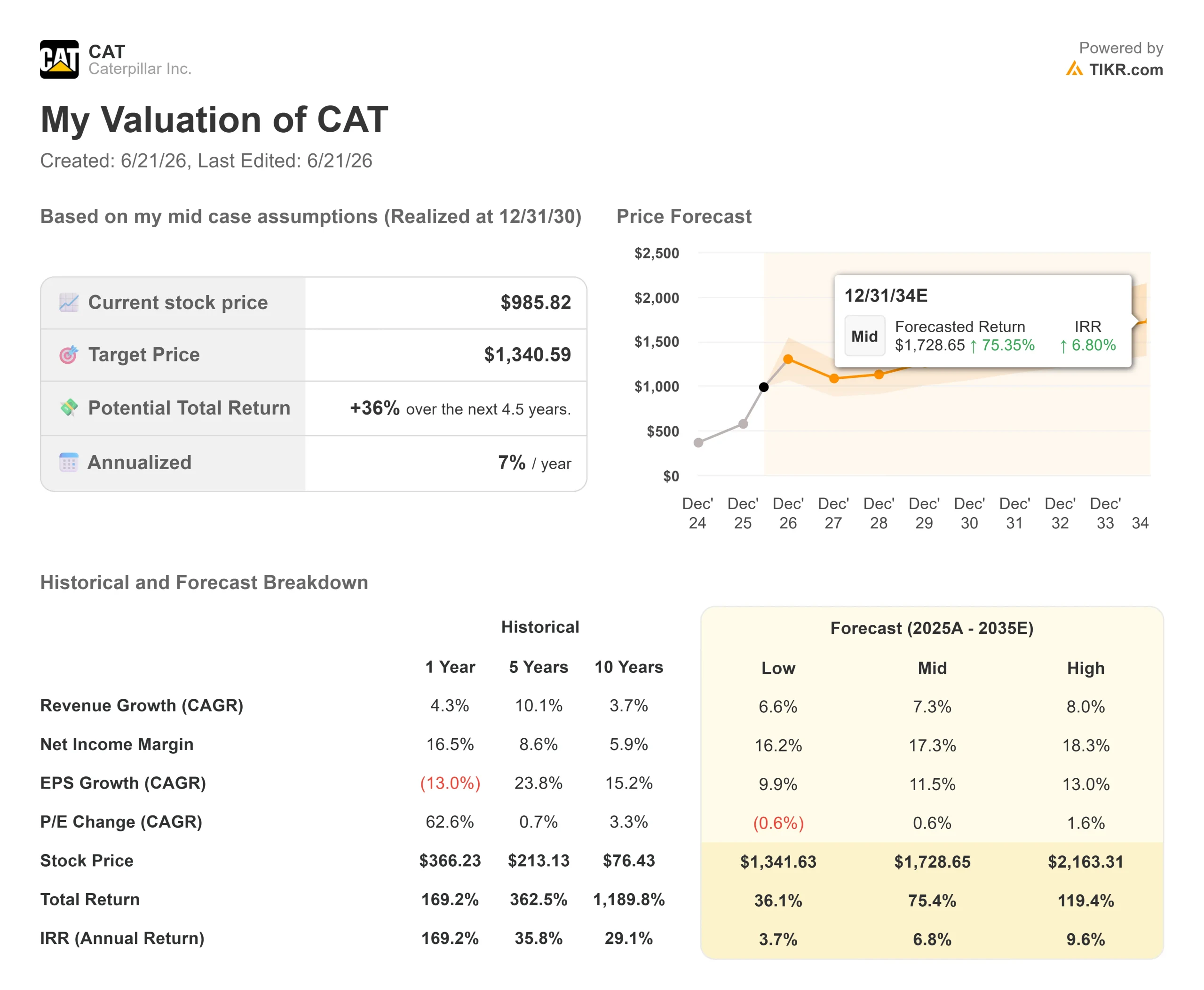
- Current Price: $985.82
- Target Price (Mid): ~$1,340
- Potential Total Return:~36%
- Annualized IRR: ~7% / year
See analysts’ growth forecasts and price targets for Caterpillar stock (It’s free!) >>>
Using the mid-case scenario, the TIKR model values Caterpillar at around $1,340 by the end of 2030. From $985.82, that is about a 36% total return over roughly the next 4.5 years, or around 7% per year.
The two revenue CAGR drivers are Power and Energy volume from data center demand and Construction Industries volume from infrastructure spending, together supporting revenue growth of around 7% per year. The margin driver is cost absorption as new engine and turbine capacity scales, lifting the net income margin toward around 17%. The primary risk is tariffs layered on multiple compression: at nearly 39x forward earnings, there is little room for error. The upside case points toward roughly $2,163 if power growth and services compound; the downside leaves only a modest return from here.
Conclusion
Watch the Power and Energy segment margin at second-quarter earnings, expected August 5, 2026. If it holds steady while the segment keeps growing, the case that Caterpillar has structurally re-rated into a durable power company stays intact, and the premium can survive. If that margin keeps eroding, tariffs and capacity costs are biting deeper than guided, and a stock at all-time highs has the most to lose. After a run of more than 60% this year, CAT is no longer an obvious bargain. It is a quality compounder whose next move depends on execution, and August will show whether it is there.
See what stocks billionaire investors are buying so you can follow the smart money with TIKR.
Should You Invest in Caterpillar?
The only way to really know is to look at the numbers yourself. TIKR gives you free access to the same institutional-quality financial data that professional analysts use to answer exactly that question.
Pull up Caterpillar, and you’ll see years of historical financials, what Wall Street analysts expect for revenue and earnings in the quarters ahead, how valuation multiples have moved over time, and whether price targets are trending up or down.
You can build a free watchlist to track Caterpillar alongside every other stock on your radar. No credit card required. Just the data you need to decide for yourself.
Analyze Caterpillar on TIKR Free →
Looking for New Opportunities?
- See what stocks billionaire investors are buying so you can follow the smart money.
- Analyze stocks in as little as 5 minutes with TIKR’s all-in-one, easy-to-use platform.
- The more rocks you overturn… the more opportunities you’ll uncover. Search 100K+ global stocks, global top investor holdings, and more with TIKR.
Disclaimer:
Please note that the articles on TIKR are not intended to serve as investment or financial advice from TIKR or our content team, nor are they recommendations to buy or sell any stocks. We create our content based on TIKR Terminal’s investment data and analysts’ estimates. Our analysis might not include recent company news or important updates. TIKR has no position in any stocks mentioned. Thank you for reading, and happy investing!