
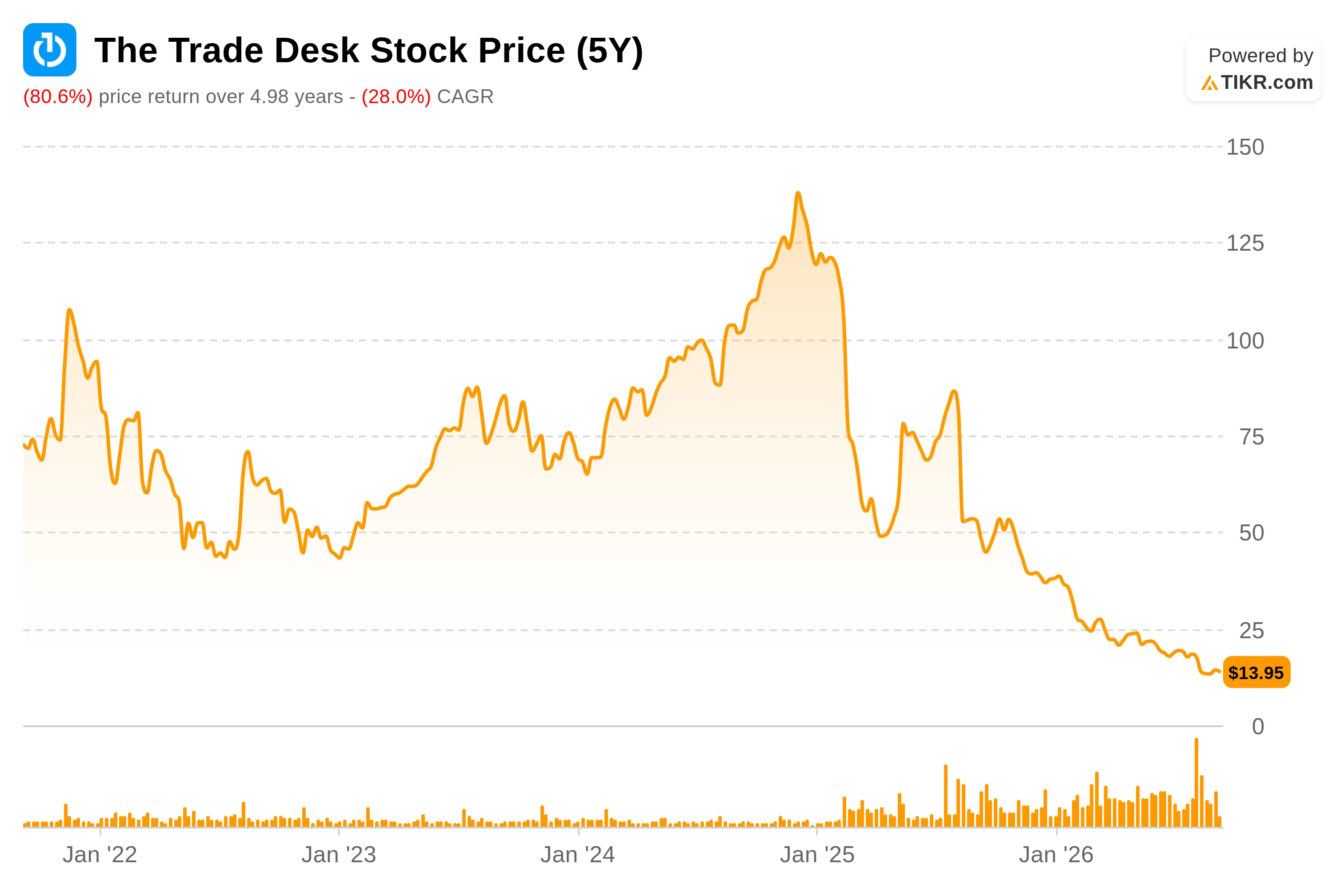
For years, The Trade Desk looked unstoppable. The demand-side ad platform beat its own guidance quarter after quarter, grew revenue at a 28% annual clip from 2020 to 2025, and kept customer retention above 95% for a decade. The stock climbed to a peak of $130.09 in December 2024, and investors paid nearly 90 times forward earnings for the privilege of owning it.
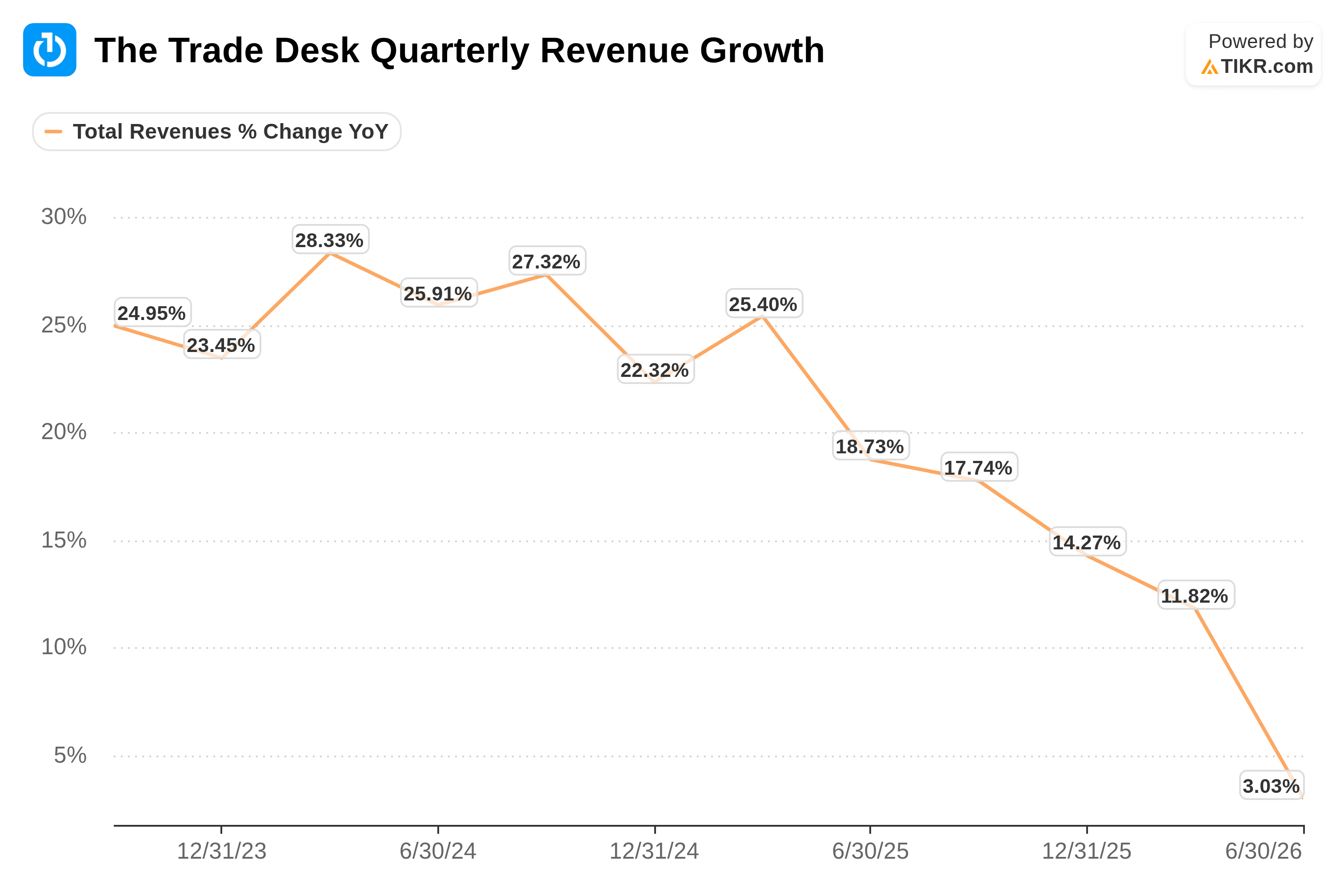
Then the wheels came off. The stock has fallen roughly 90% from that peak to about $14. The second quarter of 2026 delivered the worst news yet: revenue of $715 million, up just 3% year over year, the slowest growth in company history outside the pandemic quarter. Management then guided third-quarter revenue to at least $650 million against Wall Street’s $807 million expectation, implying revenue could actually shrink. The forward P/E has compressed from around 90 to roughly 12.
What went wrong? A drawn-out fee dispute with agency giant Publicis weighed on sales, while Amazon, Google, and other walled gardens seized more ad budgets. HSBC downgraded the stock to Reduce with a $10 price target, and analysts now expect earnings to decline next year.
But CEO Jeff Green says the turnaround is underway. On the earnings calls, he keeps pointing to three catalysts, and a fresh executive team suggests the push is serious.
1. Zuma: the AI upgrade to Kokai
Nearly all clients now run on Kokai, The Trade Desk’s AI-powered platform, and Green says the next leap is Zuma, a major usability upgrade launching this month: “This represents substantial platform usability upgrades and helps us get the best out of AI, which we’ve already added.”
Green also insists The Trade Desk will lead advertising’s “agentic revolution,” and pushes back on the idea that AI will disrupt the DSP model: “I wouldn’t say that the DSP model, if you will, is going to be disrupted by AI. It is AI.” The company announced a partnership with agency Stagwell to use agentic AI to create, edit, and modify campaigns.
2. Retail media becomes a real business
Green claims retailers on the platform now represent more than 80% of U.S. retail sales, including a recently renewed partnership with Walmart, the world’s largest retailer. For perspective, he notes Amazon represents less than 15% of U.S. retail spend.
The company is also unlocking on-site retail media, sponsored listings, through integrations with Koddi and Dollar General, and Lyft chose The Trade Desk to power its off-site advertising. The hire of Kristi Argyilan, the architect of Target’s Roundel retail media business, as chief commercial officer signals how seriously management takes this.
3. CTV, audio, and new data products
Connected TV and audio grew double digits again in Q2, with audio now the fastest-growing channel at over 7% of the business. The Trade Desk keeps expanding its Spotify partnership and is pushing Ventura, its operating system for CTV. A new AI data product, Audience Unlimited, is in open beta with “very encouraging results,” cutting costs by more than 25% in early campaigns.
Longer term, Green sees AI search engines like ChatGPT and Gemini unlocking ad inventory that expands his total addressable market: “I think this represents a tremendous opportunity for us.”
The honest part
None of this is guaranteed. Revenue growth has decelerated from 25% to 18% to 14% to 12% to 3% over the last five quarters, and competition from the walled gardens is not going away.

But the company is still hugely profitable, with operating margins near 20% and about $1.5 billion in cash against no net debt. That buys time, and the valuation no longer assumes perfection: at roughly 12 times forward earnings, the stock is priced for disappointment, not for a turnaround.
This article is for informational purposes only and is not investment advice. Data as of September 2026. Do your own research before making any investment decision.