Key Takeaways for Eli Lilly Stock as of September 2026
- 12-Month Rally: Eli Lilly stock has climbed 50% over the past year, fueled by a Q2 that posted 48% revenue growth and a full-year guidance raise to $85 billion to $87 billion.
- Model Upside: TIKR sees $1,987 by 2030, a 77% total return.
- Bullish Tilt: The Street carries 18 buy ratings, 6 outperforms and 4 holds on Eli Lilly stock, and its $1,319 mean target sits 17% above the current price.
- Coverage Expansion: The Medicare GLP-1 Bridge program added 20 million eligible seniors on July 1, and Foundayo’s prescriber base grew from 8,000 to 36,000 in a single quarter.
Why Eli Lilly Stock Has Climbed 50% in the Past Year
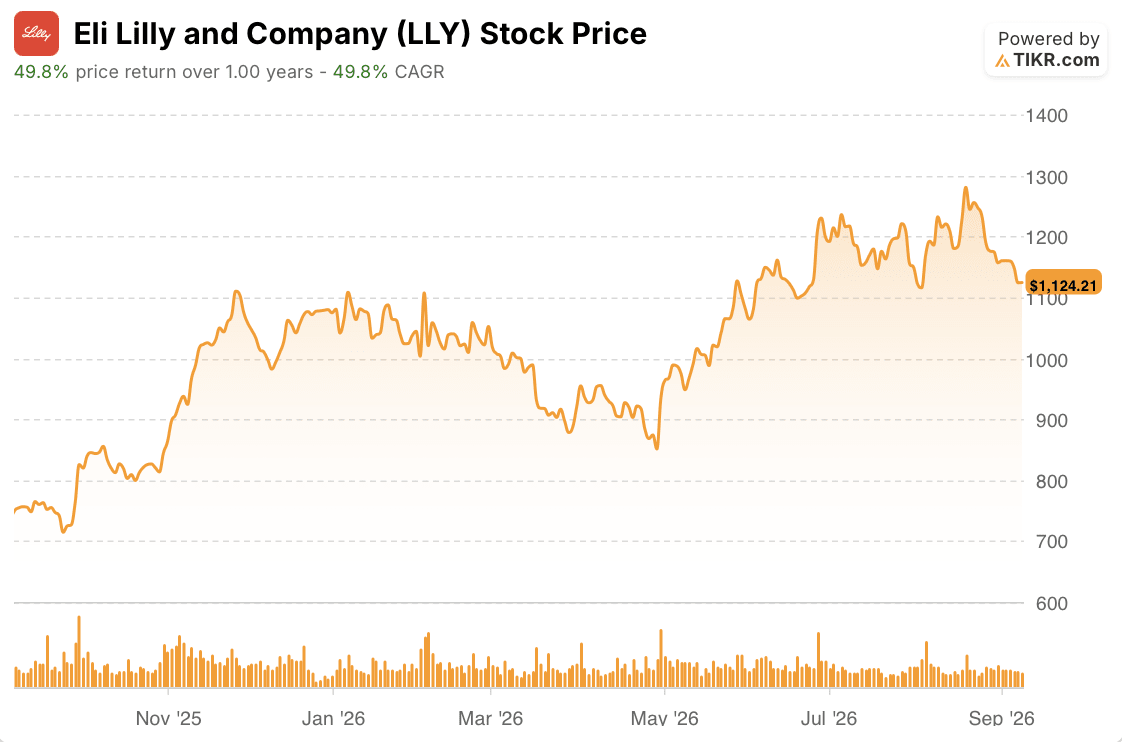
Eli Lilly (LLY) stock has gained 50% over the past twelve months, and the clearest marker behind that run sits inside a single earnings report. On August 5, Lilly posted second-quarter revenue growth of 48% year over year, with non-GAAP earnings per share of $8.38 against a Street estimate of $6.01, and management raised full-year revenue guidance by $2.5 billion to a range of $85 billion to $87 billion.
Zepbound and Mounjaro alone added $6.3 billion of that quarter’s growth, combining for $14.9 billion in revenue. CFO Lucas Montarce framed the guidance change on the Q2 earnings call: “We have increased the low end of our revenue range by $3 billion, and the high end by $2 billion, reflecting a strong underlying performance of our Key Products in the first half of 2026.” A guide-up that size, stacked on a quarter that beat consensus EPS by 39%, is what turns a good stock into one the market keeps re-rating.
The climb has not been a straight line. Eli Lilly stock consolidated between March and May, pulling back from levels near $1,100 into the $900s, before reclaiming that ground once second-quarter numbers landed in August. TIKR’s own model shows why the move held: Lilly’s price-to-earnings multiple actually contracted 2.3% over the trailing year, so the entire climb traces back to earnings growth rather than a richer valuation.
That distinction matters for anyone pricing the stock today. A rally built on multiple expansion is fragile once sentiment cools. One built on 48% revenue growth and a raised guide is a different animal, and it’s the reason the Street has kept its ratings skewed bullish through the run.
Medicare Bridge and Foundayo Give Eli Lilly Stock New Legs
The August print had a sequel. On July 1, the Medicare GLP-1 Bridge program went live, opening coverage to 20 million eligible seniors at $50 a month, and Ilya Yuffa, president of Lilly USA, told analysts that 60% to 70% of enrollees are new to therapy. That is fresh volume layered onto a market Lilly already leads.
Foundayo, the oral GLP-1 pill known chemically as orforglipron, is compounding that effect. Yuffa said the prescriber base grew from 8,000 at the prior quarter’s call to 36,000, and that prescription volume nearly doubled in the last week of July alone. With Foundayo now approved in the UAE, Saudi Arabia and Mexico and under review in more than 40 other markets, the growth that drove the past year’s run still has room to compound.
Wall Street Keeps Raising Its Target on Eli Lilly Stock
Eli Lilly stock carries 18 buy ratings, 6 outperforms and 4 holds as of September 9, with 1 underperform and 1 sell rounding out coverage. Separately, 29 analysts publish a price target, and their mean sits at $1,319, which is 17% above the current $1,124 share price.
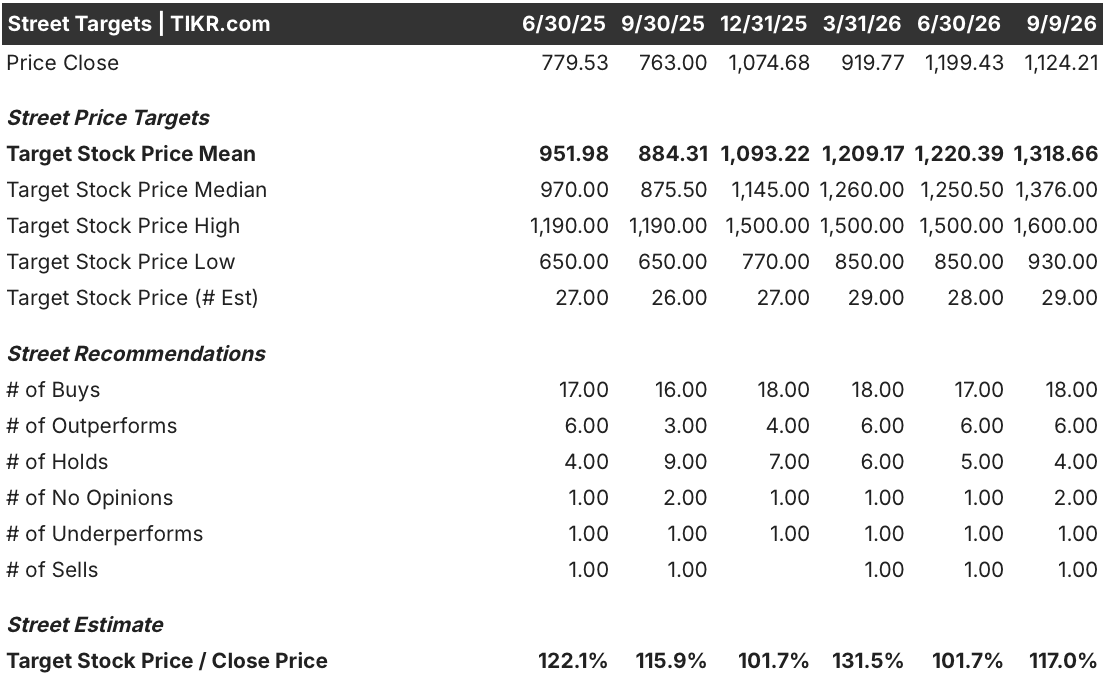
That gap has held steady rather than raising a red flag. A year earlier, on September 30, 2025, the mean target stood at $884 against a $763 close, a 16% premium roughly in line with today’s spread. Over the twelve months since, the mean target rose 49%, slightly ahead of the stock’s 47% climb over the same stretch, and holds on the stock fell from 9 to 4 while buys grew from 16 to 18. Analysts raised numbers into this rally rather than chasing it from behind, a different and more durable signal than a target catching up to a price that already ran.
TIKR Values Eli Lilly Stock at $1,987, Well Above Current Levels
TIKR’s mid-case model values Eli Lilly at $1,987 by December 2030, implying a 77% total return from the current price of $1,124, or 14% annualized over roughly 4.3 years.
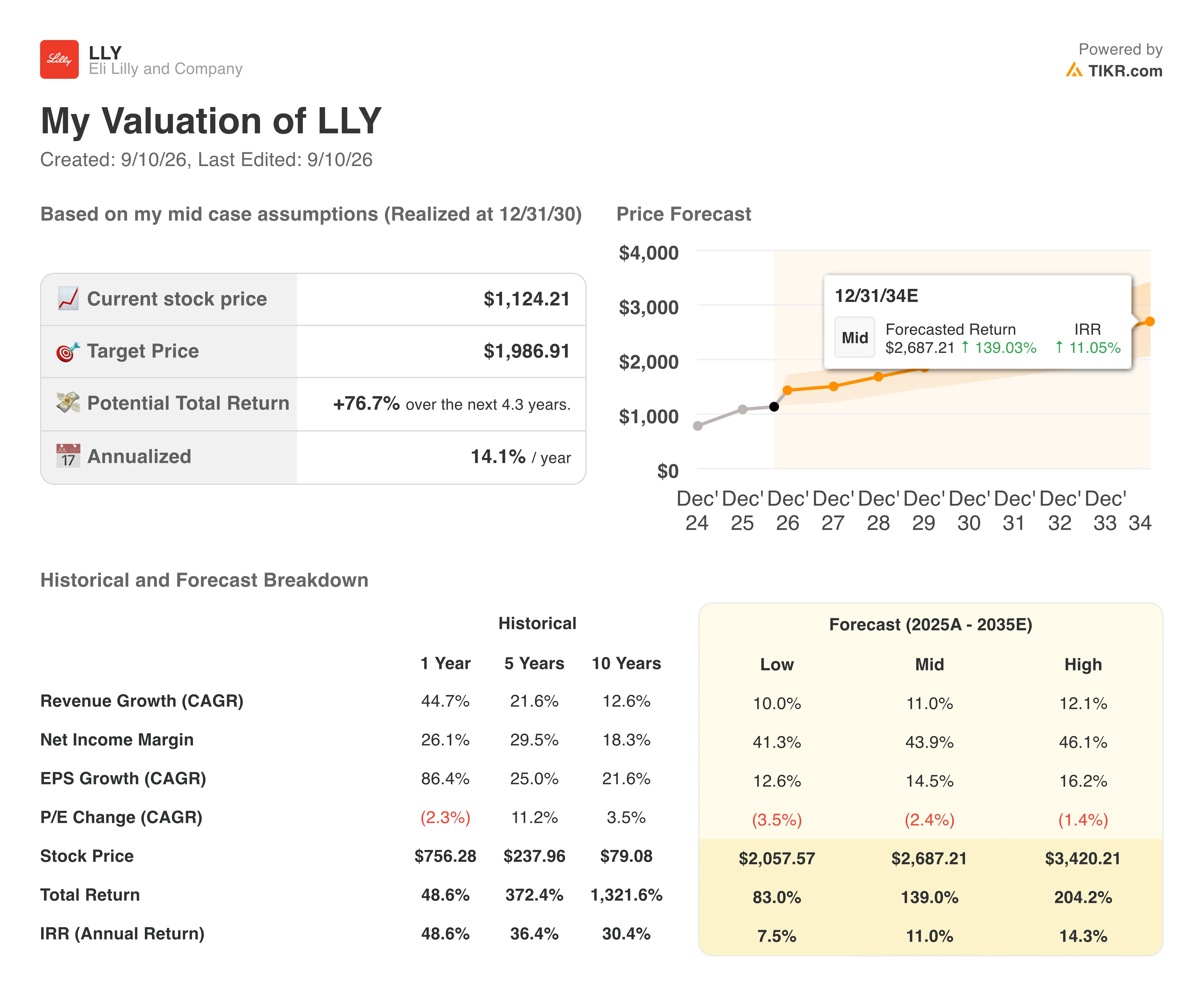
That annualized rate sits well above what a mega-cap pharmaceutical name has historically delivered, reflecting a business TIKR still expects to compound earnings at a double-digit clip years after this rally began.
The model’s gap tracks the Street’s own math: analysts already see 17% upside from current levels, and TIKR extends that same earnings trajectory, the one that delivered 48% revenue growth and an August guidance raise, out through the rest of the decade.
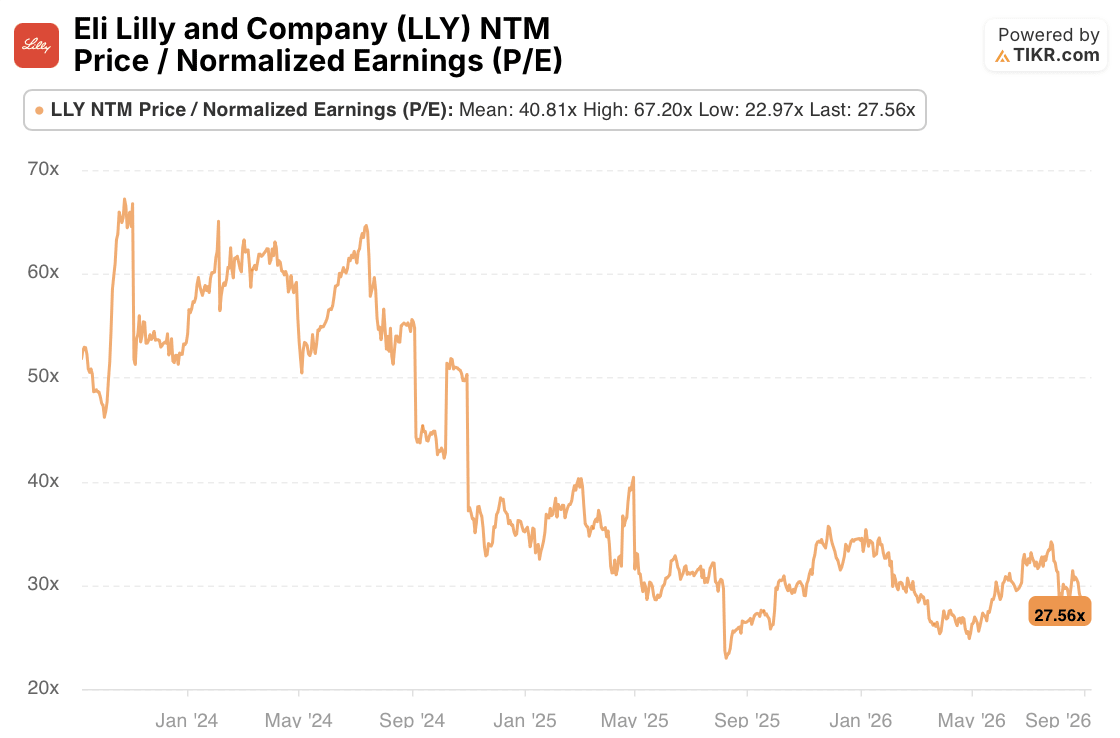
The stock’s own multiple confirms as much. Lilly trades at 28x forward earnings today, well below its two-year mean of 41x and barely above the 23x low from that stretch, so TIKR’s target does not require investors to pay a richer multiple than they already do.
Should You Invest in Eli Lilly and Company?
The only way to really know is to look at the numbers yourself. TIKR gives you free access to the same institutional-quality financial data that professional analysts use to answer exactly that question.
Pull up Eli Lilly and Company stock and you’ll see years of historical financials, what Wall Street analysts expect for revenue and earnings in the quarters ahead, how valuation multiples have moved over time, and whether price targets are trending up or down.
You can build a free watchlist to track Eli Lilly and Company alongside every other stock on your radar. No credit card required. Just the data you need to decide for yourself.
Access Professional Tools to Analyze LLY stock on TIKR for Free →
Looking for New Opportunities?
- See what stocks billionaire investors are buying so you can follow the smart money.
- Analyze stocks in as little as 5 minutes with TIKR’s all-in-one, easy-to-use platform.
- The more rocks you overturn… the more opportunities you’ll uncover. Search 100K+ global stocks, global top investor holdings, and more with TIKR.
Disclaimer:
Please note that the articles on TIKR are not intended to serve as investment or financial advice from TIKR or our content team, nor are they recommendations to buy or sell any stocks. We create our content based on TIKR Terminal’s investment data and analysts’ estimates. Our analysis might not include recent company news or important updates. TIKR has no position in any stocks mentioned. Thank you for reading, and happy investing!