

Few corners of the market generate as much everyday-investor chatter as quantum computing. On any given week, IonQ, Rigetti Computing, and D-Wave Quantum rank among the most discussed tickers in retail investing forums, and their stock prices swing like few others: 50%-plus moves in both directions are part of the routine.
The excitement is understandable. Quantum computing could be an extremely important technology story of the next two decades. But before you buy the story, it helps to understand exactly what these companies are, and what they are not. This is a guide to evaluating them the way a careful investor should: not on hype, but on cash, burn, and dilution.
What quantum computing actually is
A quantum computer is an experimental kind of computer that processes information in a fundamentally different way from the phone or laptop you are reading this on. Regular computers store everything as bits, ones and zeros. Quantum computers use qubits, which can hold many states at once. That difference could one day let them solve certain problems that regular computers effectively cannot, things like simulating molecules for drug discovery or optimizing enormously complex logistics networks.
The key phrase is “one day.” Broad commercialization is still years away. In a survey of 48 quantum experts, Fast Company found that even optimists describe the industry as being in a “premarket phase.” As one investor put it: until a quantum computer solves a commercially useful problem that classical computers cannot, there isn’t really a market, just competing bets on how to get there. When Nvidia’s CEO said in early 2025 that “truly useful” quantum computers were still two decades away, quantum stocks cratered in a single session. They later recovered, but the episode showed how far these valuations run ahead of the technology.
So be clear-eyed about what you are buying: not a proven business, but a funded science experiment with a stock ticker.
Why normal valuation does not work here
These are speculative, early-stage companies that make very little money today. Last quarter, IonQ did about $80 million in revenue. Rigetti did about $5 million. D-Wave did about $3 million. Price-to-earnings ratios are meaningless when there are no earnings, and price-to-sales ratios produce absurd numbers. D-Wave has at times traded at a price-to-sales ratio above 1,000.
Mention valuation for these names only with a strong warning attached: any multiple you compute is a measure of hope, not of value.
Instead, the numbers that matter are about survival and funding:
- How much cash does the company have? Cash is runway. It determines how long the company can keep operating without help.
- How fast is it burning through that cash? Compare the cash pile against quarterly operating cash flow. A company burning $70 million a quarter with $540 million in the bank has roughly two years before it needs more money.
- How often does it sell new shares to stay funded? Quantum companies fund themselves by issuing stock, often through at-the-market (ATM) programs that let them dribble new shares into the market. In 2025 alone, four pure-play quantum companies issued a combined $4.15 billion in stock: IonQ ($2 billion), Rigetti ($350 million), D-Wave ($550 million), and Quantum Computing Inc. ($1.25 billion). Every new share dilutes existing shareholders, and there is no reason to assume the dilution stops.
How to find names like these in TIKR
You do not need to rely on forum tips to find emerging-tech stocks. In TIKR, open the Screener and build the search yourself. A screen that surfaces quantum-type names looks something like this: U.S.-listed technology companies, market capitalization between $1 billion and $20 billion, trailing-twelve-month revenue under $500 million, and cash and investments above $300 million. That combination, small but valuable, tiny revenue, large cash pile, is the fingerprint of a pre-revenue technology bet.
Once you have your list, open each company’s Financials tab. The balance sheet shows cash and investments; the cash flow statement shows operating cash flow, which is the burn rate. Then open the Estimates tab and count the analysts. Fewer than 20 analysts covering a multi-billion-dollar company tells you something important: the professional research community considers the story too unproven to staff heavily.
Now let’s apply that framework to the three names retail investors watch most closely.
1. IonQ (IONQ): The best-funded bet
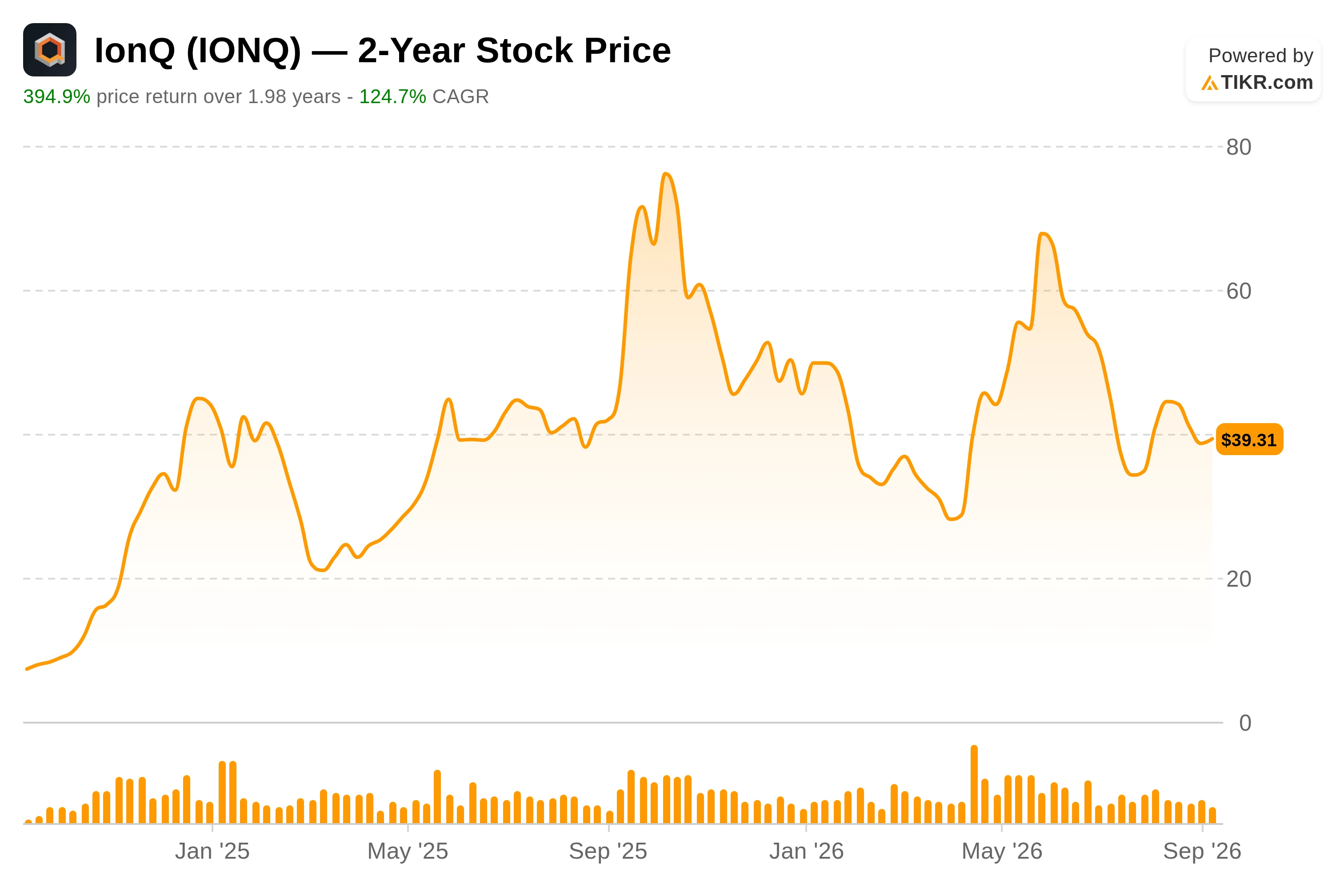
IonQ builds quantum computers using trapped-ion technology, which its supporters argue produces fewer errors than rival approaches. It is the largest and best-funded of the pure plays, and the closest to generating real revenue.
The second quarter of 2026 was its strongest yet: revenue of $80.1 million, up 287% year over year, with full-year guidance raised to $280-290 million. Remaining performance obligations, contracted work not yet recognized as revenue, reached $485 million.
On the survival metrics, IonQ is in a league of its own. TIKR’s Financials tab shows about $2.1 billion in cash and short-term investments at the end of the second quarter. (The company cites $3.0 billion including longer-dated investments, and about $2.0 billion on a pro-forma basis after its $1.8 billion acquisition of chipmaker SkyWater Technology, which closed in July.) Against quarterly operating cash burn of roughly $100 million, that is about five years of runway.
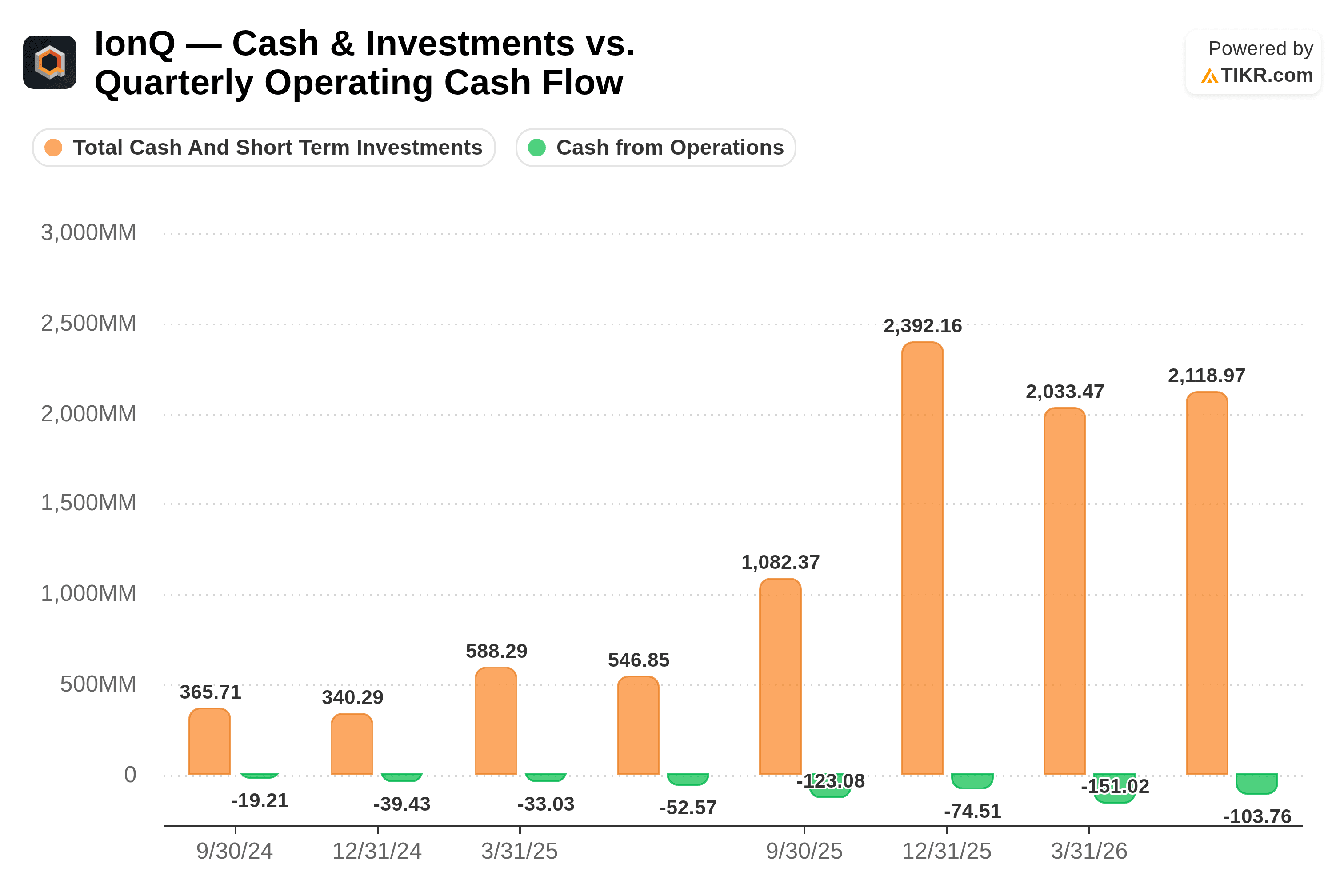
The catch is dilution and valuation. IonQ funded that war chest by selling about $2 billion of stock in 2025, and its market capitalization sits near $15 billion against guided revenue under $300 million, a price-to-sales multiple above 50. The balance sheet is a fortress; the valuation assumes the fortress gets stormed by customers. Roughly eight analysts publish estimates on TIKR’s Estimates tab, the most engaged coverage of the three names here, but still a thin bench compared with the 30-plus analysts covering large-cap tech.
2. Rigetti Computing (RGTI): Real hardware, tiny revenue
Rigetti takes a different technical path, superconducting qubits, and unlike most peers it actually sells whole quantum computers. Its 9-qubit Novera systems ship to government labs, universities, and commercial customers, and second-quarter revenue rose 185% to $5.1 million on those system sales.
But $5 million a quarter is a rounding error next to a $5 billion market capitalization, and the operating loss widened to $28.1 million as R&D spending climbed. The company ended June with roughly $394 million in cash and investments and no debt, which covers several years of cash burn at the current quarterly rate of about $16 million. Then, in early September, Rigetti signed a $100 million CHIPS Act award with the Department of Commerce, which will take a minority equity stake in return, a genuine vote of confidence from Washington, though as the saying goes, government funding advances research; it does not create a viable business.
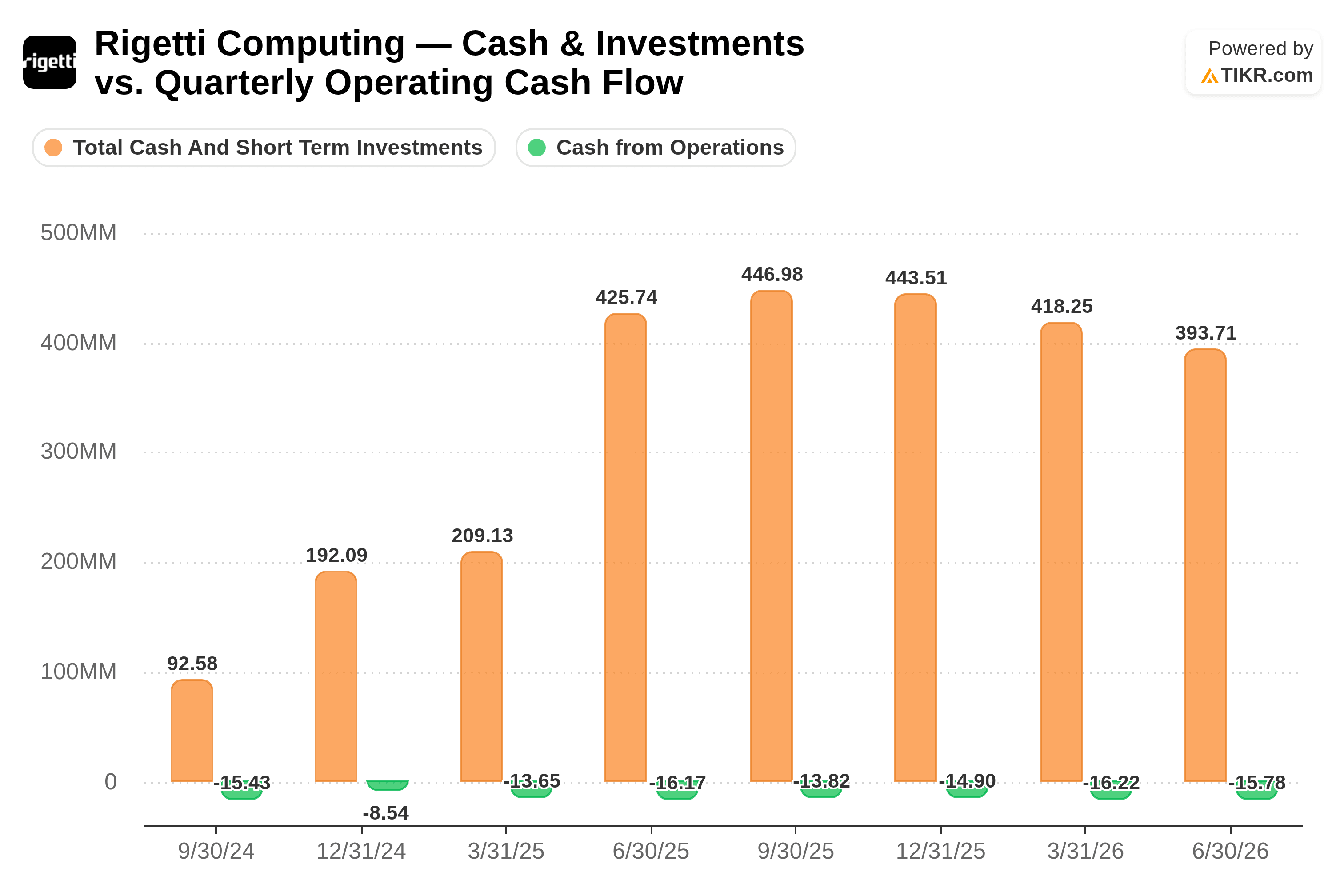
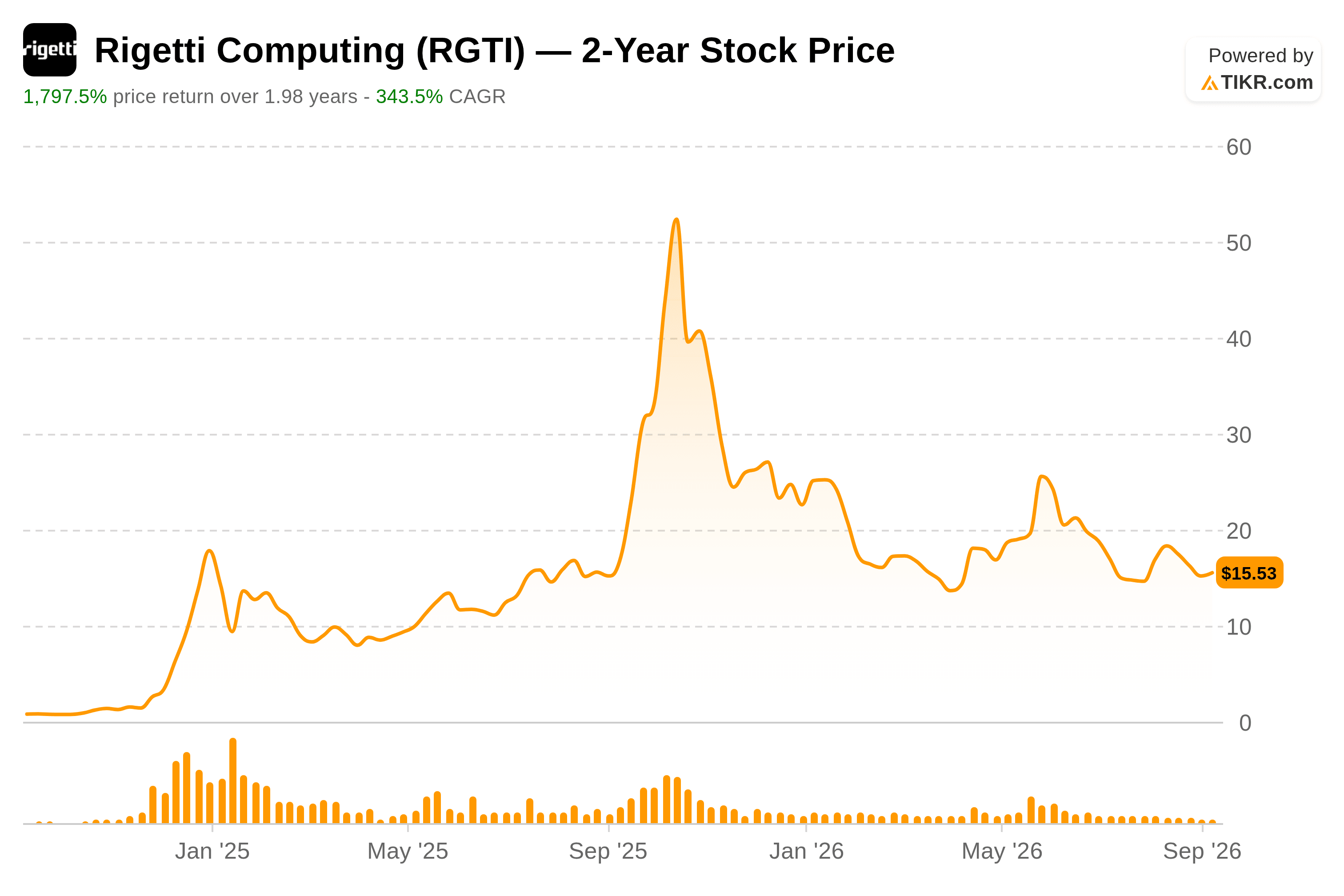
Watch the dilution. Rigetti raised $350 million through an at-the-market share program in 2025, and the stock’s history tells the retail story: a 52-week range of roughly $12.50 to $58, with shares down about 30% year to date despite the government news. This is the most volatile of the three, which is precisely why it stays on retail watchlists. About thirteen analysts publish estimates, so treat any price target as a rough sketch, not a forecast.
3. D-Wave Quantum (QBTS): momentum in bookings, not yet in revenue
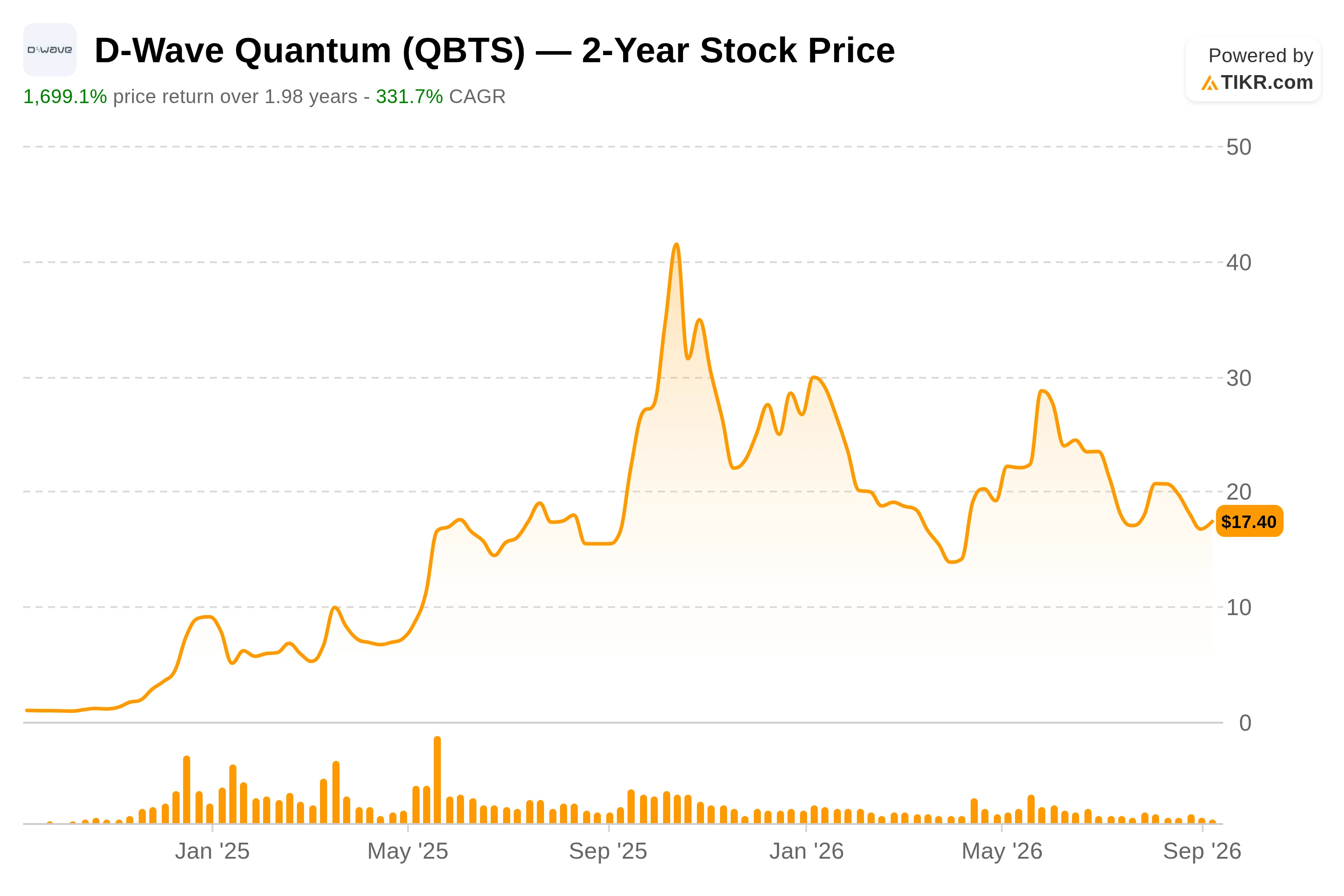
D-Wave is the veteran of the group and takes yet another approach, quantum annealing, a specialized method aimed at optimization problems rather than general-purpose computing. It also sells access to its systems by subscription, which gives it the most “software-like” revenue of the three.
The second quarter showed both the promise and the problem. Recognized revenue was just $3.1 million, down slightly year over year and well short of estimates, and the stock fell more than 9%. But bookings tell a livelier story: first-half bookings surged more than 1,100% to $35.5 million, including a $20 million system sale to Florida Atlantic University, and remaining performance obligations hit $40.7 million.
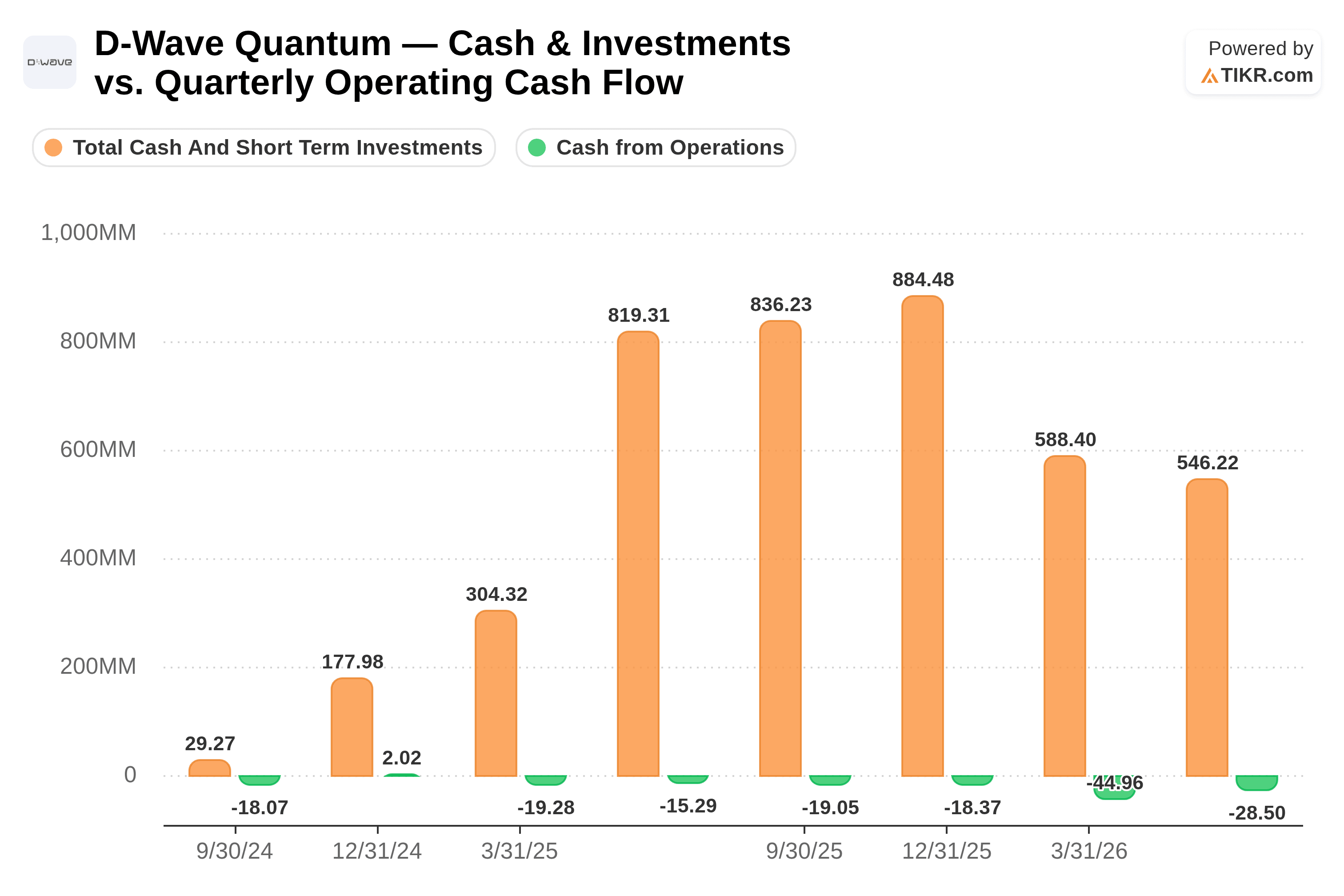
On funding, D-Wave ended June with $546 million in cash and marketable securities, down by a third from a year earlier mostly because of its Quantum Circuits acquisition. The burn is real: operating cash outflow was about $29 million in the quarter, a pace that gives the company roughly four to five years of runway. And the dilution treadmill keeps turning. D-Wave sold $550 million of stock through ATM programs in 2025, shares outstanding rose from about 359 million to 372 million in the first half of 2026, and the company has filed for another $330 million shelf. Add a CFO resignation in late August, and you have the full speculative package: real technology progress wrapped in real financial fragility.
The survival checklist
If you are tempted by any of these names, run through this checklist first, all of it available in TIKR’s Financials and Estimates tabs:
- Cash runway. Divide cash and investments by the quarterly cash burn. Under two years of runway means a dilutive raise is likely coming.
- Dilution trend. Chart shares outstanding over time. If it climbs every quarter, you are paying for the company’s R&D with your ownership percentage.
- Bookings vs. recognized revenue. Backlog (remaining performance obligations) shows demand; recognized revenue shows delivery. Both matter, but only one pays the bills today.
- Analyst coverage. A handful of analysts means thin professional scrutiny. Do your own work.
- Position size. These are call options on a technological breakthrough, not core holdings. Size them so that a 70% drawdown, which has happened to all three, does not change your life.
Quantum computing may indeed change the world. But the history of transformative technology is littered with visionary companies whose early shareholders still lost everything through dilution and delay. Focus on survival and funding, keep positions small, and let the cash flow statement, not the forum thread, tell you when the story is actually working.
Looking for New Opportunities?
- See what stocks billionaire investors are buying so you can follow the smart money.
- Analyze stocks in as little as 5 minutes with TIKR’s all-in-one, easy-to-use platform.
- The more rocks you overturn… the more opportunities you’ll uncover. Search 100K+ global stocks, global top investor holdings, and more with TIKR.
This article is for informational purposes only and is not investment advice. Data as of September 2026. Do your own research before making any investment decision.


