Key Stats for Carnival Corporation Stock
- Current Price: $25.99
- Target Price (Mid): ~$53
- Street Target: ~$35
- Potential Total Return: ~104%
- Annualized IRR: ~17% / year
- Earnings Reaction: (0.95%) on March 27, 2026
- Max Drawdown: 29.71% on 5/19/26
Now Live: Discover how much upside your favorite stocks could have using TIKR’s new Valuation Model (It’s free) >>>
What Happened?
Carnival Corporation (CCL), the world’s largest cruise operator, dropped 6.27% on June 10, 2026, its worst single-day decline in months, and the selloff had nothing to do with cruise demand.
The trigger was a data breach. According to a data breach notice filed with the Maine Attorney General, the attack began around April 10, 2026, when an unauthorized actor used social engineering to access a limited portion of Carnival’s IT system. The company identified the intrusion on April 14. The Maine AG filing puts the total number of affected individuals at 5,995,277, or nearly 6 million. Carnival began notifying those individuals on May 27. Wider media coverage on June 10 reignited concern about litigation costs and reputational damage, adding fuel to a risk-off market day.
That pressure now layers on top of a year already under strain. Fiscal 2026 EPS guidance of $2.21 (per management’s March 27 earnings call) sits below the $2.25 reported in fiscal 2025, almost entirely because of a $500 million fuel headwind. Against that, nearly 85% of 2026 is already booked at historically high prices, customer deposits reached nearly $8 billion in Q1, and management’s PROPEL plan targets more than 50% EPS growth versus 2025 by 2029.
The TIKR model weighs in at a mid-case target of approximately $53 by November 2030, implying around 104% total return from the current price.
What the June 10 Drop Actually Means
The 6.27% decline had two parts. Broad equity markets retreated ahead of a U.S. inflation data release, and high-beta consumer names took the heaviest losses. At the same time, coverage of the April breach widened, with analysts flagging potential remediation costs, regulatory scrutiny, and litigation exposure.
Context matters here. Carnival’s 10-Q filed March 27, 2026, states that costs from cyber incidents over the prior three years were not material to its consolidated results. The current breach involved a limited portion of the IT system, not the core reservation or payment infrastructure. Carnival is also offering affected individuals 24 months of complimentary credit monitoring, per the Maine AG filing.
The practical effect: CCL now sits roughly 24% below its 52-week high of $34.03 and within range of its 52-week low of $22.11, per TIKR. At $25.99, the stock trades at 8.52x NTM EV/EBITDA and 11.95x NTM P/E, near the low end of its recent range.

See historical and forward estimates for Carnival Corporation stock (It’s free!) >>>
Record Operating Results, One Ugly Line Item
Q1 2026 was operationally exceptional across every metric except the fuel line. Revenue of $6.165 billion beat the street estimate by 0.43% per TIKR. Net income of $275 million came in more than 55% above the prior year and $40 million above December guidance. Adjusted EPS of $0.20 beat the $0.18 consensus by 8.94%. Free cash flow reached $697 million, nearly double the $318 million from Q1 a year earlier.
Demand metrics back this up. With 85% of 2026 booked at historically high prices, bookings up 10% year over year, and customer deposits of nearly $8 billion (up ~10% from the prior year’s record), the revenue line is unusually visible. The booking curve has extended into 2028 with cumulative future-year bookings reaching a first-quarter record.
CEO Josh Weinstein explained the structural shift on the March 27 call: “Guests are engaging earlier in the vacation journey, purchasing more inclusive packages, excursions and other experiences before they even step on board.” Pre-cruise purchasing front-loads revenue and reduces the onboard volatility that has historically made cruise stocks hard to own.
The problem is fuel. CFO David Bernstein laid out the math: $0.11 of operational improvement for the full year, more than offset by a $0.38 per share fuel headwind. Guidance assumes Brent crude at $90 in April-May, $85 in Q3, and $80 in Q4. Weinstein noted that consumption efficiency improvements already save approximately $650 million versus 2019 levels, which more than offsets the gross dollar impact of the current spike.
What PROPEL Actually Says
PROPEL (Powering Growth and Returns, Responsibly) sets Carnival’s targets through 2029: return on invested capital above 16%, EPS growth of more than 50% versus 2025, more than $14 billion returned to shareholders, and a net debt target of 2.75x EBITDA. Management also authorized an initial $2.5 billion buyback, with Bernstein making clear on the call: “Over this period with $14 billion of expected shareholder returns, there’ll be additional stock buybacks.”
Weinstein identified four drivers: improved commercial operations through marketing, revenue management, and personalization technology; just three new ships entering service during the PROPEL period across a 96-ship fleet; monetization of the private destination network; and continued cost discipline.
The destination piece is underappreciated. Carnival is building a Caribbean network, including Celebration Key, Grand Bahama, RelaxAway at Half Moon Cay, and Isla Tropicale in Roatan, alongside its Alaska footprint. As Weinstein put it: “We are looking to create a bit of a strategic fence for ourselves where we have great opportunities to go to great places that are very, very close to the home ports that we sail from.” These assets generate incremental per-guest revenue while cutting fuel consumption, a margin driver that compounds throughout the plan.
On AI, Weinstein addressed whether it could commoditize cruise pricing and undercut Carnival’s internal revenue management system (YODA). His answer: “AI has the opportunity to be harnessed for the benefit of supercharging what we do, including how we manage YODA. We’re already starting to utilize some pretty advanced technology in how we operate our business on the revenue side.”
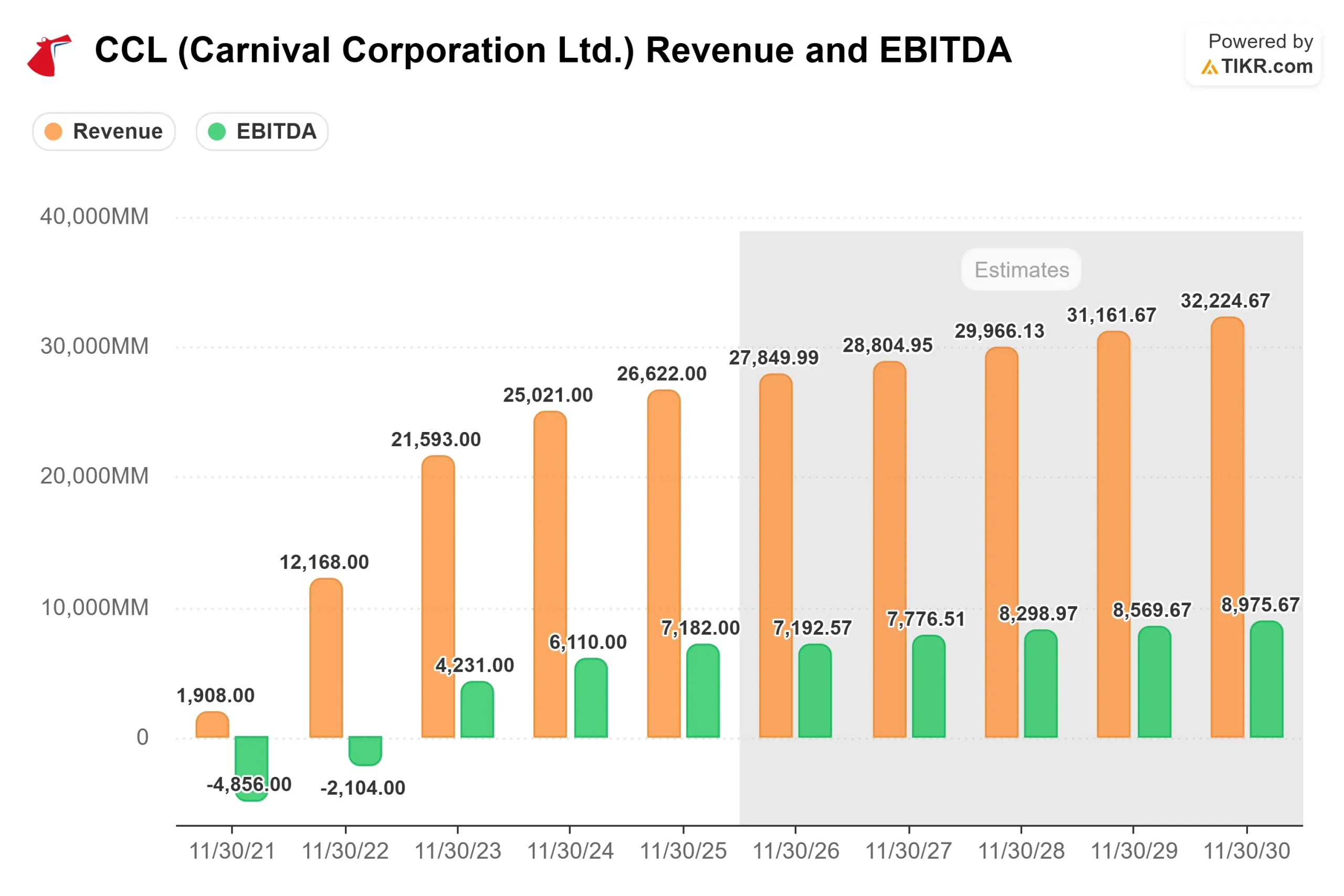
On valuation, CCL trades at a clear discount to peers. Royal Caribbean (RCL) sits at 12.07x NTM EV/EBITDA and 15.32x NTM P/E. Norwegian Cruise Line Holdings (NCLH) sits at 9.52x and 11.90x. CCL at 8.52x NTM EV/EBITDA is the cheapest of the three by that metric, per TIKR’s Competitors page. That discount makes sense for a business with structural problems. It is harder to justify for one generating record bookings, a $7 billion EBITDA run rate, and a credible $14 billion capital return program.
New analyst coverage supports the bull case. Loop Capital initiated with a Buy and a $36 target on June 1, 2026. Street coverage now stands at 18 Buys, 5 Outperforms, and 5 Holds across 28 recommendations tracked by TIKR, with zero Underperforms or Sells. The street mean target of $34.59 implies around 33% upside; the high of $45 implies around 73%.
See how Carnival Corporation performs against its peers in TIKR (It’s free!) >>>
TIKR Advanced Model Analysis
- Current Price: $25.99
- Target Price (Mid): ~$53
- Potential Total Return: ~104%
- Annualized IRR: ~17% / year

See analysts’ growth forecasts and price targets for Carnival Corporation stock (It’s free!) >>>
The mid-case uses a revenue CAGR of around 4% from fiscal 2025 to fiscal 2030 per TIKR, consistent with the “moderate yield growth” framing management used for PROPEL. The two revenue drivers are yield expansion across ticket pricing and onboard spending, and incremental revenue from the private destination portfolio as it ramps to full capacity.
The margin driver is net income margin expanding from around 11% in fiscal 2026 to approximately 14% by fiscal 2030, per TIKR estimates, reflecting consumption efficiency gains, decelerating cost growth, and the operating leverage of a near-fixed capacity base.
The primary downside risk is fuel. A 10% move in fuel cost per metric ton impacts the bottom line by approximately $160 million or $0.11 per share for the remainder of fiscal 2026, per Bernstein’s stated sensitivity. Sustained high fuel slows the margin expansion that the model depends on. The cybersecurity incident adds a smaller but real risk: remediation costs, regulatory exposure, and a harder-to-model effect on near-term bookings.
At $25.99, even the model’s low-case assumptions (around 11% IRR per TIKR) produce meaningful appreciation from a price already near the stock’s one-year floor.
Conclusion
Carnival’s current price reflects a market pricing in lasting damage from fuel costs and now a data breach. The Q1 operating data says something different.
The verdict arrives June 30. Management guided Q2 net yield growth of approximately 2% in constant currency. A print above 2.5% confirms demand is intact and fuel is temporary. A print below 1.5%, especially alongside any booking softness tied to the cybersecurity incident, hands the bears a real catalyst. That one number will either validate the PROPEL setup or raise a legitimate question about whether the current discount is deserved.
June 30 is 19 days away.
See what stocks billionaire investors are buying so you can follow the smart money with TIKR.
Should You Invest in Carnival Corporation?
The only way to really know is to look at the numbers yourself. TIKR gives you free access to the same institutional-quality financial data that professional analysts use to answer exactly that question.
Pull up Carnival Corporation, and you’ll see years of historical financials, what Wall Street analysts expect for revenue and earnings in the quarters ahead, how valuation multiples have moved over time, and whether price targets are trending up or down.
You can build a free watchlist to track Carnival Corporation alongside every other stock on your radar. No credit card required. Just the data you need to decide for yourself.
Analyze Carnival Corporation on TIKR Free →
Looking for New Opportunities?
- See what stocks billionaire investors are buying so you can follow the smart money.
- Analyze stocks in as little as 5 minutes with TIKR’s all-in-one, easy-to-use platform.
- The more rocks you overturn… the more opportunities you’ll uncover. Search 100K+ global stocks, global top investor holdings, and more with TIKR.
Disclaimer:
Please note that the articles on TIKR are not intended to serve as investment or financial advice from TIKR or our content team, nor are they recommendations to buy or sell any stocks. We create our content based on TIKR Terminal’s investment data and analysts’ estimates. Our analysis might not include recent company news or important updates. TIKR has no position in any stocks mentioned. Thank you for reading, and happy investing!