Key Stats for BlueOwl Stock
- 1 Week Price change for BlueOwl stock: -6%
- $OWL Share Price as of Feb. 20: $11
- 52-Week High: $22
- $OWL Stock Price Target: $17
Now Live: Discover how much upside your favorite stocks could have using TIKR’s new Valuation Model (It’s free)>>>
What Happened?
Blue Owl Capital (OWL) stock dropped nearly 6% on Thursday (19th Feb) after the alternative asset manager announced it sold $1.4 billion worth of loan assets from three of its private debt funds.
More troubling for investors, the firm simultaneously revealed it would end regular quarterly liquidity payments to investors in one of its flagship retail-focused funds.
The sale involved loans changing hands at 99.7% of par value to four North American pension and insurance investors.
The biggest chunk came from Blue Owl Capital Corporation II (OBDC II), a semi-liquid private credit fund marketed to U.S. retail investors. OBDC II offloaded $600 million in loans—roughly 34% of its entire $1.7 billion portfolio.
- Here’s where things get concerning for investors. Blue Owl announced that OBDC II will no longer make regular quarterly liquidity payments.
- Instead, the fund will shift to periodic payouts funded by asset sales, earnings, loan repayments, and other one-off transactions. That means, investors just lost predictable access to their money.
- This move tightens restrictions on investor liquidity at a time when private credit firms are already facing questions about transparency and redemption capacity.
- The decision follows increased redemption requests across some Blue Owl business development companies, Bloomberg reported.
It also comes just months after the firm tried and failed to merge OBDC II with its larger, publicly-traded sibling fund—a deal that would have crystallized roughly 20% losses for OBDC II investors before Blue Owl abandoned the plan.
See analysts’ growth forecasts and price targets for OWL stock (It’s free!) >>>
What the Market Is Telling Us About OWL Stock
The market’s negative reaction to Blue Owl Capital stock reflects growing concerns about liquidity management in private credit, especially in products marketed to retail investors who expect semi-liquid access to their capital.
- By halting regular quarterly payments and forcing investors into irregular, opportunistic distributions, Blue Owl is essentially acknowledging it can’t meet redemption demands through normal operations.
- This is the second major liquidity event for OBDC II in recent months. Last November, Blue Owl tried to merge the struggling fund into OBDC, temporarily halting all redemptions until the deal closed.
- Investors pushed back hard against the 20% haircut embedded in that transaction, and Blue Owl eventually scrapped the merger.
Now the firm is taking a different approach—selling assets at near-par and distributing up to $2.35 per share, or roughly 30% of net asset value, back to shareholders.
- Blue Owl framed the transaction positively, with OBDC II president Logan Nicholson calling it an “opportunistic” move that delivers value while maintaining portfolio diversification.
- But the optics are not that good. Selling 34% of a fund’s portfolio in one shot and eliminating predictable liquidity suggests the fund may have been under stress from redemption requests it couldn’t sustainably meet.
- The other two funds involved—OBDC and Blue Owl Technology Income Corp (OTIC)—each sold $400 million in assets, representing 2% and 6% of their portfolios, respectively.
- These are much smaller proportions, suggesting those funds aren’t facing the same redemption pressure as OBDC II.
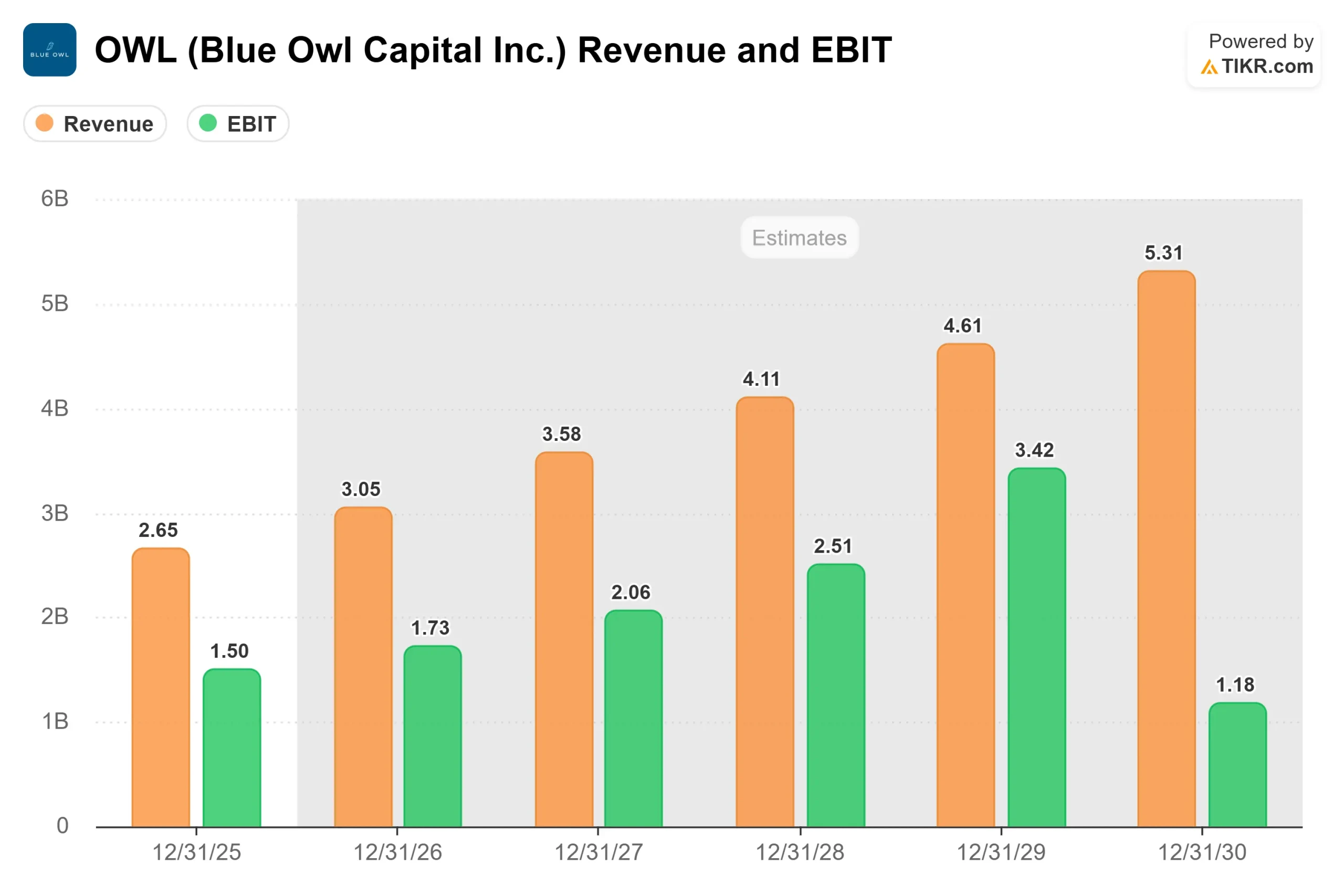
- Blue Owl Capital stock now trades 50% below its 52-week high and is down over 30% year to date.
- Management emphasized during the recent earnings call that it met all tender requests in Q4 and has ample liquidity across products. But actions indicate otherwise.
- When you’re selling billions in assets and eliminating regular distributions, investors interpret that as a sign of weakness, not strength.
The broader issue here is whether private credit firms can successfully operate semi-liquid retail products during periods of market stress.
Blue Owl has been aggressive in expanding into the retail wealth channel, but liquidity challenges could slow that expansion if investors lose confidence in its ability to access capital when needed.
Estimate a company’s fair value instantly (Free with TIKR) >>>
How Much Upside Does OWL Stock Have From Here?
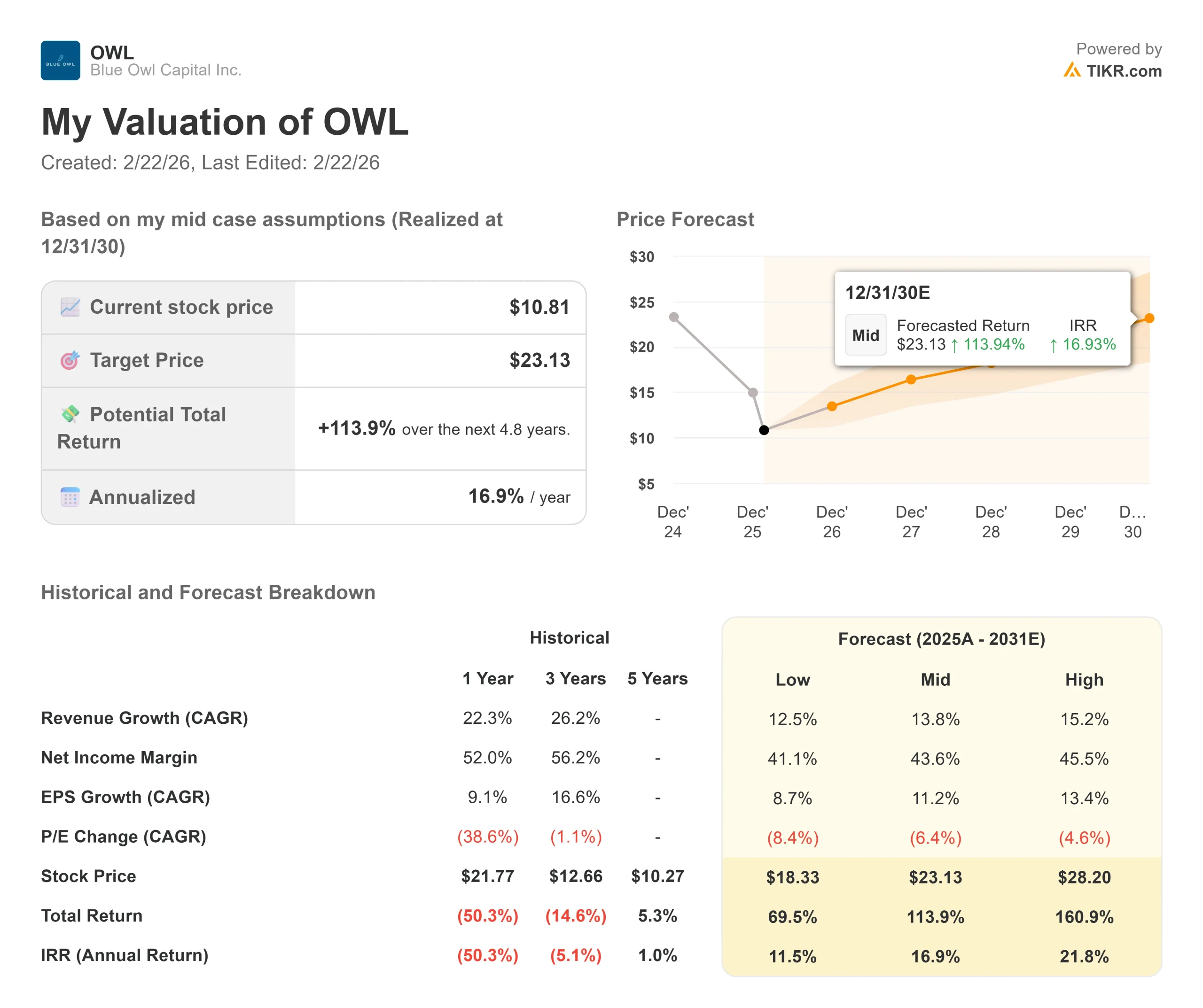
With TIKR’s new Valuation Model tool, you can estimate a stock’s potential share price in under a minute.
All it takes is three simple inputs:
- Revenue Growth
- Operating Margins
- Exit P/E Multiple
If you’re not sure what to enter, TIKR automatically fills in each input using analysts’ consensus estimates, giving you a quick, reliable starting point.
From there, TIKR calculates the potential share price and total returns under Bull, Base, and Bear scenarios so you can quickly see whether a stock looks undervalued or overvalued.
See a stock’s true value in under 60 seconds (Free with TIKR) >>>
Looking for New Opportunities?
- See what stocks billionaire investors are buying so you can follow the smart money.
- Analyze stocks in as little as 5 minutes with TIKR’s all-in-one, easy-to-use platform.
- The more rocks you overturn… the more opportunities you’ll uncover. Search 100K+ global stocks, global top investor holdings, and more with TIKR.
Disclaimer:
Please note that the articles on TIKR are not intended to serve as investment or financial advice from TIKR or our content team, nor are they recommendations to buy or sell any stocks. We create our content based on TIKR Terminal’s investment data and analysts’ estimates. Our analysis might not include recent company news or important updates. TIKR has no position in any stocks mentioned. Thank you for reading, and happy investing!