Key Stats for Bloom Energy Stock
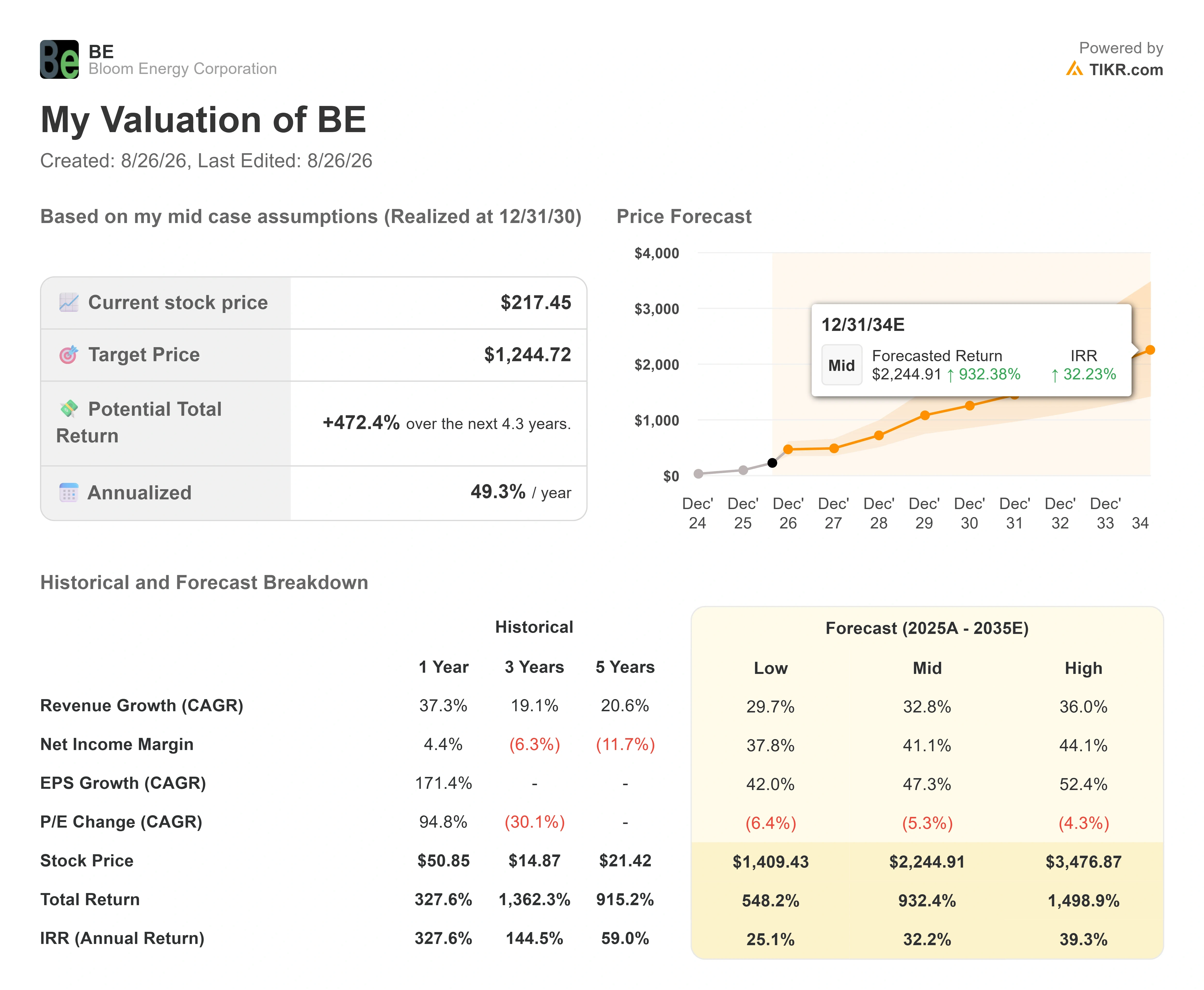
- Current Price: $217.45
- Target Price (Mid): ~$1,245
- Street Target: ~$275
- Potential Total Return: ~470%
- Annualized IRR: ~49% / year
Now Live: Discover how much upside your favorite stocks could have using TIKR’s new Valuation Model (It’s free) >>>
What Happened?
Bloom Energy (BE) closed up 6.58% at $217.45 on August 25, and the headline reason was not a contract or a chip deal. It was a congressional filing. Newly surfaced disclosures showed that Nancy Pelosi’s household bought 15,000 Bloom shares and 200 call options struck at $100 and expiring in June 2027, with the purchases dated July 24 and July 28. Reported value ranges vary by outlet, from roughly $3 million to as much as $14.5 million for the Bloom position, but the more telling detail is the timing: the July 28 buy landed the same day Bloom posted its record quarter, meaning the stake was built into the print, not after a headline. Retail sentiment flipped from bearish to bullish once the filing circulated, though shares had already been climbing through August on that earnings result.
What makes this pop worth a second look is where it landed: on top of the strongest quarter Bloom has ever reported, with a raised outlook that the market is still digesting. The question is whether the fundamentals justify staying once the Pelosi headline fades.
A Record Quarter the Pelosi Headline Nearly Buried
On July 28, Bloom reported its first billion-dollar quarter. Revenue hit $1.065 billion, up 166% year over year and 42% sequentially, with product revenue of $935 million making up nearly 90% of the total. Non-GAAP EPS of $0.78 beat the Street’s $0.41 estimate by more than 90%. Non-GAAP operating income reached $240 million, up 737% from a year earlier, and free cash flow of $175 million came in against a consensus that had modeled a cash burn.
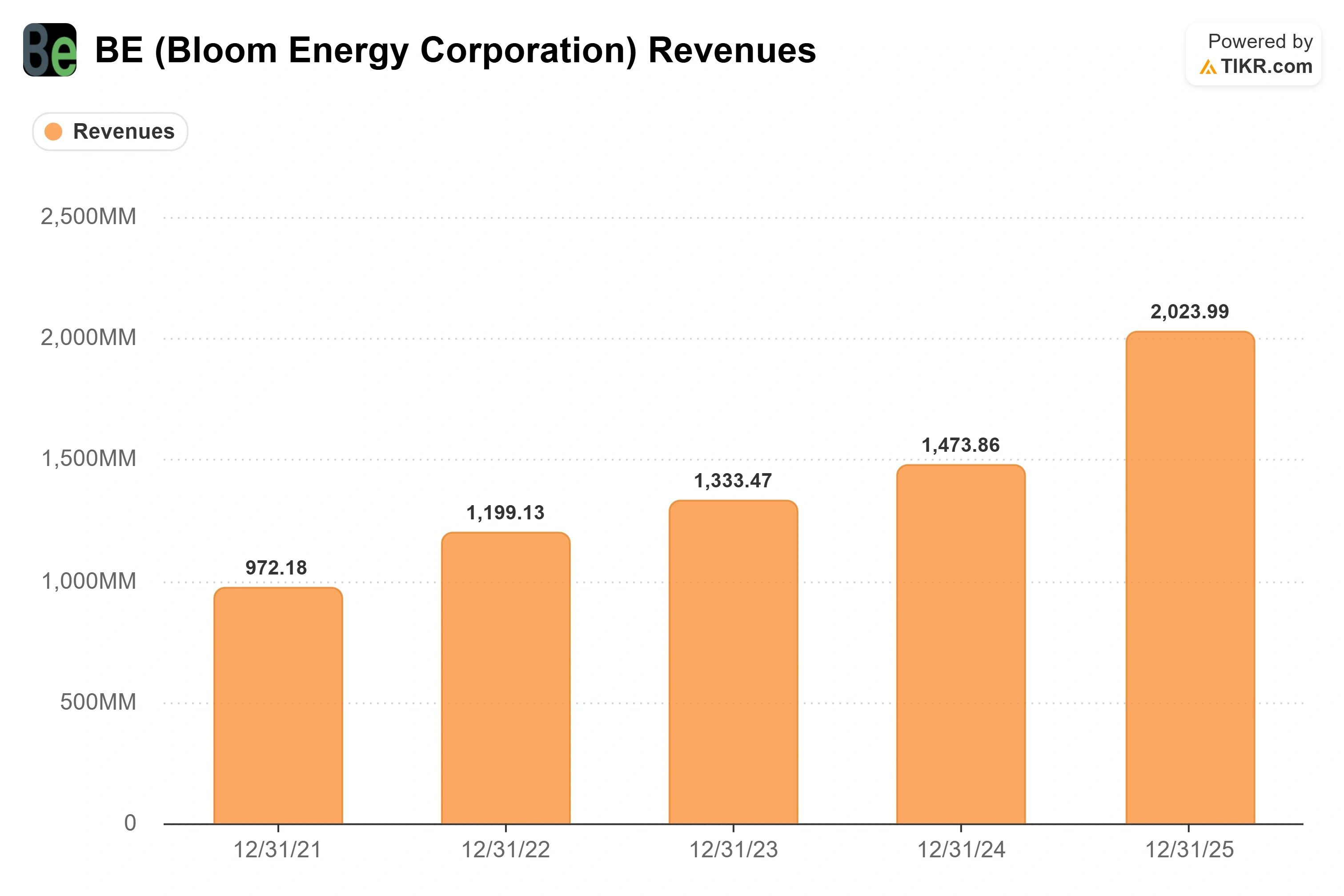
Management then raised full-year 2026 revenue guidance to $3.9 billion to $4.2 billion, which at the midpoint doubles 2025 revenue of just over $2 billion. It also lifted non-GAAP operating income guidance to $800 million to $900 million, nearly double the range set at the start of the year. That is the print the Pelosi trade sat on top of, and it explains why the disclosure moved the stock at all.
CFO Simon Edwards framed the profitability shift as structural. “Revenue grew 166%, while operating expenses grew just 48%,” he told analysts, arguing that Bloom’s largely fixed R&D and G&A base means each incremental gigawatt of deliveries carries little added overhead. That matters because the market’s central worry about Bloom has always been whether volume converts into durable earnings, and this quarter it did.
See historical and forward estimates for Bloom Energy stock (It’s free!) >>>
Why Customers Are Paying Up for Speed
Bloom sells solid oxide fuel cells that generate power on site, letting data centers skip the multi-year wait for a grid connection. CEO K.R. Sridhar put the economics bluntly, explaining that a one-gigawatt AI data center can generate $12 billion to $24 billion in annual revenue for its operator, so pulling power in within a month rather than years is worth $1 billion to $2 billion that would otherwise not exist. Time to power, in his words, “is really time to token revenue.” That pitch has landed: Sridhar said all major U.S. hyperscalers and over a dozen neoclouds and colocation operators have now validated Bloom’s technology, a status it reached in under a year after taking a decade to earn in commercial and industrial markets.
Brookfield expanded its project-financing framework fivefold in June, from $5 billion to $25 billion, an expansion that followed performance rather than promises since Brookfield committed the first $5 billion, watched Bloom deliver, then multiplied its backing. Two August updates reinforced the speed narrative: Bloom launched Power Connect on August 18, a factory-integrated platform it says cuts onsite installation time by more than 40%, and expanded its MiTAC microgrid partnership to roughly 250 megawatts of AI-related capacity across nearly two dozen customers.
At $217.45, Bloom trades at roughly 12.4 times next-twelve-month revenue and about 52 times NTM EV/EBITDA, a steep premium to its electrical-equipment peer group. Fellow fuel-cell names Plug Power and FuelCell Energy both carry negative NTM EV/EBITDA multiples, meaning they remain unprofitable on a forward basis, while Bloom is not. GE Vernova, the more credible long-term threat, trades far cheaper near 4.8 times revenue but is developing competing fuel-cell technology that it does not expect to be ready for two to three years. Bloom’s premium holds only if it converts its validated pipeline into shipped, profitable gigawatts before that window closes. The risks are not hypothetical: a July short-seller report questioned Bloom’s scandium sourcing, allegations that remain unproven and that Bloom rejects, but the episode helped drive a 52.65% peak-to-trough drawdown on July 29.

See how Bloom Energy performs against its peers in TIKR (It’s free!) >>>
TIKR Advanced Model Analysis
- Current Price: $217.45
- Target Price (Mid): ~$1,245
- Potential Total Return: ~470%
- Annualized IRR: ~49% / year
See analysts’ growth forecasts and price targets for Bloom Energy stock (It’s free!) >>>
TIKR’s mid-case model values Bloom at around $1,245 by the end of 2030, implying roughly 470% total return from the current price, or about 49% annualized. That output rests on two revenue drivers: sustained AI data center deployments converting Bloom’s validated hyperscaler pipeline into shipments, and the Brookfield-backed financing shelf removing the capital friction that would otherwise cap how fast customers can buy. The margin driver is operating leverage, with net income margins modeled to expand toward the low 40s as fixed R&D and G&A spread across a larger revenue base, the dynamic Edwards flagged this quarter.
The upside case is that Bloom stays the default onsite power supplier through the 2027 to 2029 AI buildout and margins compound as guided. The downside is that AI capital spending slows, a project-heavy backlog slips, or the scandium litigation forces a supply or disclosure setback, any of which would compress a multiple that leaves no room for disappointment. The model is a scenario built on those assumptions, not a promise, and both the potential return and the risk here are unusually large.
Conclusion
The Pelosi trade is a distraction that points to a real story. The number to watch in the Q3 report, likely in late October, is product gross margin, which ran 37.2% this quarter. Holding above the mid-30s while shipments ramp would confirm Edwards’s structural-leverage claim and support the premium. A slip back toward the high 20s, or any softening in the backlog conversion Sridhar described, would signal the market paid up for a ramp that stalled. The disclosure got investors in the door.
See what stocks billionaire investors are buying so you can follow the smart money with TIKR.
Should You Invest in Bloom Energy?
The only way to really know is to look at the numbers yourself. TIKR gives you free access to the same institutional-quality financial data that professional analysts use to answer exactly that question.
Pull up Bloom Energy, and you’ll see years of historical financials, what Wall Street analysts expect for revenue and earnings in the quarters ahead, how valuation multiples have moved over time, and whether price targets are trending up or down.
You can build a free watchlist to track Bloom Energy alongside every other stock on your radar. No credit card required. Just the data you need to decide for yourself.
Analyze Bloom Energy on TIKR Free →
Looking for New Opportunities?
- See what stocks billionaire investors are buying so you can follow the smart money.
- Analyze stocks in as little as 5 minutes with TIKR’s all-in-one, easy-to-use platform.
- The more rocks you overturn… the more opportunities you’ll uncover. Search 100K+ global stocks, global top investor holdings, and more with TIKR.
Disclaimer:
Please note that the articles on TIKR are not intended to serve as investment or financial advice from TIKR or our content team, nor are they recommendations to buy or sell any stocks. We create our content based on TIKR Terminal’s investment data and analysts’ estimates. Our analysis might not include recent company news or important updates. TIKR has no position in any stocks mentioned. Thank you for reading, and happy investing!