Key Takeaways
- Kimberly-Clark yields 5.4% and Unilever yields 3.6%.
- Over the past twelve months, Kimberly-Clark’s dividend used 92% of its free cash flow, compared with 59% for Unilever.
- Kimberly-Clark’s dividend per share grew 3% a year from fiscal 2020 to fiscal 2025, while Unilever’s slipped 0.5% a year in its own currency.
- Kimberly-Clark trades at 14x forward earnings, below its five-year average of 19x, and expects its Kenvue deal to close by the end of this year.
Any retiree hunting for dividend income is going to look at stocks like Kimberly-Clark (KMB) and Unilever (UL). This summer, both warned that the Middle East conflict is pushing up their costs.
Retirees seeking income want a check they can count on. Kimberly-Clark’s dividend yields 5.4%, compared with 3.6% for Unilever. Unilever’s dividend, though, has far more cash behind it.
So which is the better dividend stock for retirees?
| Metric | Kimberly-Clark (KMB) | Unilever (UL) |
|---|---|---|
| Dividend yield | 5.4% | 3.6% |
| Dividend growth, fiscal 2020–2025 | 3.3% a year | -0.5% a year |
| Dividend growth, fiscal 2015–2025 | 3.7% a year | 3.7% a year |
| Cash dividend payout ratio (TTM) | 92% | 59% |
| Net debt / EBITDA | 1.49x | 2.33x |
| Interest coverage | 12.21x | 8.79x |
| Forward P/E | 13.8x | 16.1x |
Kimberly-Clark: the bigger check
Kimberly-Clark pays $1.28 a share each quarter. Its dividend per share grew 3.3% a year from fiscal 2020 to fiscal 2025, from $4.28 to $5.04.
Sales are growing slowly, but profits are growing faster. In the second quarter of 2026, net sales rose 0.6% from a year earlier to $4.2 billion. Adjusted EPS from continuing operations rose 10.4% to $1.80.
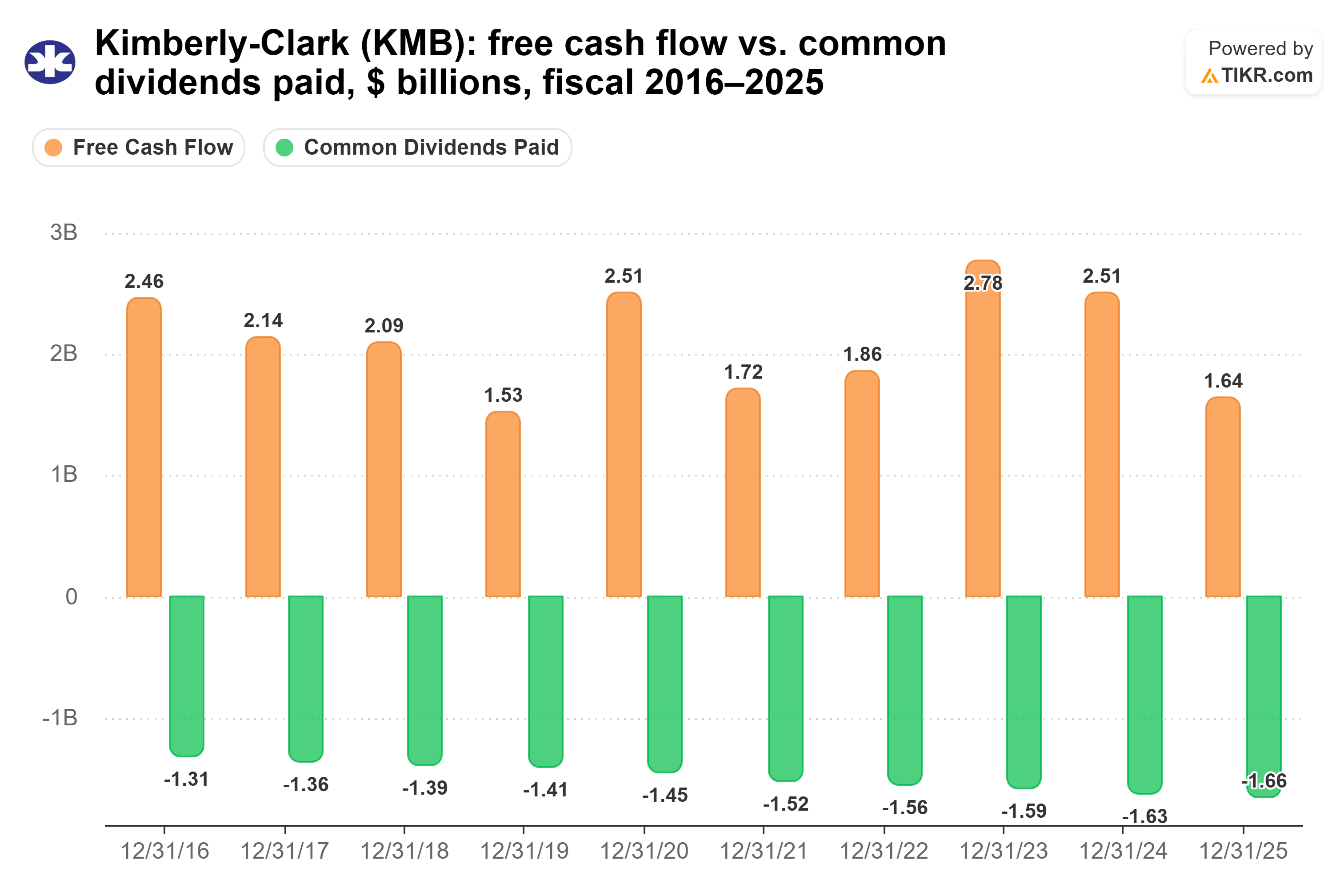
The dividend is where things get tight. Over the twelve months to June 30, 2026, it ate up 92% of free cash flow, which leaves a thin cushion. The chart shows free cash flow covering the dividend every year from fiscal 2016 to fiscal 2024. In fiscal 2025, free cash flow fell to $1.64 billion from $2.51 billion, just short of the $1.66 billion paid out.
Cash has improved since then. Cash from operations was $1.7 billion in the first half of 2026, up from $1.1 billion a year earlier.
The main risk is China, where false claims about its diapers spread on social media. Management expects them to weigh on sales and profits in the near term.
Unilever: room to spare
Unilever’s dividend has the cushion that Kimberly-Clark’s lacks. Over the twelve months to June 30, 2026, it used 59% of free cash flow, so the dividend is well-covered. The chart shows free cash flow clearing the dividend every year since fiscal 2016. The ratio ran between 53% and 74% from fiscal 2021 to fiscal 2025.

Dove, Vaseline, Home Care, deodorants, India and Latin America are leading the growth. CEO Fernando Fernandez told analysts on July 28: “We have corrected some of the own goals that we scored last year, and we are very pleased with the turnaround performance that we have had in the first half.”
Measured in its own currency, Unilever’s dividend per share slipped 0.5% a year from fiscal 2020 to fiscal 2025, from 1.87 to 1.82. Because the dividend is set in that currency, the US-dollar amount ($2.20 a year at today’s exchange rate) moves with the exchange rate. The main risk management names is commodity inflation, particularly in Home Care.
So which dividend wins?
For retirees, Kimberly-Clark is the better dividend stock. The check decides it.
At its 5.4% yield, $10,000 in Kimberly-Clark pays $540 a year. If the dividend keeps growing at its 5-year rate of 3.3%, that becomes about $725 in year 10, a 7.2% yield on your original $10,000. The same $10,000 in Unilever pays $360 now and about $343 in year 10 at its 5-year rate. At those rates, Unilever’s income never catches up.
The balance sheet backs this up with lower leverage and stronger interest coverage than Unilever’s. And you aren’t paying up for the yield. At 13.8x forward earnings, Kimberly-Clark trades well below its five-year average of 18.6x and not far above its April 7 low of 12.3x.
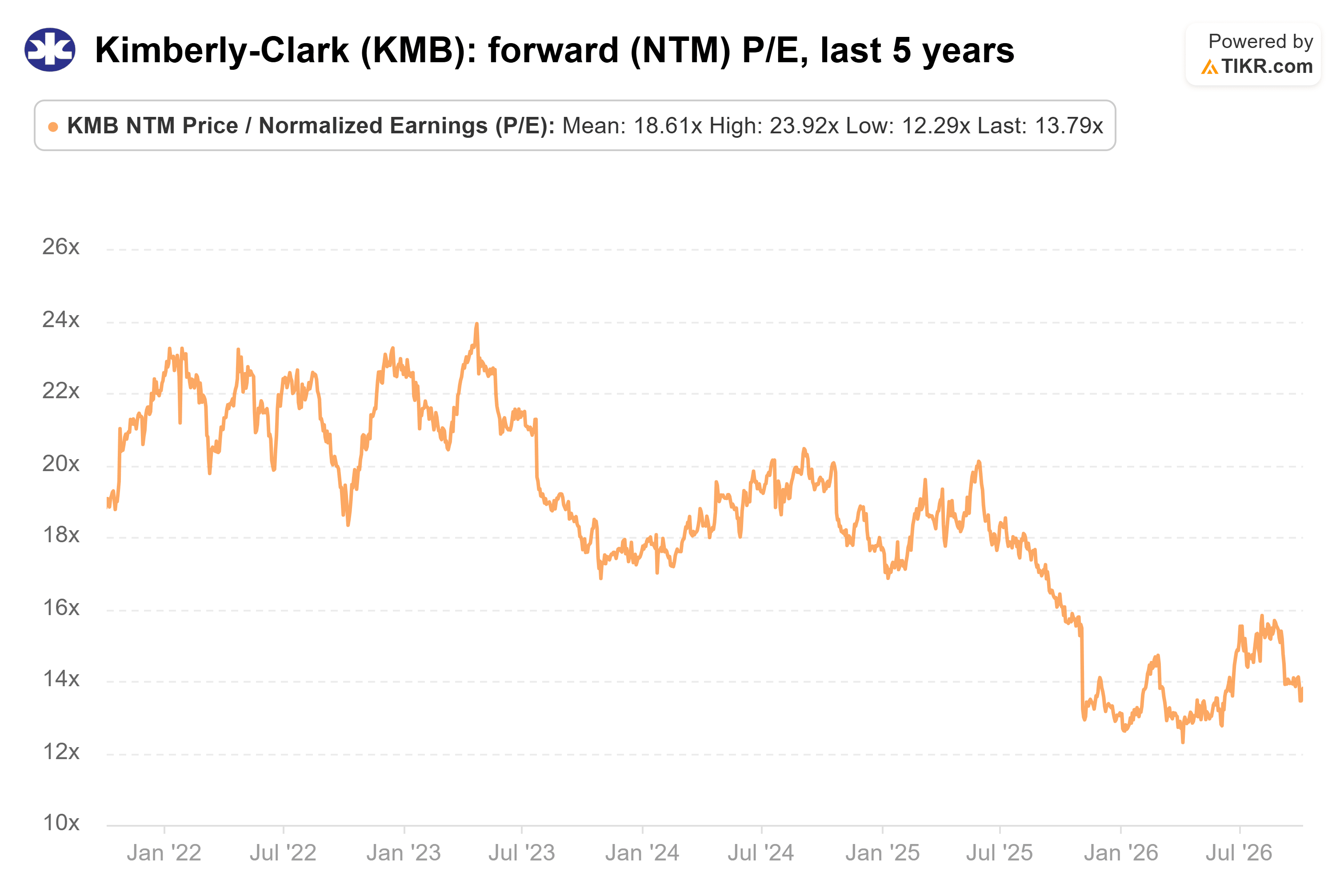
Unilever, for comparison, trades at 16.1x.
This isn’t to say Unilever’s dividend isn’t safe. Paying out 59% of free cash flow leaves plenty of room, and free cash flow has cleared the dividend every year on the chart. It’s just that a retiree wants a check that grows in dollars, and Unilever’s hasn’t.
Of course, Kimberly-Clark’s 92% payout leaves little room for a bad year, and it still has to close its Kenvue acquisition, which management says is on track for the end of this year. The next report will show whether the first half’s cash rebound holds.
So what is Kimberly-Clark stock actually worth?
TIKR lets you forecast the future price of any stock in less than a minute. Just enter a few assumptions into TIKR’s valuation model and see what Kimberly-Clark could be worth. Start from Wall Street consensus estimates, or adjust the inputs to reflect your own view of the business. It’s free to use.
Disclaimer:
Please note that the articles on TIKR are not intended to serve as investment or financial advice from TIKR or our content team, nor are they recommendations to buy or sell any stocks. We create our content based on TIKR Terminal’s investment data and analysts’ estimates. Our analysis might not include recent company news or important updates. TIKR has no position in any of the stocks mentioned. Thank you for reading, and happy investing!