


Key Takeaways for Realty Income Corporation Stock’s Dividend as of July 2026
- Operating income climbed 17% year-over-year in the quarter ended March 31, 2026, as revenue growth accelerated to 12%, the fastest pace in four quarters.
- The quarterly dividend held at $0.81, up 2% year-over-year, near a $3.24 annualized rate.
- A 72% payout ratio, measured against Q1 AFFO per share of $1.13, is falling as AFFO growth of 7% outpaces the 2% dividend raise.
- TIKR’s mid-case model targets $76 for Realty Income stock by December 2030: a 23% total return, 5% annualized.
Realty Income’s Operating Income Growth Outpaces Its Slowing Dividend Raise Pace

Realty Income Corporation (O) grew total revenue 12% year-over-year in the quarter ended March 31, 2026, the fastest pace in four quarters. That acceleration matters because the dividend raise investors just received grew only 2% over the same span.
Operating margin expanded to 46% from 44% a year earlier. Operating income rose 17% year-over-year to $0.71 billion, even as depreciation and amortization climbed to $0.63 billion for the quarter.
That operating leverage flowed through to cash generation. Realty Income reported AFFO per share of $1.13 in the first quarter, up 7% year-over-year, more than three times the 2% growth rate of the quarterly dividend.
Management raised full-year AFFO per share guidance to a range of $4.41 to $4.44, citing $2.8 billion of investment volume at a 7.1% initial weighted average cash yield during the quarter.
Net debt held at 5.2 times annualized pro forma adjusted EBITDA, within the company’s targeted range, even as full-year investment volume guidance rose to $9.5 billion.
That gap between cash flow growth and dividend growth is where the payout math shows up. AFFO growing faster than the quarterly payout is the mechanical definition of a falling payout ratio, not a rising one.
Realty Income Stock’s Payout Ratio Is Falling as AFFO Outpaces the Dividend Raise

Realty Income’s quarterly dividend per share held at $0.81 in the quarter ended March 31, 2026, up 2% from the same quarter last year. Annualized, that puts the current run rate near $3.24 per share.
Against AFFO per share of $1.13 for the quarter, that dividend represents a payout ratio near 72%. AFFO grew 7% year-over-year in the same quarter, more than three times the 2% pace of the dividend raise, a gap that pulls the payout ratio lower rather than higher.
TIKR’s forward dividend estimates point to a reacceleration ahead. Quarterly DPS is projected to reach $0.84 by June 2027, a 3% year-over-year pace versus the 2% booked most recently.
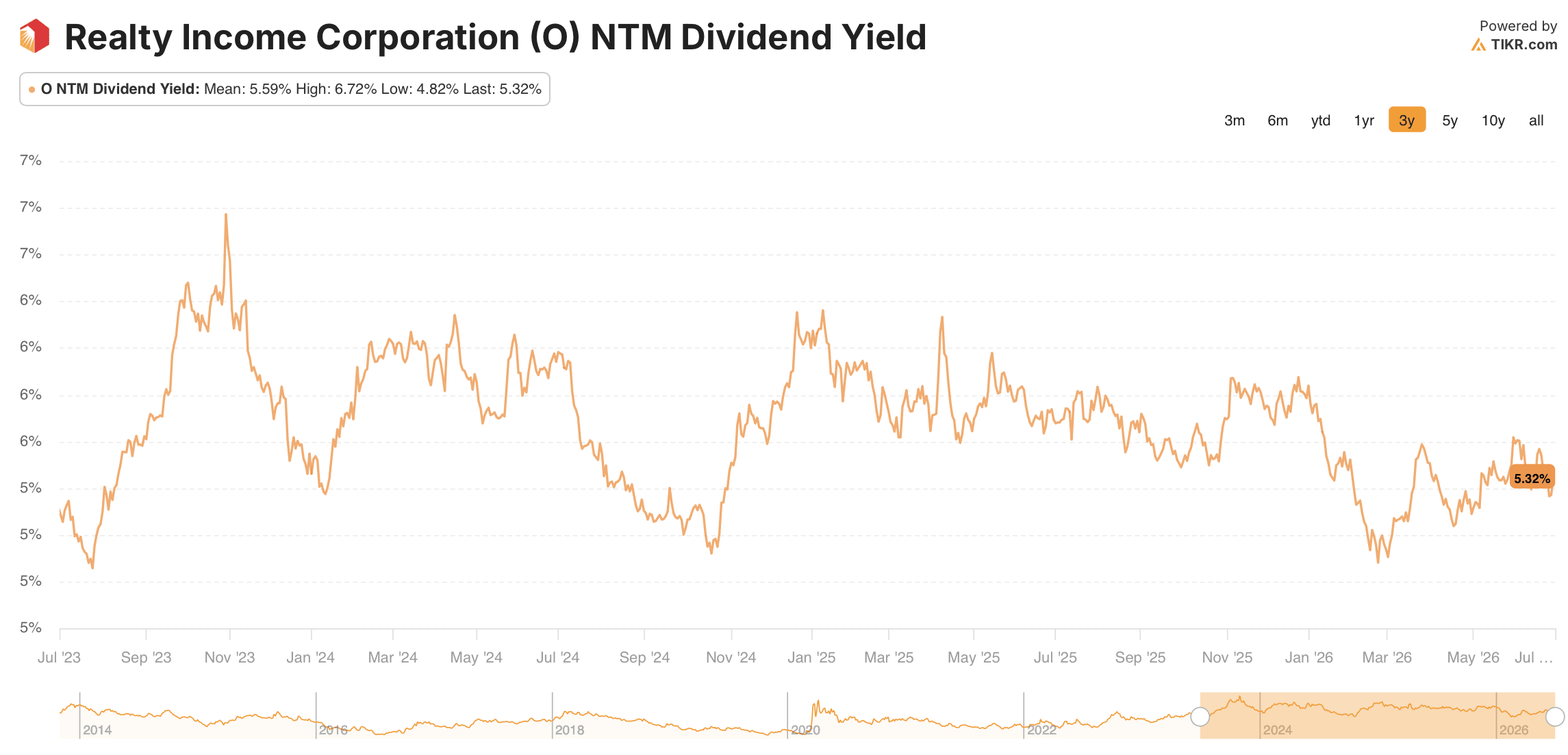
NTM dividend yield compressed to 5.3% as of July 1, 2026, down from 5.8% at the end of 2025. The move looks driven more by Realty Income stock’s price gain than by the pace of the raise.
A payout ratio that keeps sliding below 70% would confirm the AFFO growth gap is durable, not a single-quarter artifact.
TIKR’s $76 Target on Realty Income Stock Holds if AFFO Keeps Outrunning the Dividend Raise
TIKR’s mid-case model targets $76 for Realty Income stock by December 2030, a 23% potential total return and 5% annualized rate from today’s $62 price.
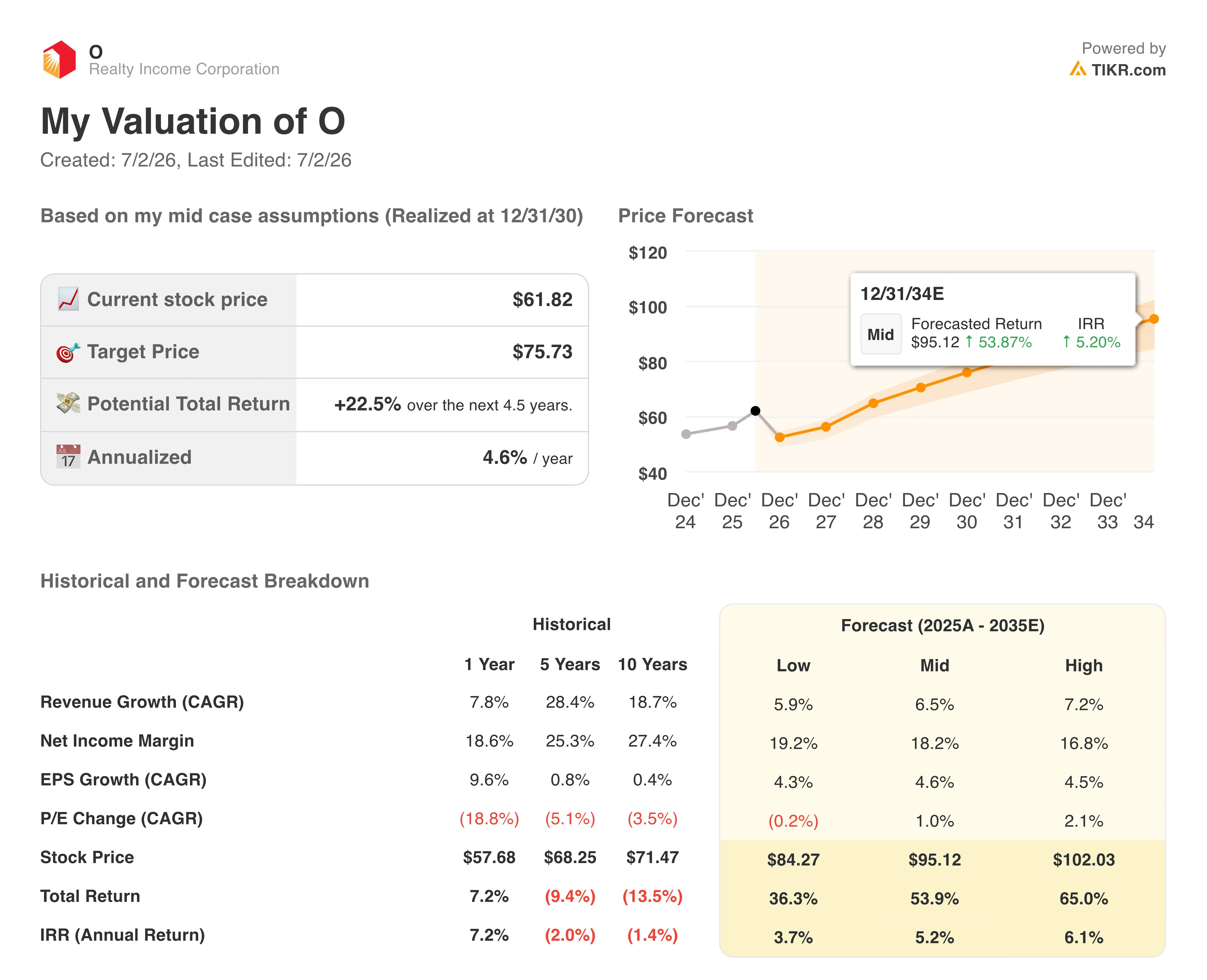
That path points to mid-single-digit annualized returns, a profile suited to income-focused holders more than growth-oriented ones, given Realty Income stock’s yield-heavy total return math.
The target looks reachable as long as the AFFO growth documented in the first quarter keeps outpacing the 2% dividend raise pace, since a falling payout ratio gives Realty Income more room to lift the dividend without straining coverage. A stall in that AFFO growth would remove the cushion the payout ratio trend currently provides.
Should You Invest in Realty Income Corporation?
The only way to really know is to look at the numbers yourself. TIKR gives you free access to the same institutional-quality financial data that professional analysts use to answer exactly that question.
Pull up Realty Income Corporation stock and you’ll see years of historical financials, what Wall Street analysts expect for revenue and earnings in the quarters ahead, how valuation multiples have moved over time, and whether price targets are trending up or down.
You can build a free watchlist to track Realty Income Corporation alongside every other stock on your radar. No credit card required. Just the data you need to decide for yourself.
Access Professional Tools to Analyze O stock on TIKR for Free →


