Key Stats for Chevron Stock
- Current Price: $173.63 (June 18, 2026 close)
- Target Price (Mid): ~$176
- Street Target: ~$216
- Potential Total Return: ~1.5%
- Annualized IRR: ~0.3% / year
- Earnings Reaction: +0.87% (May 1, 2026)
- Max Drawdown: 17.77% (June 18, 2026)
Now Live: Discover how much upside your favorite stocks could have using TIKR’s new Valuation Model (It’s free) >>>
What Happened?
Chevron Corporation (CVX) spent most of 2026 as a stock that the whole market wanted to own.
Berkshire Hathaway cut its Chevron position by 35% last quarter, selling 45.7 million shares worth more than $8 billion, its single largest reduction of the quarter. Chevron has long been a Buffett-approved core holding rather than a junior pick, so the size of the cut carried weight. The firm still owns roughly $17 billion of the stock, but it lightened up hard.
Then the tape turned. Chevron rode crude above $100 as the war with Iran choked off the Strait of Hormuz, the waterway that normally carries about a fifth of the world’s oil. The stock hit a 52-week high of $214.71. It now sits at $173.63, down 17.77% from that high. The catalyst that drove the stock all year is now pulling it down.
The Ceasefire That Changed the Trade
The turn is recent. Crude has given back roughly 20% from its 2026 highs as a tentative U.S.-Iran agreement pointed toward the Strait of Hormuz reopening. Because Chevron carries more oil leverage than its integrated peers, it feels every dollar of that decline.
This was always the risk. Chevron was never just a bet on a great business. It was a leveraged bet on the Strait staying closed, wearing a dividend aristocrat’s suit. When peace signals arrived, the war premium drained fast.
CEO Mike Wirth does not think the market has this right. At the Bernstein Strategic Decisions Conference on May 28, he argued the physical shortage was still building even as futures stayed calm. “The buffers and the shock absorbers are being steadily drawn down, and the ability for the market to absorb this imbalance is drastically diminished today versus where we started,” Wirth said. When the moderator suggested the share price might not be as cyclical as feared at current levels, his answer was blunt: “We call that a buying opportunity.”
So the disagreement is real. Berkshire sold into strength. The CEO is calling the dip a gift. The market, for now, is siding with Berkshire.
See historical and forward estimates for Chevron stock (It’s free!) >>>
What Berkshire May Have Seen
The case for trimming does not require predicting peace. Chevron’s reported earnings have been messy. First-quarter net income was $2.2 billion, or $1.11 per share, down from $3.5 billion a year earlier. The stock rose just 0.87% on May 1, even though adjusted earnings of $1.41 beat the Street’s $0.97 estimate handily.
That gap was an accounting artifact. When oil spikes mid-quarter, Chevron’s hedges on physical cargo move against it before the barrels are delivered, creating a paper loss that later unwinds. It is a fair point for the bulls. But it also captures the bear’s discomfort: Chevron’s earnings power is hard to read quarter to quarter because it is tied to the price of a barrel, not to anything the company controls.
Then there is valuation. Chevron trades at 4.92x NTM EV/EBITDA, a modest discount to ExxonMobil at 6.49x and below the peer-group average of 6.53x. That discount is defensible given Chevron’s AA balance sheet and low 0.50 beta. But a cheap multiple on earnings about to lose their commodity tailwind is not the same as a bargain.
The Floor Under the Stock
What keeps this from being a simple “oil is falling, sell it” story is the cash machine underneath. Chevron has raised its dividend for 39 consecutive years, with a 6% annual growth rate over the last 15, and it returned more than $50 billion to shareholders over the past two years. The yield is 4.2%.
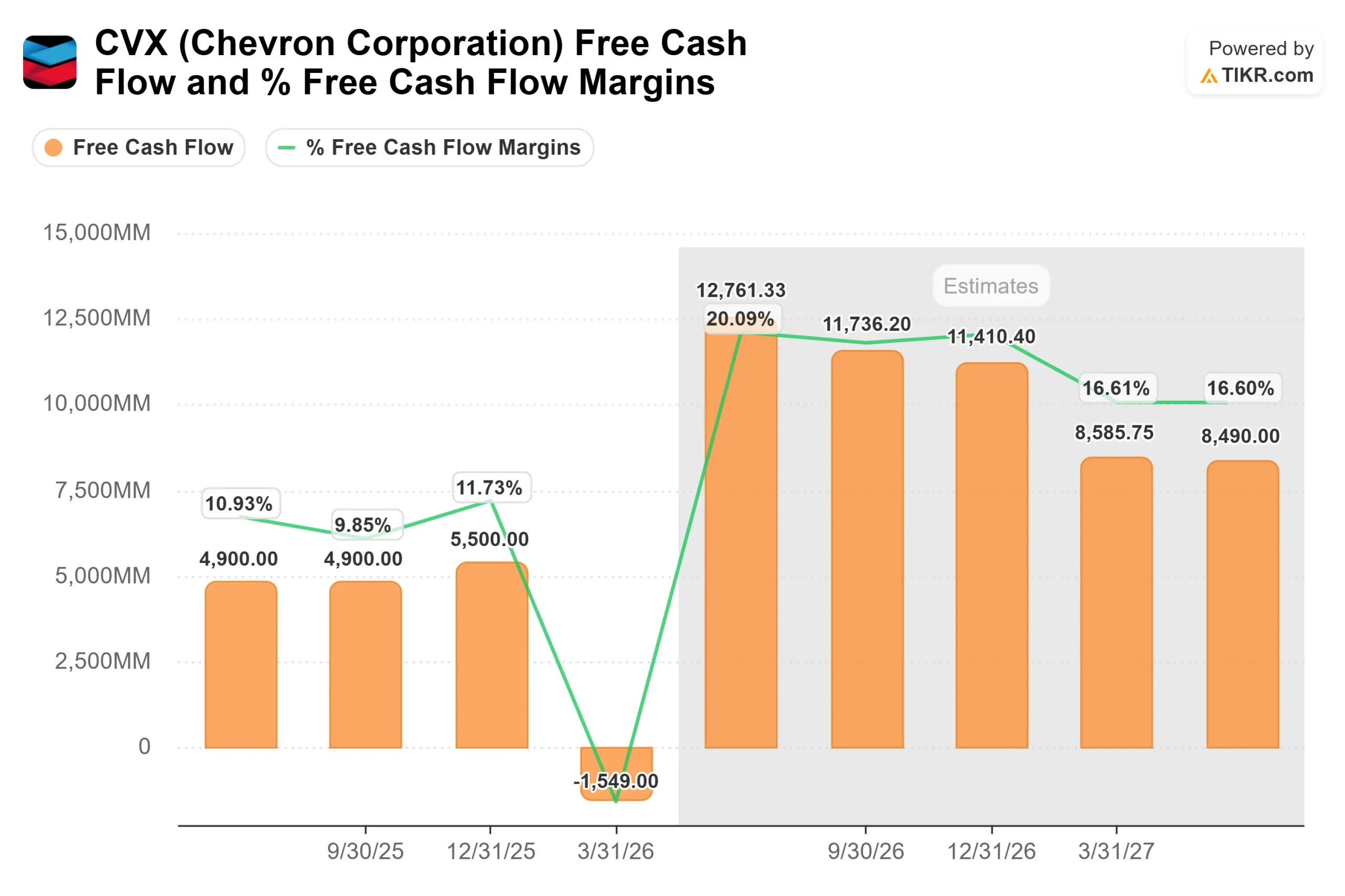
That engine runs on free cash flow that TIKR estimates show climbing from $16.6 billion in 2025 toward roughly $38 billion by 2030, with margins widening from around 9% to around 20%. The drivers are real. The Hess acquisition added about 500,000 barrels per day of low-cost Guyana production, and the Tengiz expansion in Kazakhstan lifted that field toward 1 million barrels per day. Wirth also flagged a newer lever, saying Chevron is “deep into discussions with Microsoft,” though not yet signed, to build natural-gas power for data centers, a cash stream he called largely insulated from oil prices.

See how Chevron performs against its peers in TIKR (It’s free!) >>>
TIKR Advanced Model Analysis
- Current Price: $173.63
- Target Price (Mid): ~$176
- Potential Total Return: ~1.5%
- Annualized IRR: ~0.3% / year

See analysts’ growth forecasts and price targets for Chevron stock (It’s free!) >>>
The TIKR mid-case model leans toward the market, not the CEO. Realized by 2030, it targets around $176, a total return near 1.5%, and an annualized return around 0.3%. At today’s price, the base case pays you the dividend and little else.
It gets there with two volume drivers and no top-line growth: the Hess Guyana ramp and the Tengiz expansion carry production while revenue is modeled flat. The margin driver is the structural cost program, which management targets at $3 to $4 billion by year-end. The main risk is the one playing out live: a durable Iran deal that sends Brent back toward $60 compresses upstream margins before those savings can offset them.
The asymmetry is what makes Chevron worth a look. Sustained high oil and a faster Guyana ramp push the high case to around $263, a total return above 50%. Even the low case lands near $183, because the 4.2% yield cushions the fall. You are not risking a collapse here. You are risking dead money while collecting a dividend.
Conclusion
Watch Chevron’s Q2 2026 adjusted free cash flow, reported July 31. The thesis hangs on whether Q1’s cash drag was accounting noise or something stickier. A clean figure above $5 billion confirms the bulls and gives the stock a reason to close the gap toward the Street’s roughly $216 target, where consensus runs 13 Buys, 5 Outperforms, 6 Holds, 1 Underperform, and 1 Sell. A soft number, with oil now falling, hands the argument to Berkshire.
Wirth may be right that the physical market is tighter than the futures curve suggests. But Berkshire was right that a stock priced for $100 oil had little margin of safety once peace became the base case. At $173.63, you are buying a fortress balance sheet and a 39-year dividend at a fair, not cheap, price, with the commodity wind now against you.
See what stocks billionaire investors are buying so you can follow the smart money with TIKR.
Should You Invest in Chevron?
The only way to really know is to look at the numbers yourself. TIKR gives you free access to the same institutional-quality financial data that professional analysts use to answer exactly that question.
Pull up Chevron, and you’ll see years of historical financials, what Wall Street analysts expect for revenue and earnings in the quarters ahead, how valuation multiples have moved over time, and whether price targets are trending up or down.
You can build a free watchlist to track Chevron alongside every other stock on your radar. No credit card required. Just the data you need to decide for yourself.
Analyze Chevron on TIKR Free →
Looking for New Opportunities?
- See what stocks billionaire investors are buying so you can follow the smart money.
- Analyze stocks in as little as 5 minutes with TIKR’s all-in-one, easy-to-use platform.
- The more rocks you overturn… the more opportunities you’ll uncover. Search 100K+ global stocks, global top investor holdings, and more with TIKR.
Disclaimer:
Please note that the articles on TIKR are not intended to serve as investment or financial advice from TIKR or our content team, nor are they recommendations to buy or sell any stocks. We create our content based on TIKR Terminal’s investment data and analysts’ estimates. Our analysis might not include recent company news or important updates. TIKR has no position in any stocks mentioned. Thank you for reading, and happy investing!