Key Takeaways
- Walmart stock is up 12% over the past year, closing at $119 on October 16, though it still trades 10% below its $132 close on April 30.
- The Street rates Walmart stock with 28 buys, 10 outperforms, 4 holds, 1 underperform, and 1 sell, and the $127 mean target is up 12% in a year and sits 7% above the close.
- My model puts Walmart stock at $130 by January 31, 2029, a 9% total return, or 4% a year.
- Third-quarter guidance calls for adjusted operating income growth of just 2% to 4% in constant currency.

Walmart Inc. (WMT) stock is up 11.6% over the past year, closing at $119 on October 16, 2026, a day after Deutsche Bank upgraded the shares to buy with a $136 price target.
That return hides a round trip. Walmart stock closed at $132 on April 30, then fell 21% to $104 by September 30, by my math, with its two sharpest drops landing on earnings mornings. Even after October’s bounce, the stock sits 9.9% under that April close.
Walmart Stock Spent Six Months Climbing
The year opened near its low. Walmart stock closed at $101.18 on October 31, 2025, then jumped 6.5% on November 20 after Walmart beat third-quarter estimates and raised its full-year outlook for the second straight quarter. Adjusted EPS came in at $0.62 against a $0.60 estimate, and Walmart lifted its fiscal 2026 sales growth forecast to 4.8% to 5.1% in constant currency.
From there the stock reached $119.14 by January 31 and $131.93 by April 30, touching the mid-$130s twice along the way (no single event explains the February peak or the March dip).
Two Earnings Mornings Took WMT Stock Back to $103.92
The giveback came in two steps:
- On May 21, Walmart stock fell 7% after first-quarter results came with a cautious outlook. Revenue rose 7.3% to $177.8 billion, but Walmart held its full-year forecast instead of raising it, with higher fuel prices weighing on operating income.
- On August 20, shares dropped about 9% even though Walmart beat estimates and raised guidance. Adjusted EPS of $0.81 cleared the $0.74 estimate, yet the Walmart U.S. comp grew just 2.6%, with new drug-price rules on pharmacy (Maximum Fair Pricing) costing 125 basis points.
The August profit number needed a footnote. Walmart booked about $2.9 billion in tariff refunds, roughly 0.5% of a year’s U.S. sales, for a net benefit of about 750 basis points to operating income growth. CFO John David Rainey argued on the Q2 earnings call that the business underneath was getting more profitable: “We grew operating income 10% ex tariffs. That’s 4x the level of revenue growth.”
Walmart is putting that refund back into price, ending the quarter with 11,000 rollbacks against a normal level of about 5,000. With that spending included, it guided third-quarter adjusted operating income growth to just 2% to 4% in constant currency. The stock closed September at $104.
Walmart Stock’s October Bounce
By my math, Walmart stock has climbed 14% since September 30. Deutsche Bank’s October 15 upgrade argued that shoppers hunting for value in a higher-inflation economy play to Walmart’s strengths, and that investors are starting to look past the soft U.S. comp. The shares rose about 3% to $119 that day, according to Reuters, in a week when consumer staples gained 5% while technology fell 6.4%.
The Street Added Holds on Walmart Stock
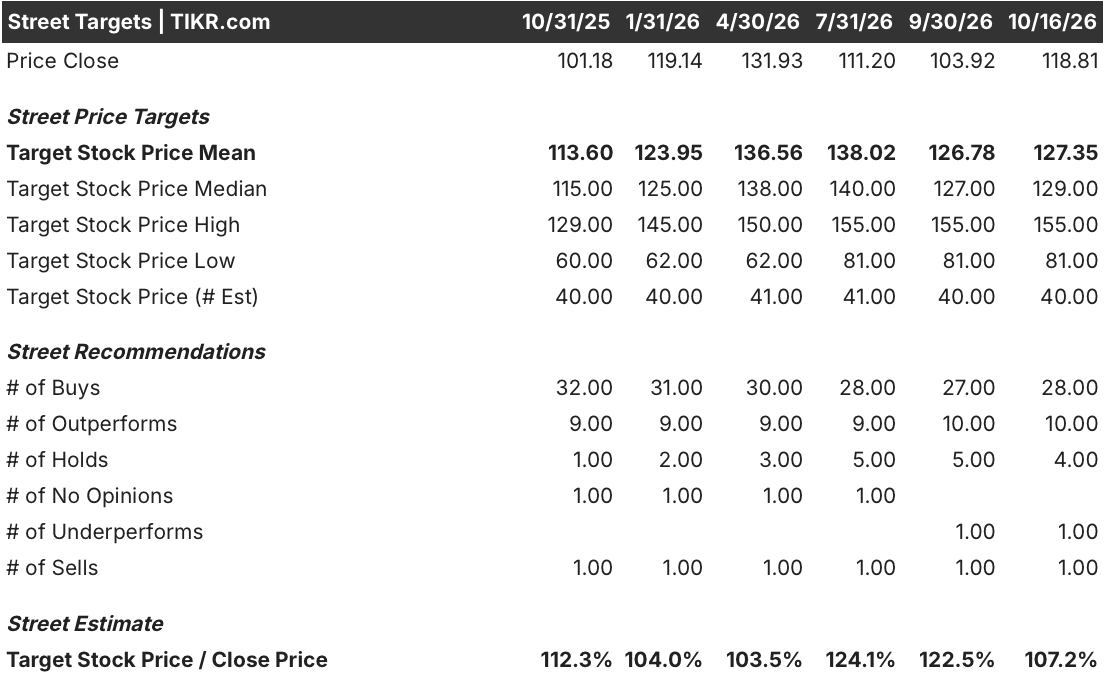
Walmart stock carries 28 buys, 10 outperforms, 4 holds, 1 underperform, and 1 sell as of October 16. Holds have climbed from 1 a year ago, peaking at 5 in July and September. The mean price target of $127.35 sits 7.2% above the close; it is up 12.1% from $113.60 a year ago but 7.7% below its $138 peak on July 31. Even so, the gap to the close has narrowed from 12.3% a year ago to 7.2% now. The Street still sees upside, just less of it.
Does WMT Stock Have Room at 39.5x Earnings?

The input I argued with myself over was the multiple. Walmart trades at 39.5x forward earnings against a 33.9x three-year average, and Rainey has already said that lapping the second quarter’s 19% EPS growth will be a challenge next year. So I set the exit P/E at 36x. That is below today’s level but still well above the 29.3x five-year average, because global advertising grew 38% last quarter and Walmart U.S. CEO Dave Guggina has put Walmart Connect’s margins at roughly 70%.
The business inputs are plain. I have revenue growing 4.5% a year, the midpoint of the raised guide and a touch under the 4.9% five-year pace, since the drug-pricing drag carries into next year. I put operating margin at 4.7%, up from 4.4% last year and 4.2% over five years. That gets Walmart stock to $129.89 by January 31, 2029, a 9.3% total return from $119, or 4% a year.
That target lands 2% above the Street’s mean and $6.11 short of Deutsche Bank’s $136, by my math. Every 1x of P/E moves it by $3.61. At 4% a year, the margin story is carrying the stock while the multiple gives some back. That makes Walmart a hold-what-you-own name at $118.81, not a bargain.
The Q3 Number That Decides Walmart Stock’s Next Move
Rainey told investors to read the second and third quarters together, so the third-quarter report is the test. Walmart guided third-quarter net sales growth to 3% to 3.75% and adjusted operating income growth to 2% to 4%, both in constant currency, with adjusted EPS of $0.62 to $0.64. Its forecast assumes a stronger U.S. sales trend as the rollbacks take hold. The cleaner test is the U.S. comp without health and wellness, which strips out the pharmacy pricing drag and has run at 3% to 4% for two and a half years. Holding or beating that range would support the 4.7% margin path in my model. A core comp slipping under 3% would be the first sign the rollbacks aren’t lifting sales.
Think 36x is too generous, or 4.7% margins too cautious? Plug in your own numbers and build a Walmart model in 60 seconds, free, starting from consensus estimates. Learn more here.
So what is Walmart stock actually worth?
TIKR lets you forecast the future price of any stock in less than a minute. Just enter a few assumptions into TIKR’s valuation model and see what WMT stock could be worth. Start from Wall Street consensus estimates, or adjust the inputs to reflect your own view of the business. It’s free to use.
Disclaimer:
Please note that the articles on TIKR are not intended to serve as investment or financial advice from TIKR or our content team, nor are they recommendations to buy or sell any stocks. We create our content based on TIKR Terminal’s investment data and analysts’ estimates. Our analysis might not include recent company news or important updates. TIKR has no position in any of the stocks mentioned. Thank you for reading, and happy investing!