


Samsung Electronics (A005930) and SK Hynix (A000660) extended their slide on Monday, October 19. In late-morning Seoul trading, Samsung was down 0.23% and SK Hynix was down 3.14%, with Yonhap tying the weakness to worries about heavy AI infrastructure spending after Wall Street’s tech selloff. (Both are intraday figures.)
Both stocks are coming off their worst week since 2008. Between October 12 and 16, Samsung fell 17.75% and SK Hynix dropped 24.33%, as foreign investors sold a net 11.2 trillion won (around $8.4 billion) of Korean shares, nearly 79% of it in these two names.
Friday’s AI Debt Scare Reached Seoul
The Nasdaq fell 2.14% on Friday to 26,140.03, as investors worried that debt-heavy AI infrastructure companies won’t earn profits fast enough to repay what they owe, with borrowing costs expected to rise. Chip stocks fell for an eighth straight day, their longest losing streak since 2008. CoreWeave (CRWV), the AI cloud provider at the center of the debt worries, sank 12%, and memory peer Micron (MU) lost 5.6%.
The easy read on Monday’s gap: SK Hynix is a pure memory company, while Samsung also sells phones, TVs and appliances, so Samsung should hold up better.
Samsung Is More of a Chip Stock Than It Looks
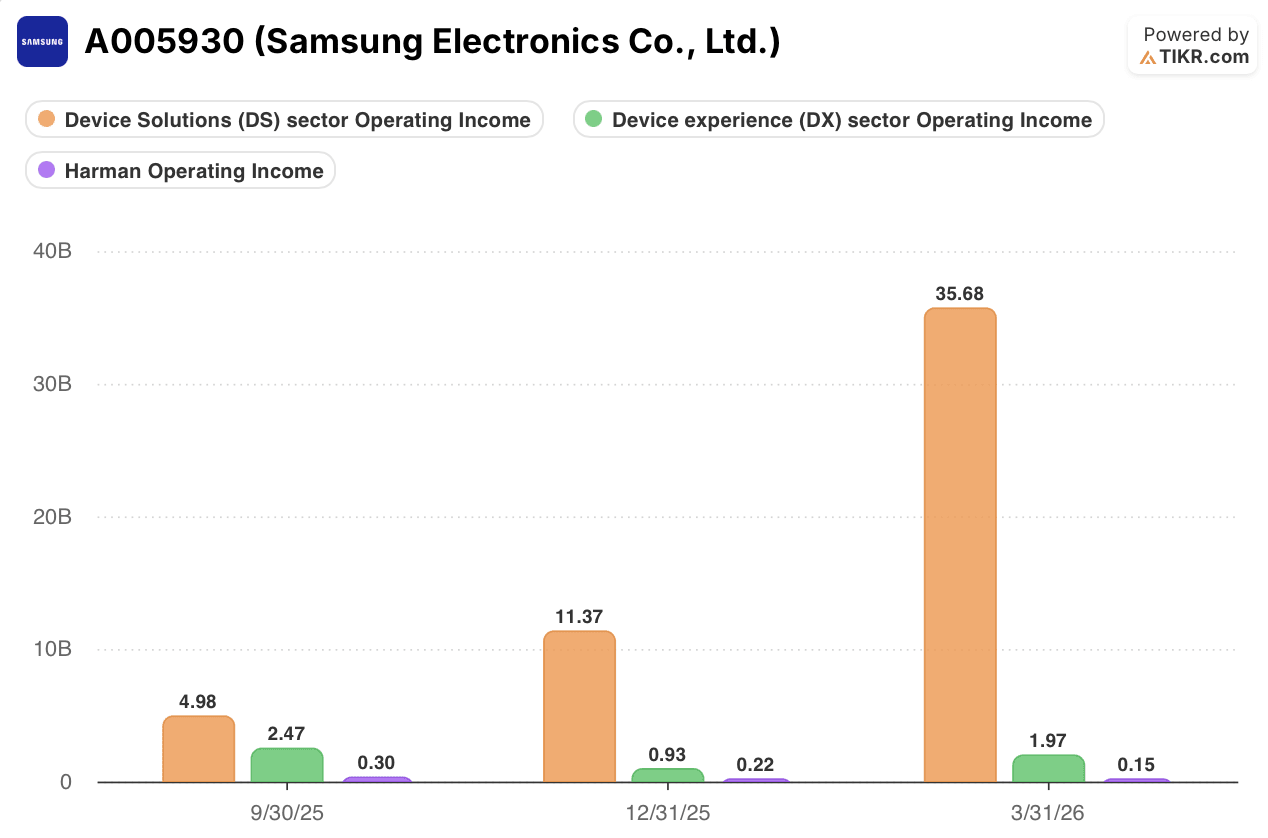
Samsung’s profits are more concentrated in chips than its product lineup suggests. Device Solutions, which includes memory chips, accounted for about 64% of the combined operating income of DS, Device Experience (DX) and Harman in Q3 2025, rising to about 94% in Q1 2026. By Q2, DS earned 89.2 trillion won (around $67 billion) in operating profit, nearly matching Samsung’s company-wide operating profit of 89.5 trillion won (about $67 billion). DX, which includes phones, network equipment, TVs and home appliances, lost 0.8 trillion won (about $600 million), while Harman, its automotive and audio business, earned 0.4 trillion won (about $300 million).
The third quarter leans further the same way. Samsung guided to 107.4 trillion won (around $80 billion) of operating profit on a record 195 trillion won (around $146 billion) of sales, and analysts estimate the memory business alone earned around 110 trillion won (around $82 billion), more than the whole company.
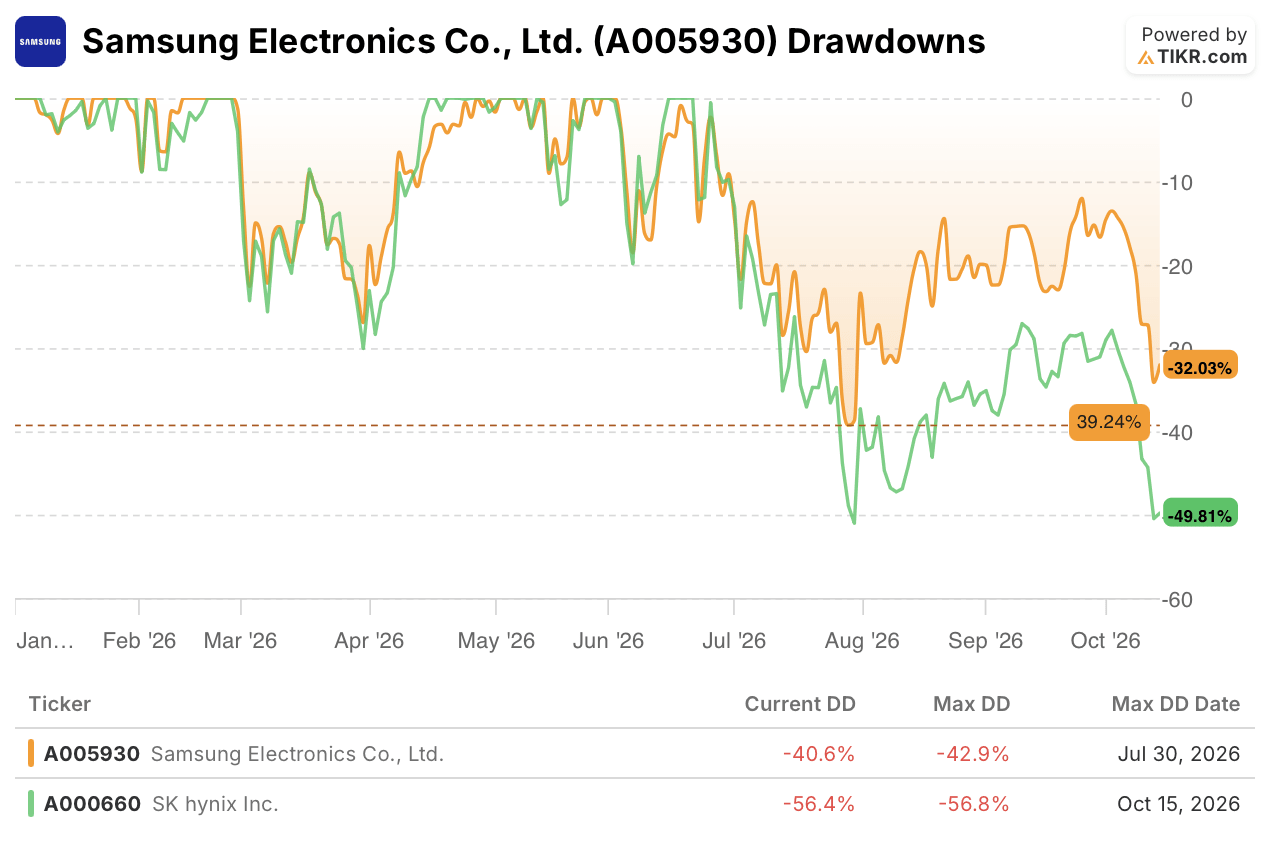
So Samsung’s profits ride the same memory cycle as SK Hynix’s but the difference is where each stock sits. SK Hynix trades 56.4% below its peak, and its deepest drawdown of the year came on October 15. Samsung sits 40.6% below its peak, short of the 42.9% drawdown it hit on July 30.
What SK Hynix’s 3x Multiple Already Assumes
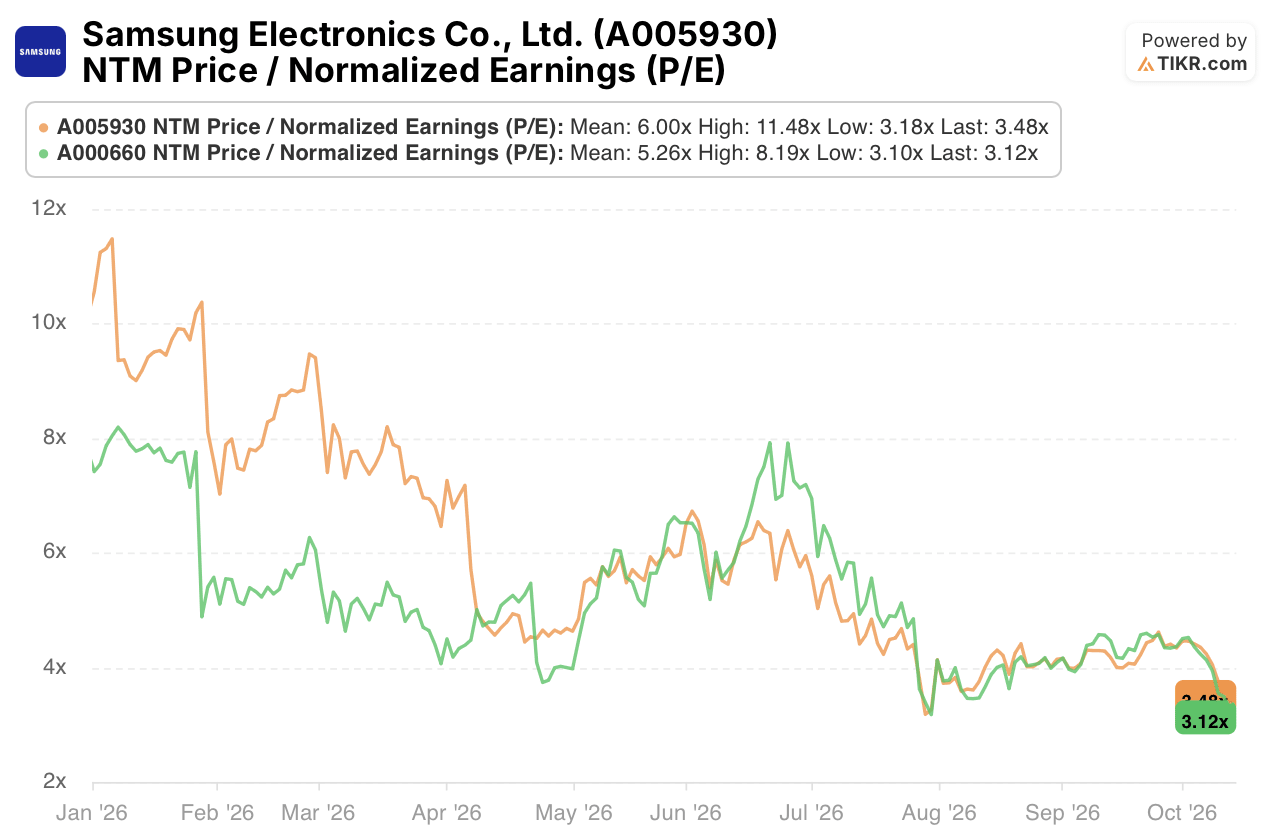
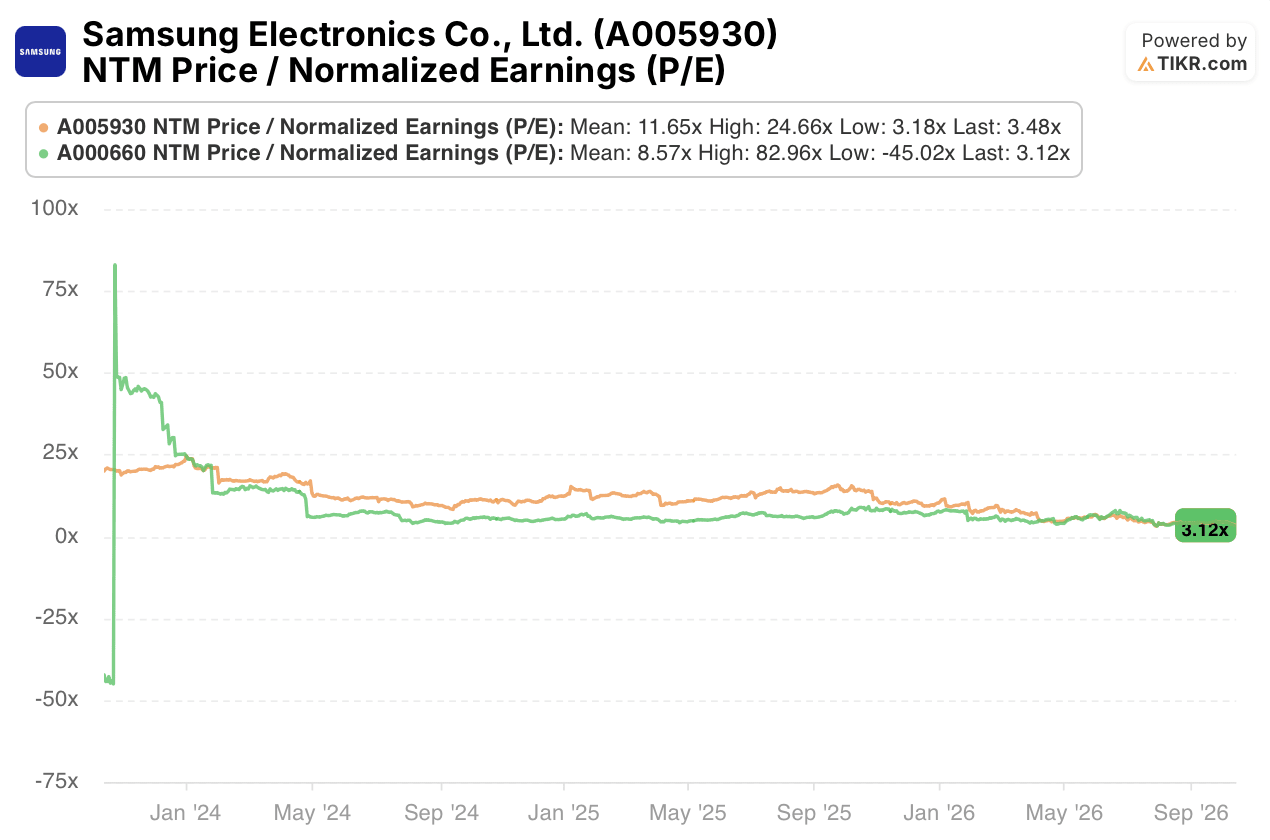
SK Hynix trades at 3.12 times next-12-month normalized earnings, about 64% below its three-year average of 8.57 times. Samsung sits at 3.48 times, against a three-year average of 11.65 times. SK Hynix is now about 10% cheaper than Samsung on this measure.
The catch: those multiples sit on record earnings. If memory prices roll over, the earnings shrink and the stocks stop looking cheap. That’s the bear case, and SK Hynix is already at 3.12 times against a 2026 low of 3.10 times. Friday’s worry, though, was whether AI borrowers can repay debt on time, not whether they want fewer chips.
SK Hynix’s October 28 Report Is the Next Test
SK Hynix reports third-quarter results on October 28, and that call matters more than any intraday move this week. At about 3 times forward normalized earnings, the market is already doubting that SK Hynix’s record profits will last, so the call is a straight test of demand. Firm customer commitments for 2027 supply would back the idea that this selloff is about how AI spending gets financed, not whether buyers still want the chips. Any sign of customers delaying orders over financing would put earnings forecasts at risk, and a 3x multiple offers no floor if those forecasts fall.
Want to see how deep the memory selloff runs? You can pull up the same segment, drawdown and NTM P/E charts for Samsung, SK Hynix and Micron on TIKR for free. Learn more here.
So what is Samsung stock actually worth?
TIKR lets you forecast the future price of any stock in less than a minute. Just enter a few assumptions into TIKR’s valuation model and see what Samsung stock could be worth. Start from Wall Street consensus estimates, or adjust the inputs to reflect your own view of the business. It’s free to use.
Value Samsung Electronics Co., Ltd. for free→
Disclaimer:
Please note that the articles on TIKR are not intended to serve as investment or financial advice from TIKR or our content team, nor are they recommendations to buy or sell any stocks. We create our content based on TIKR Terminal’s investment data and analysts’ estimates. Our analysis might not include recent company news or important updates. TIKR has no position in any of the stocks mentioned. Thank you for reading, and happy investing!


