Key Takeaways
- Nvidia’s board opened an independent investigation on Nov. 8 after reports that CEO Jensen Huang had a relationship with an alleged Chinese spy, and Huang admitted to an affair in an email to staff.
- Nvidia has been backstopping the AI buildout, with $36 billion of off-balance-sheet agreements for neoclouds and a guarantee of up to $105 billion tied to an OpenAI data center in Ohio.
- That support matters more as credit cracks: CoreWeave’s default swaps topped 1,289 basis points, and Microsoft is reportedly cutting back on neoclouds after letting an Oracle deal lapse.
- A CEO under investigation likely has less room to sign the next backstop, which may not end the AI trade alone but could be the last straw, with tests on Nov. 10, 17 and 18.
Nvidia (NVDA) has a Jensen Huang problem.
U.S. officials believe Huang had a romantic relationship with an alleged Chinese spy, according to reports in the Financial Times and The New York Times. The woman, Alice Huang, is affiliated with Megaspeed, an Nvidia customer accused of helping restricted Chinese companies get Nvidia’s AI chips.
Within hours, Waterworld Capital, an investor on X, had a verdict: “AI trade is done.”
Then on Sunday, Nvidia’s board opened an independent investigation, and Huang admitted the affair in an email to staff.
Talk about bad timing.
TIKR tracks 62 analysts on Nvidia. How many say “Buy”?
See the full breakdown of Buy, Hold, and Sell ratings on Nvidia, along with Wall Street’s revenue and earnings estimates, all in one place. More than 500,000 investors use TIKR to research stocks like this one. See Nvidia’s Analyst Ratings
Jensen has been holding up the plates
The problem here is that the “AI trade” has been heavily reliant on Nvidia’s direct involvement up and down the supply chain, which has been an extension of the risks that Huang has been willing to take.
Risks that, let’s face it, he may no longer have the capacity and judgment to push through correctly.
As of Nvidia’s July quarterly report, it had $36 billion of off-balance-sheet AI cloud agreements, or backstops, for neoclouds. It also has a guarantee of up to $105 billion tied to a proposed 10-gigawatt OpenAI data center in Ohio. And it agreed to buy up to $6.3 billion of computing capacity from CoreWeave (CRWV) if CoreWeave can’t find another customer.
Plus: management said in August it expects AI labs it backs with its own balance sheet to make up roughly a quarter of next year’s business.
Plenty of investors treat all that as a safety net. Talking about CoreWeave’s slide on a Nov. 5 episode of TBPN, co-host Jordi Hays said: “I don’t think that Jensen would ever let this company fail.”
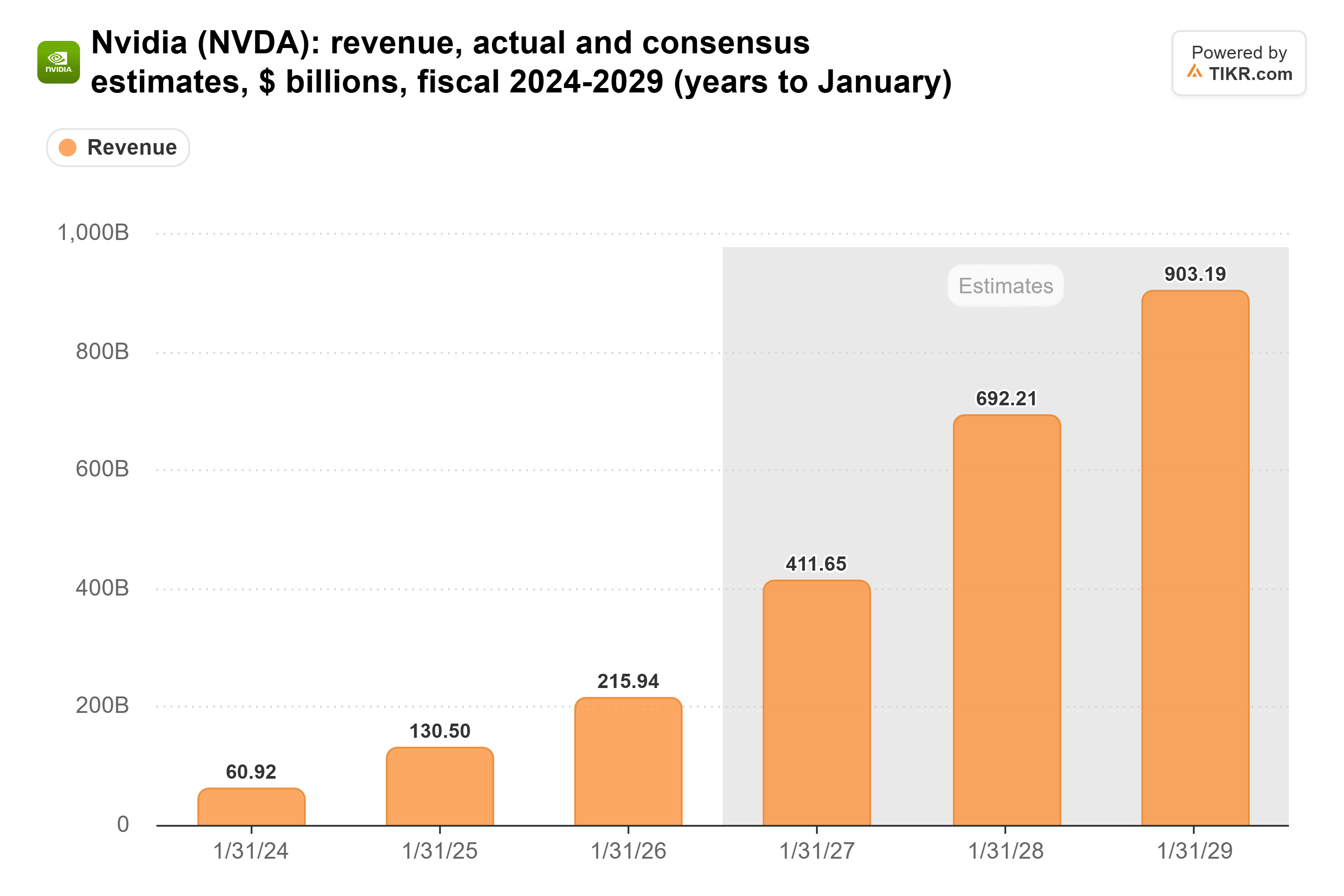
The buildout Nvidia has been backstopping shows up in its own estimates, too. Analysts expect revenue to nearly double, from $216 billion in the year ended January 2026 to $412 billion in the year ending January 2027, and to reach $903 billion two years after that.
Investors already doubt those later years. Nvidia trades at 15x forward earnings. That’s less than half its five-year average of 36x, and in general it’s pricing like the semiconductor supercycle is soon to end.
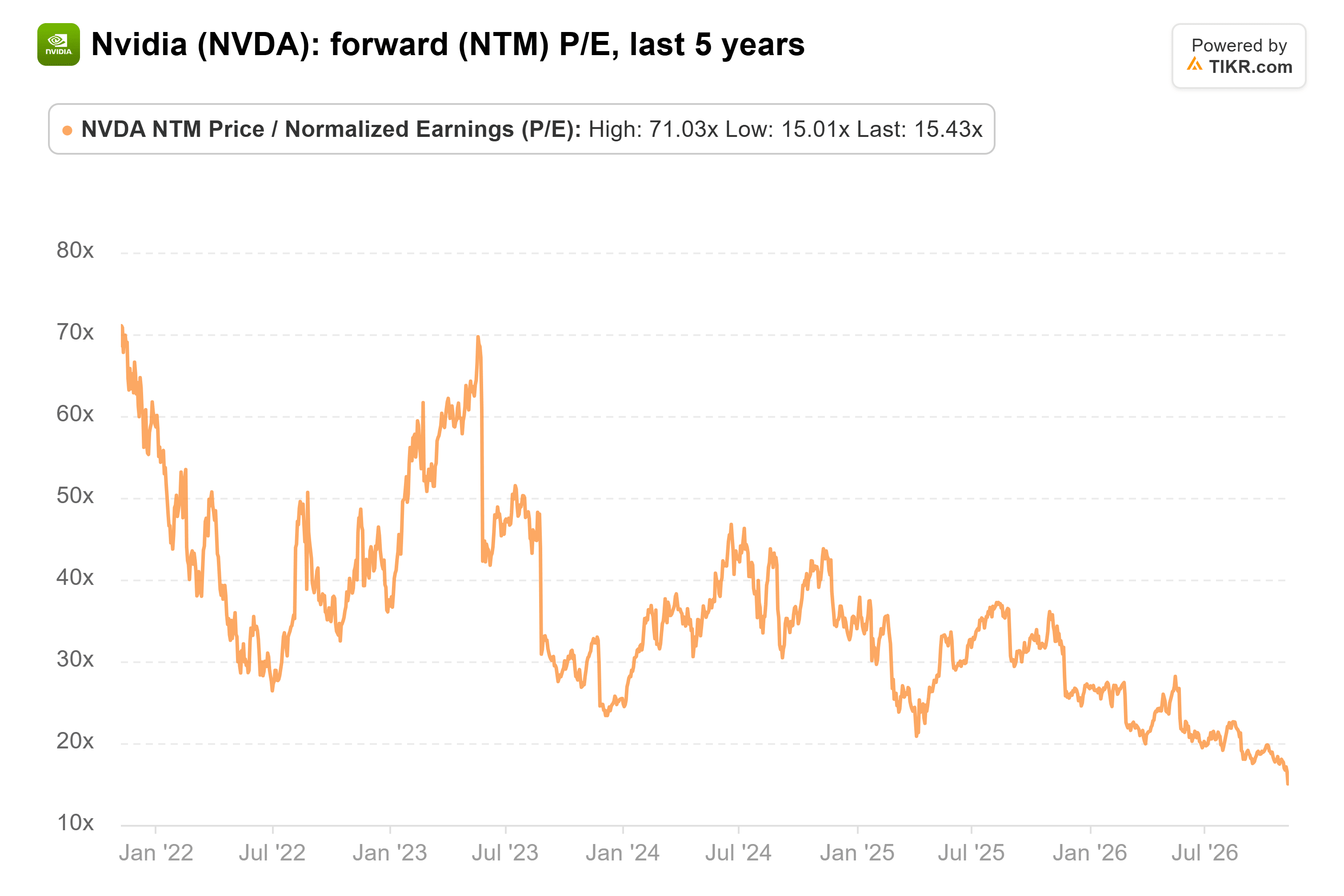
If the buildout stalls, the estimates are what fall next.
Credit was already cracking
CoreWeave shows why that safety net matters. It borrowed heavily to build, and its interest expense went from $28 million in 2023 to $1.23 billion in 2025.
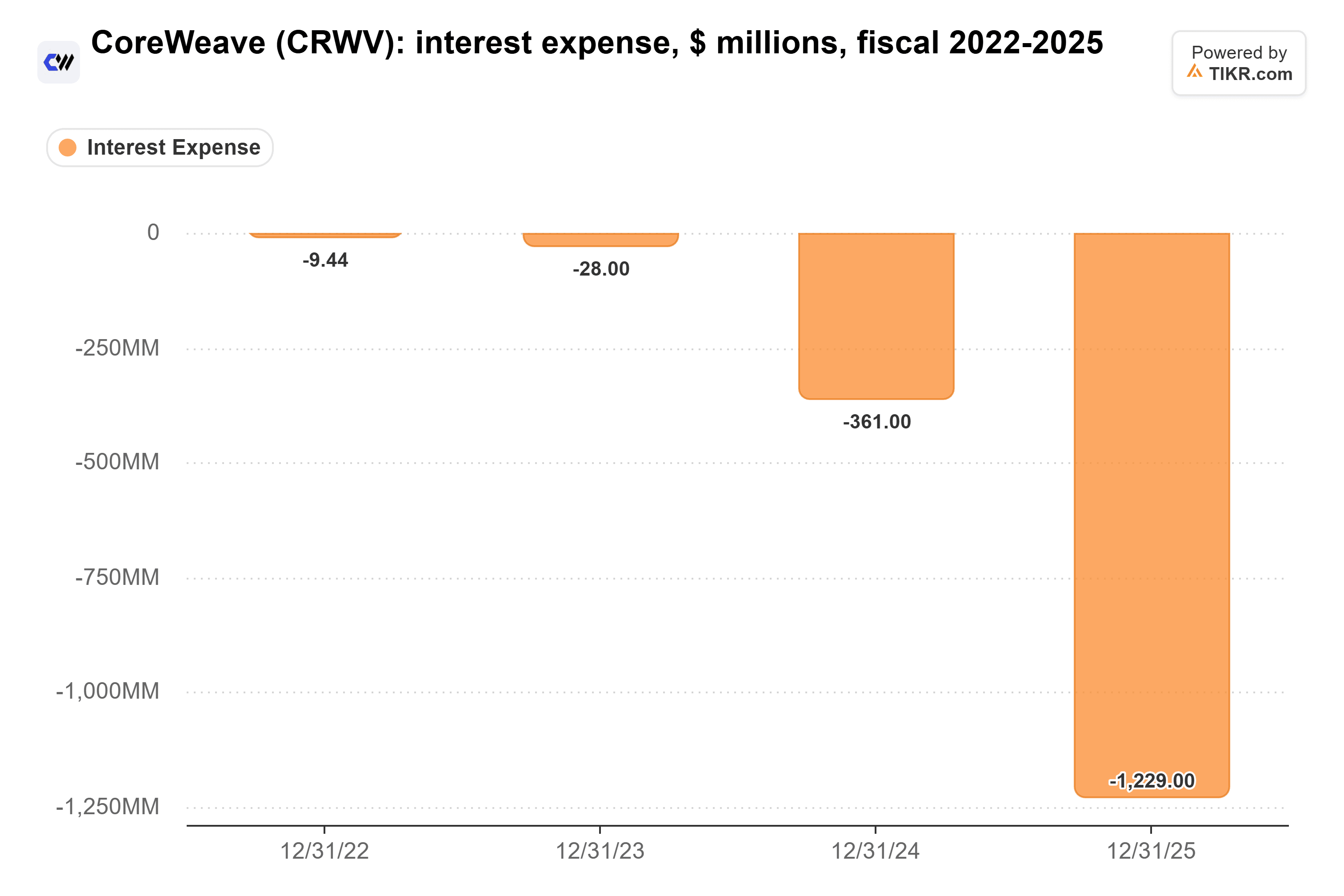
It’s carrying about $51.6 billion of debt, and lenders are now pricing it like a company in distress. Its 2032 bonds yield north of 16%, and its five-year credit default swaps topped 1,289 basis points on Nov. 5, per Deutsche Bank. Nvidia’s were about 139.
Then there’s Microsoft (MSFT), which supplied 62% of CoreWeave’s 2024 revenue. It’s shrinking its roster of neocloud partners, and CNBC reported on Friday that it chose not to renew a deal with Oracle (ORCL). Microsoft hasn’t decided which neoclouds it’ll drop yet, according to CNBC’s sources, but none leans on it like CoreWeave does.
I’m skeptical lenders will do a whole lot more with politics this uncertain. What worries me is a state putting a data center moratorium on the ballot and passing it in a landslide. Last week’s local votes showed how that could go: about 82% of voters in Alhambra, California backed a citywide ban on data center construction. Texas’s governor-elect, Gina Hinojosa, campaigned on a statewide moratorium, and Goldman Sachs estimates moratoriums could affect 45% of planned U.S. data center capacity. No wonder Nvidia’s own stock sank 9% on Nov. 5.
Jensen won’t have a free hand
So the AI buildout needs Nvidia’s balance sheet more than ever, just as Huang comes under investigation. A committee of independent directors with outside counsel is running the board’s inquiry. And three House Republican committee chairs have asked him to a closed-door briefing on Nov. 18.
I’d guess a CEO in that spot won’t have nearly as free a hand to guarantee the next OpenAI campus or take on another neocloud’s unused capacity while the investigation is ongoing. I’d also expect his board to think twice before adding to their off-balance-sheet exposure purely on his say-so.
Plenty is still unknown. The board says it has no reason to believe national security or Nvidia secrets were compromised, and Huang stays CEO. But you can see how this all works its way through the system.
It could be the last straw
The way I see it, the Huang news probably isn’t enough to topple the AI trade on its own. But for a buildout this strained already, it could be the straw that breaks the camel’s back.
We’ll know a lot more soon. CoreWeave reports tomorrow and Nvidia reports on Nov. 17, and Huang’s House briefing is the day after. Of course, if CoreWeave’s customers hold firm and the board clears Huang quickly, this could all blow over. Fow now.
But any signal of slowdown in lending capacity or demand could rapidly spread contagion through the whole trade.
So what is Nvidia stock actually worth?
TIKR lets you forecast the future price of any stock in less than a minute. Just enter a few assumptions into TIKR’s valuation model and see what Nvidia could be worth. Start from Wall Street consensus estimates, or adjust the inputs to reflect your own view of the business. It’s free to use.
Disclaimer:
Please note that the articles on TIKR are not intended to serve as investment or financial advice from TIKR or our content team, nor are they recommendations to buy or sell any stocks. We create our content based on TIKR Terminal’s investment data and analysts’ estimates. Our analysis might not include recent company news or important updates. TIKR has no position in any of the stocks mentioned. Thank you for reading, and happy investing!