Key Stats for Uber Stock
- Current Price: $78.80
- Target Price (Mid): ~$225
- Street Target: ~$102
- Potential Total Return: ~185%
- Annualized IRR: ~27% / year
Now Live: Discover how much upside your favorite stocks could have using TIKR’s new Valuation Model (It’s free) >>>
What Happened?
Uber Technologies (UBER) closed at $78.80 on August 21, roughly 23% below the $101.99 high it set within the past year. The reason for the slide is not hidden. It is a single word: Waymo. In late July, Uber confirmed that Waymo had notified it of plans to launch its own app in Austin and Atlanta in January 2028, ending the exclusivity that kept Waymo’s robotaxis available only through Uber there. The existing Waymo fleet stays on the Uber app through at least May 2028, but the signal was enough: shares fell more than 4% on July 24 and closed below $66, their lowest level in over a year and the floor of a 34.13% drawdown.
If the most advanced robotaxi operator no longer needs Uber’s app, does Uber’s moat survive the autonomous era? It is a fair question, and the second-quarter results, reported August 5, answer it more directly than the share price suggests.
The Business Accelerated While the Stock Got Sold
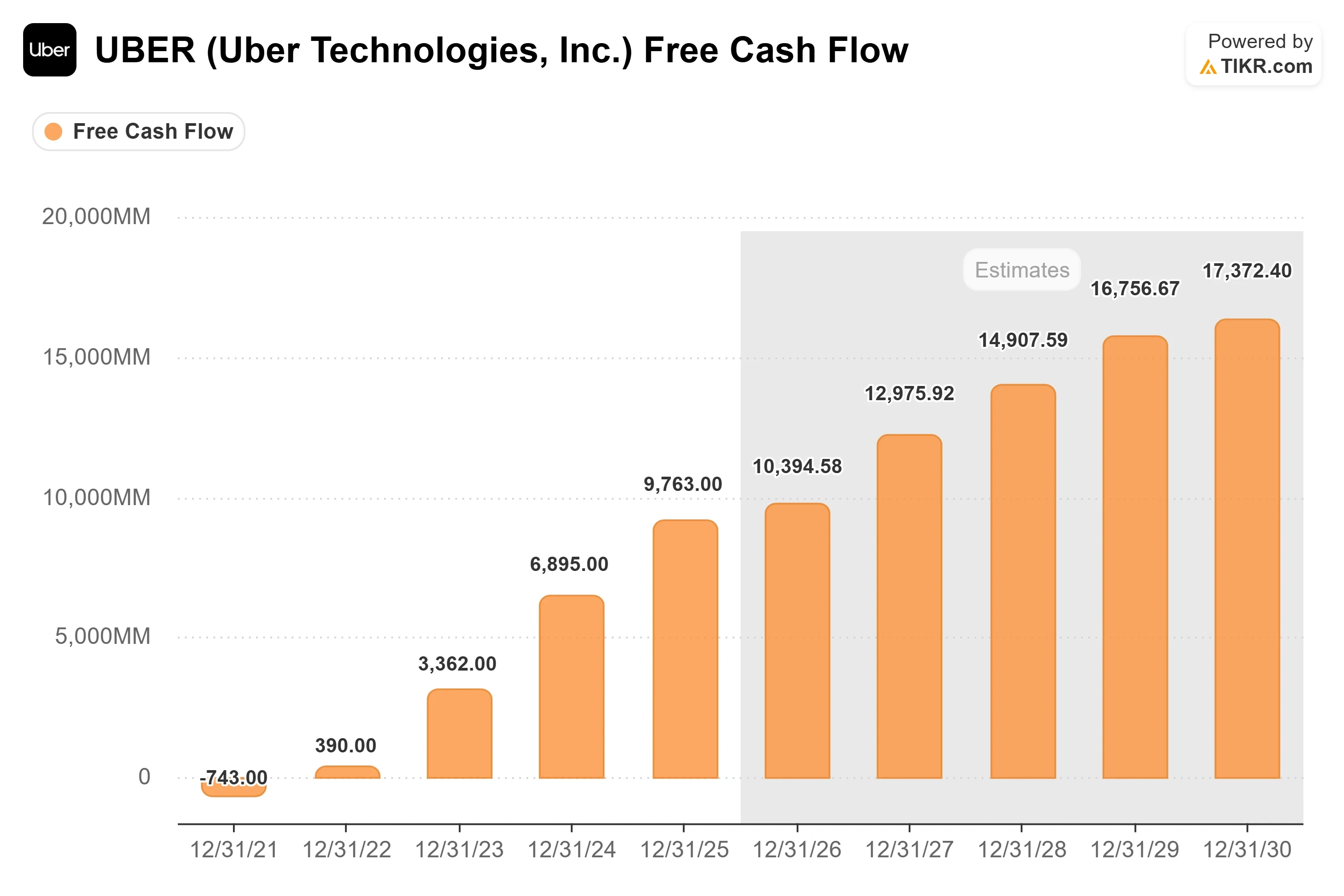
Uber’s Q2 was not the quarter of a company being disintermediated. Gross bookings grew 22% year over year to more than $58 billion, the fourth straight quarter above 20%. Revenue reached $14.19 billion, up 12%, with the gap to bookings driven partly by a UK accounting change rather than weaker demand. Adjusted EBITDA rose 33% to $2.82 billion, and trailing twelve-month free cash flow crossed $10 billion for the first time in the company’s history.
CEO Dara Khosrowshahi framed the AV question as a market structure that favors an aggregator. “A few years ago, many expected AI to converge around a single foundation model. Instead, multiple frontier models have emerged alongside a growing open source ecosystem,” he told analysts, arguing that autonomous vehicles as “physical AI” will fragment the same way. A fragmented supplier base needs a demand aggregator, and Uber wants to be “the world’s leading commercialization platform for autonomous vehicles.”
Through August, Uber went live with Baidu’s Apollo Go in Dubai, announced a 2,000-vehicle partnership with China’s Pony.ai for Europe, and expanded a drone tie-up with Zipline. Management reiterated it is on track for 15 AV cities by year-end, up from 7, with Nuro, Lucid, Zoox, Wayve, and Rivian in the pipeline, detailed in Uber’s investor relations materials. No single partner replaces Waymo. The point is that Uber refuses to depend on one, and with AVs still “less than 0.5% of our overall trip volume,” it has time to shape its own supply side.

See historical and forward estimates for Uber stock (It’s free!) >>>
A $966 Million Fine the Market Waved Through
On August 21, the Dutch Data Protection Authority fined Uber €825 million ($966 million) for using automated systems to deactivate driver accounts without human review, in practices Uber says were discontinued years ago. It ranks as the second-largest penalty ever issued under Europe’s GDPR, behind only a 2023 fine against Meta. Uber said it strongly disagrees and will appeal.
Investors did the math: $966 million is under 2% of Uber’s 2025 revenue, the penalty is under appeal, and it concerns policies that no longer exist. A market braced for bad news treated a near-billion-dollar headline as noise, which is often what a bottoming stock looks like.
Uber trades at 13.5 times next-twelve-month market cap to free cash flow, near the low end of its own one-year range, for a 7.4% forward FCF yield. For a business compounding bookings above 20% and generating more than $10 billion in annual cash, that is a valuation the market assigns to a company it fears, not one it believes in.
See how Uber performs against its peers in TIKR (It’s free!) >>>
TIKR Advanced Model Analysis
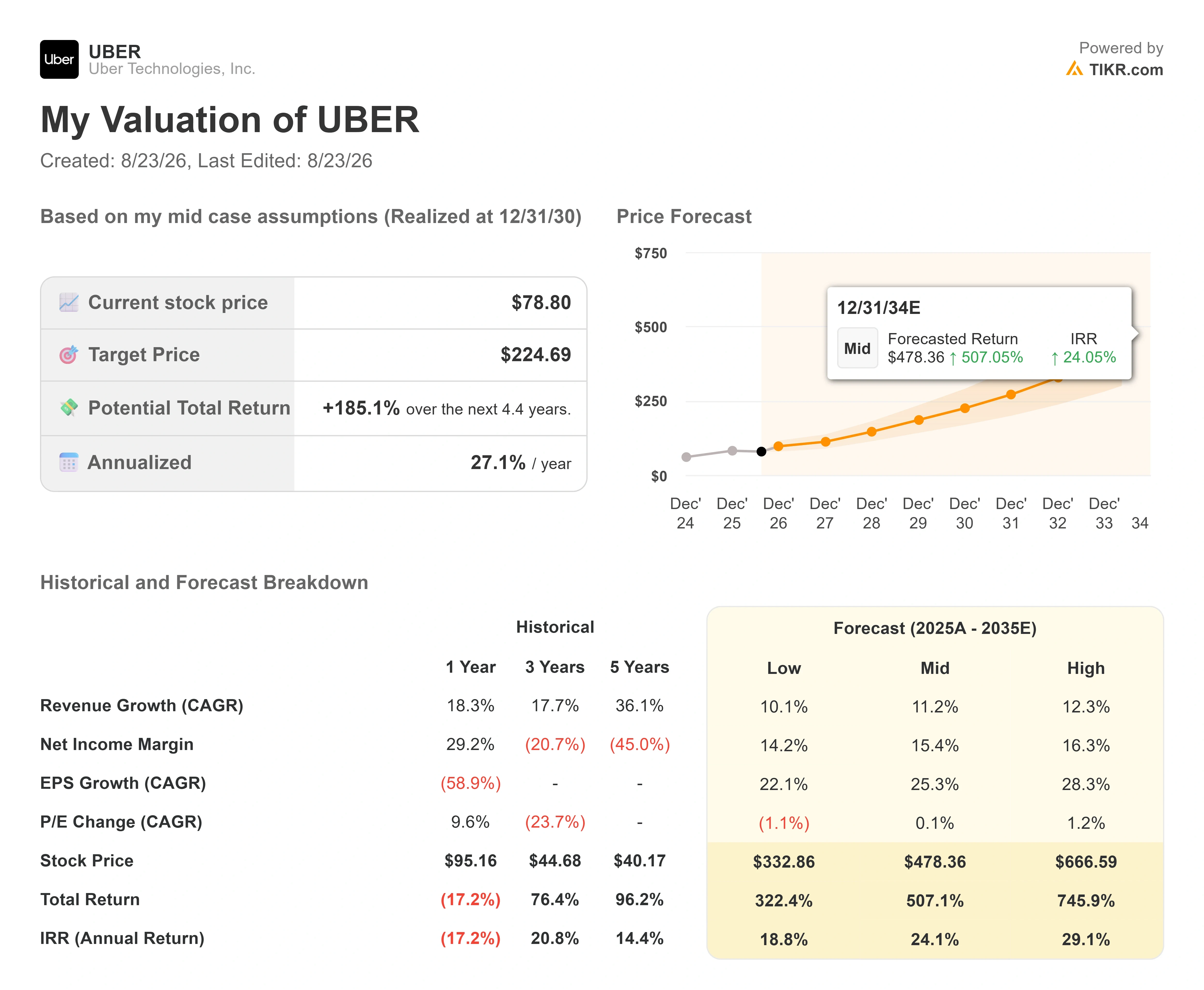
- Current Price: $78.80
- Target Price (Mid): ~$225
- Potential Total Return: ~185%
- Annualized IRR: ~27% / year
See analysts’ growth forecasts and price targets for Uber stock (It’s free!) >>>
TIKR’s mid-case model values Uber at around $225 by the end of 2030, implying roughly 185% total return, or about 27% annualized over 4.4 years. Two drivers carry it. The first is durable growth, with revenue modeled at an 11% CAGR through 2035 as Mobility compounds and the Delivery Hero deal extends the platform to nearly 100 markets. The second is margin expansion, with net income margin modeled near 15% as AI efficiency and insurance savings drop through. CFO Balaji Krishnamurthy noted engineers now see “a doubling in the code output per engineer” from AI coding tools.
The upside: if AV supply fragments as management expects, Uber’s aggregation becomes more valuable, and the multiple re-rates. The downside: if Waymo’s exit is the first of many and riders migrate to operator-owned apps, the aggregation thesis weakens, and both growth and margins compress. At around $102, the Street mean sits far below the model, reflecting how much of the AV outcome is still unresolved.
Conclusion
The next test is October 29, when Uber reports Q3 against guidance of $0.84 to $0.88 in adjusted EPS. Watch two things above the headline: whether Mobility bookings hold their 20%-plus pace, and whether AV per-vehicle utilization, which management pegged at mid-to-high 20s and low 30s trips per day, keeps climbing across the newly launched cities. A clean print on both suggests the Waymo departure reshuffled the supplier map without denting demand. Soft Mobility growth or stalling AV utilization would tell that the fear was pointing at something real. Until then, the stock is priced for the pessimistic answer to a question the fundamentals have not yet confirmed.
See what stocks billionaire investors are buying so you can follow the smart money with TIKR.
Should You Invest in Uber?
The only way to really know is to look at the numbers yourself. TIKR gives you free access to the same institutional-quality financial data that professional analysts use to answer exactly that question.
Pull up Uber, and you’ll see years of historical financials, what Wall Street analysts expect for revenue and earnings in the quarters ahead, how valuation multiples have moved over time, and whether price targets are trending up or down.
You can build a free watchlist to track Uber alongside every other stock on your radar. No credit card required. Just the data you need to decide for yourself.
Looking for New Opportunities?
- See what stocks billionaire investors are buying so you can follow the smart money.
- Analyze stocks in as little as 5 minutes with TIKR’s all-in-one, easy-to-use platform.
- The more rocks you overturn… the more opportunities you’ll uncover. Search 100K+ global stocks, global top investor holdings, and more with TIKR.
Disclaimer:
Please note that the articles on TIKR are not intended to serve as investment or financial advice from TIKR or our content team, nor are they recommendations to buy or sell any stocks. We create our content based on TIKR Terminal’s investment data and analysts’ estimates. Our analysis might not include recent company news or important updates. TIKR has no position in any stocks mentioned. Thank you for reading, and happy investing!