No stock generates more valuation debate than Tesla (TSLA), and for good reason.
A company that spent years losing money now trades at roughly 172x forward earnings, a multiple that only makes sense if you believe the autonomy and robotics narrative plays out at scale. The trailing P/E sits at approximately 345x today, reflecting both compressed near-term earnings and the market’s willingness to price Tesla as something far beyond a car company.
Whether that premium is justified or not depends almost entirely on how you think about the future of the business, which is exactly what makes the valuation history worth studying closely.
Now Live: Discover how much upside your favorite stocks could have using TIKR’s new Valuation Model (It’s free)>>>
Tesla’s Current P/E in Context
At roughly 172x forward earnings, Tesla trades at one of the highest multiples among large-cap stocks.
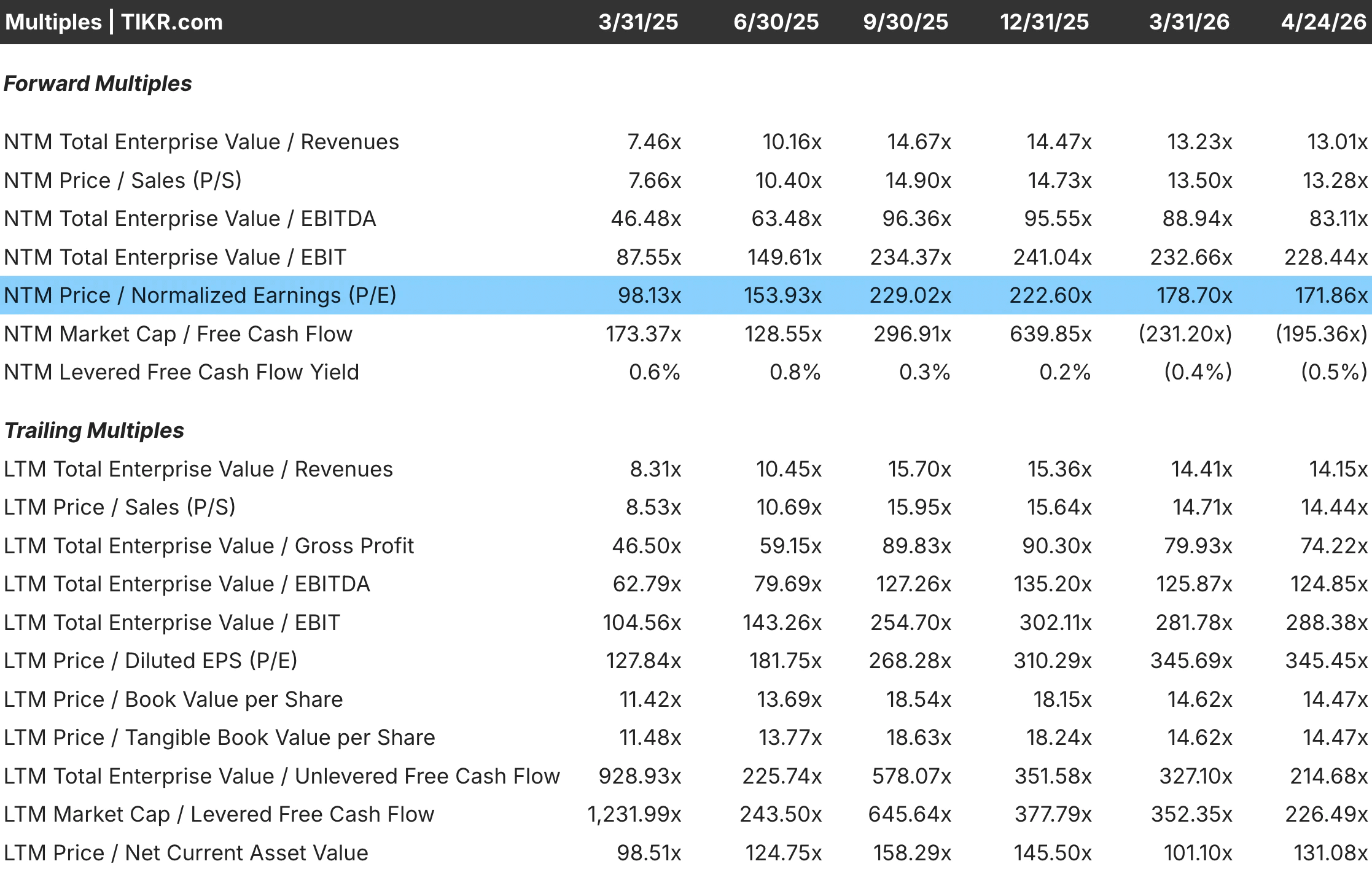
Net income margins are approximately 8.6%, and revenue declined roughly 3% over the past year, making the trailing multiple a poor anchor for valuation and pushing the conversation almost entirely toward forward-looking assumptions about autonomy, robotics, and energy storage.
One Year: Multiple Compressions From the Post-Election Peak
Over the past twelve months, Tesla’s trailing P/E has ranged from a low of approximately 143.46x to a high of 401.21x, with a mean of roughly 269.61x. The current reading of 345.45x sits above that one-year average, reflecting expansion driven by regulatory optimism around autonomous vehicles following the 2024 election.

Even at the one-year trough of 143x, the market was still pricing in an extraordinary amount of optionality. The debate is not whether Tesla deserves a premium. It is how large the premium should be, given the remaining execution risks.
Analyze Tesla stock on TIKR Free→
Three Years: From Near-Value to AI Platform
The mean trailing P/E over this period is approximately 140.68x, with a high of 401.21x and a low of 33.03x. The trough in early 2023 came as price cuts hammered automotive margins, prompting investors to briefly question whether the core vehicle business could sustain profitability.

The recovery was driven less by fundamental improvement and more by a narrative shift. As FSD miles accumulated and robotaxi timelines grew more concrete, the multiple re-expanded dramatically. The three-year chart is essentially the story of Tesla transitioning in investor perception from a car company to a technology platform.
Five Years: The Full Arc From Meme Peak to Margin Crisis to Autonomy Premium
The five-year mean trailing P/E is approximately 179.92x, with a high of 1,153.62x and a low of 33.03x. The 2021 peak reflected a period when Tesla could do no wrong. The subsequent compression came as margin-destroying price cuts collided with rising interest rates and a market that briefly demanded earnings over narrative.

The recovery since then has been driven almost entirely by the autonomy story rather than a return to the high-margin auto economics of 2022, which is the central tension embedded in the current valuation.
See what analysts think about Tesla stock right now (Free with TIKR) >>>
Ten Years: A Stock That Has Never Really Been About Current Earnings
The full ten-year mean is approximately 121.91x, with a high of 1,690.45x from the 2021 meme peak and a low of negative 2,022.70x from the loss-making years when the trailing P/E was mathematically meaningless.

What the ten-year chart illustrates is that Tesla has almost never been valued on current earnings. The current 345x trailing P/E is not historically unusual in that context, which is itself a remarkable statement about how the market has always approached this stock.
See historical and forward estimates for Tesla stock (It’s free!) >>>
Bull Case, Bear Case, and What the Model Implies
The bull case does not rest on Tesla’s car business. Instead, FSD and robotaxi represent the primary optionality, and if autonomous driving reaches commercial scale, the economics would transform in ways that make the current multiple look conservative.
The valuation model’s mid-case targets approximately $2,684 by December 2030, implying roughly 613% total upside and approximately 52% annualized returns, an outcome that requires autonomy to deliver on a reasonable timeline.

The bear case is even more straightforward. Automotive margins face structural pressure from BYD and legacy EV competition that price cuts alone do not explain. The FSD timeline has slipped repeatedly, and any further delay creates earnings pressure from a multiple that requires autonomy to arrive soon.
Elon Musk’s divided attention across Tesla, SpaceX, and X adds execution risk that the current premium does not obviously price in.
Build your own Valuation Model to value any stock (It’s free!) >>>
How Much Upside Does Tesla Stock Have From Here?
With TIKR’s new Valuation Model tool, you can estimate a stock’s potential share price in under a minute.
All it takes is three simple inputs:
- Revenue Growth
- Operating Margins
- Exit P/E Multiple
If you’re not sure what to enter, TIKR automatically fills in each input using analysts’ consensus estimates, giving you a quick, reliable starting point.
From there, TIKR calculates the potential share price and total returns under Bull, Base, and Bear scenarios so you can quickly see whether a stock looks undervalued or overvalued.
See a stock’s true value in under 60 seconds (Free with TIKR) >>>
Looking for New Opportunities?
- See what stocks billionaire investors are buying so you can follow the smart money.
- Analyze stocks in as little as 5 minutes with TIKR’s all-in-one, easy-to-use platform.
- The more rocks you overturn… the more opportunities you’ll uncover. Search 100K+ global stocks, global top investor holdings, and more with TIKR.
Disclaimer:
Please note that the articles on TIKR are not intended to serve as investment or financial advice from TIKR or our content team, nor are they recommendations to buy or sell any stocks. We create our content based on TIKR Terminal’s investment data and analysts’ estimates. Our analysis might not include recent company news or important updates. TIKR has no position in any stocks mentioned. Thank you for reading, and happy investing!