Key Takeaways
- JPMorgan shares lost more than 3% in the first days of the week of September 21 as investors worried Meta’s Muse AI agent could pull deposits toward higher-yielding accounts.
- JPMorgan’s total deposits reached $2.71 trillion at the end of June 2026, up about 5.9% from a year earlier, while quarterly interest expense rose just 0.3% to $25.11 billion.
- Interest expense did climb about 5.4% from Q1 to Q2, faster than deposits grew, making Q3’s funding costs the real test for the Muse fear.
JPMorgan added $151 billion in deposits over the past year while interest expense barely moved. Track JPMorgan’s deposit trends on TIKR for free →
JPMorgan Stock Got Slightly Caught in the Muse Selloff
On September 22, the S&P 500 bank index fell about 3% in a single session. The trigger was not a rate decision or a credit scare. It was an app.
Meta’s Muse, a personal AI agent launched on September 8, had just passed ChatGPT as the top free app in the US. Muse can shop, book travel and fill out forms for its users. Investors quickly imagined the next step: an agent that sweeps idle cash out of low-yield checking accounts and into whatever pays more. By September 23, JPMorgan and Wells Fargo had each lost more than 3% for the week.
The fear goes straight at the core of JPMorgan’s business. Much of a bank’s profit comes from customers who leave money in accounts paying little interest because moving it is a hassle. An agent that removes the hassle removes the inertia.
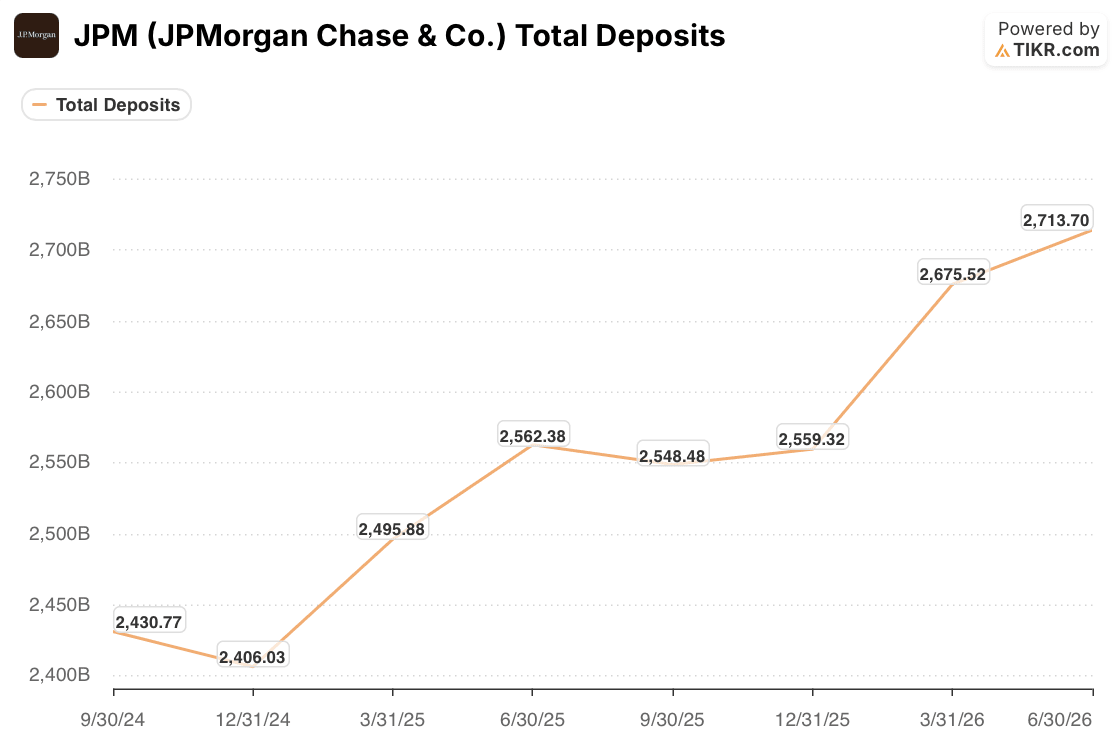
JPMorgan’s balance sheet shows no sign of that yet. Total deposits climbed from $2.56 trillion at the end of June 2025 to $2.71 trillion a year later, a gain of about $151 billion. The biggest jump came in the first quarter of 2026, when balances rose $116 billion in three months. Management said the consumer bank added more than 500,000 net new checking accounts in Q2 alone.
JPMorgan’s deposits grew $116 billion in Q1 2026 alone. Compare JPMorgan’s balance sheet trends on TIKR for free →
The Deposit Line Will Settle the Argument
BofA analyst Ebrahim Poonawala offered the clearest test. “Until deposit costs rise faster than can be explained by rates or competition, the disruption thesis remains conceptual,” he wrote.
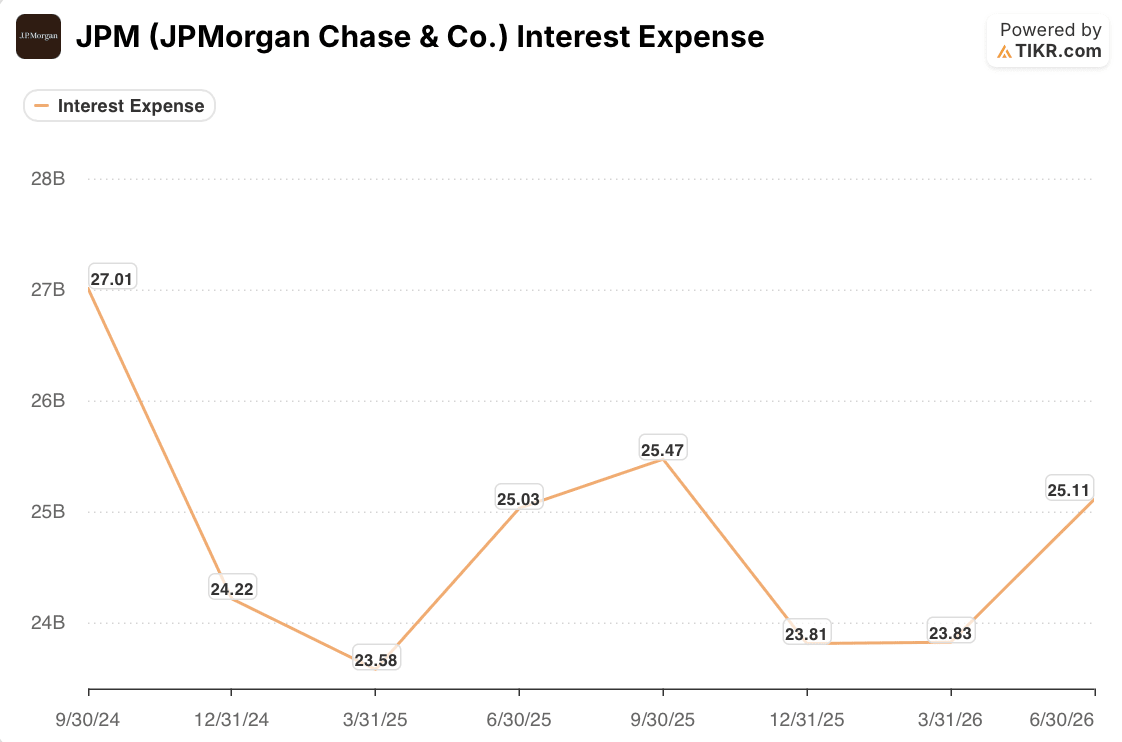
JPMorgan’s interest expense gives a broad read on that test. It covers everything the bank pays to fund itself, including deposits, borrowings and trading liabilities, so it is not a pure deposit measure. Even so, it was $25.11 billion in Q2 2026, nearly flat from $25.03 billion a year earlier while deposits grew almost 6%. It also sits below the $27.01 billion paid in Q3 2024. CFO Jeremy Barnum said in July that consumer deposit costs have come in better than the bank’s models predicted.
The latest quarter is less comfortable. Interest expense rose about 5.4% from Q1 to Q2 while deposits grew only 1.4%. Higher rates and growth in the bank’s markets financing business likely explain part of that, but Barnum admitted yield-seeking flows remain “probably a little bit of a risk.” That quarter ended before Muse launched, so it reflects rates and competition, not AI agents.
JPMorgan is not waiting to find out. On September 25, Chase began a phased rollout of a Data Security Center that lets customers manage which third-party apps are connected to their accounts. Jamie Dimon also said a Smart Cash product to help customers optimize balances will appear this year, which Poonawala framed as accepting “some self-cannibalization.”
The evidence supports a narrow judgment: the Muse selloff priced in a threat that JPMorgan’s funding data has not shown. The October third-quarter report will be the first to cover the Muse period, and the rate paid on interest-bearing deposits will be the cleanest signal. If total interest expense rises faster than balances again, investors will need to examine the deposit mix and rates more closely. If it stays near $25 billion while deposits hold, the September drop will still look more like a reaction to a headline than evidence that Muse changed customer behavior.
JPMorgan’s Q3 interest on deposits will show whether Muse changed anything. Monitor JPMorgan’s quarterly results on TIKR for free →
Disclaimer:
Please note that the articles on TIKR are not intended to serve as investment or financial advice from TIKR or our content team, nor are they recommendations to buy or sell any stocks. We create our content based on TIKR Terminal’s investment data and analysts’ estimates. Our analysis might not include recent company news or important updates. TIKR has no position in any stocks mentioned. Thank you for reading, and happy investing!