Key Stats for Robinhood Stock
- Current Price: $73.64
- Target Price (Mid): ~$161
- Street Target: ~$98
- Potential Total Return: ~119%
- Annualized IRR: ~19% / year
- Earnings Reaction: (13.24%) on 4/29/26
- Max Drawdown: (57.26%) on 3/30/26
Now Live: Discover how much upside your favorite stocks could have using TIKR’s new Valuation Model (It’s free) >>>
What Happened?
Robinhood Markets (HOOD) peaked at $153.86 in October 2025, then lost more than half its value over the following months. The stock hit a max drawdown of 57.26% on March 30, 2026, partially recovered, then fell another 13.24% on April 29 after Q1 2026 earnings came in below expectations. At $73.64 today, HOOD sits 52% below that high.
The bear case is familiar: Robinhood is a crypto-dependent trading platform, Q1 proved it, and the current valuation is hard to justify without a crypto tailwind. What Steve Quirk, Chief Brokerage Officer at Robinhood, said at the JPMorgan 54th Annual Global Technology, Media and Communications Conference on May 19 doesn’t support that reading. Quirk detailed a business expanding into wealth management, on the verge of owning its own prediction markets exchange, and positioned to recapture traders it lost to a 25-year-old regulation that was just eliminated. None of those three things were in Q1 numbers.
What the Q1 Numbers Missed
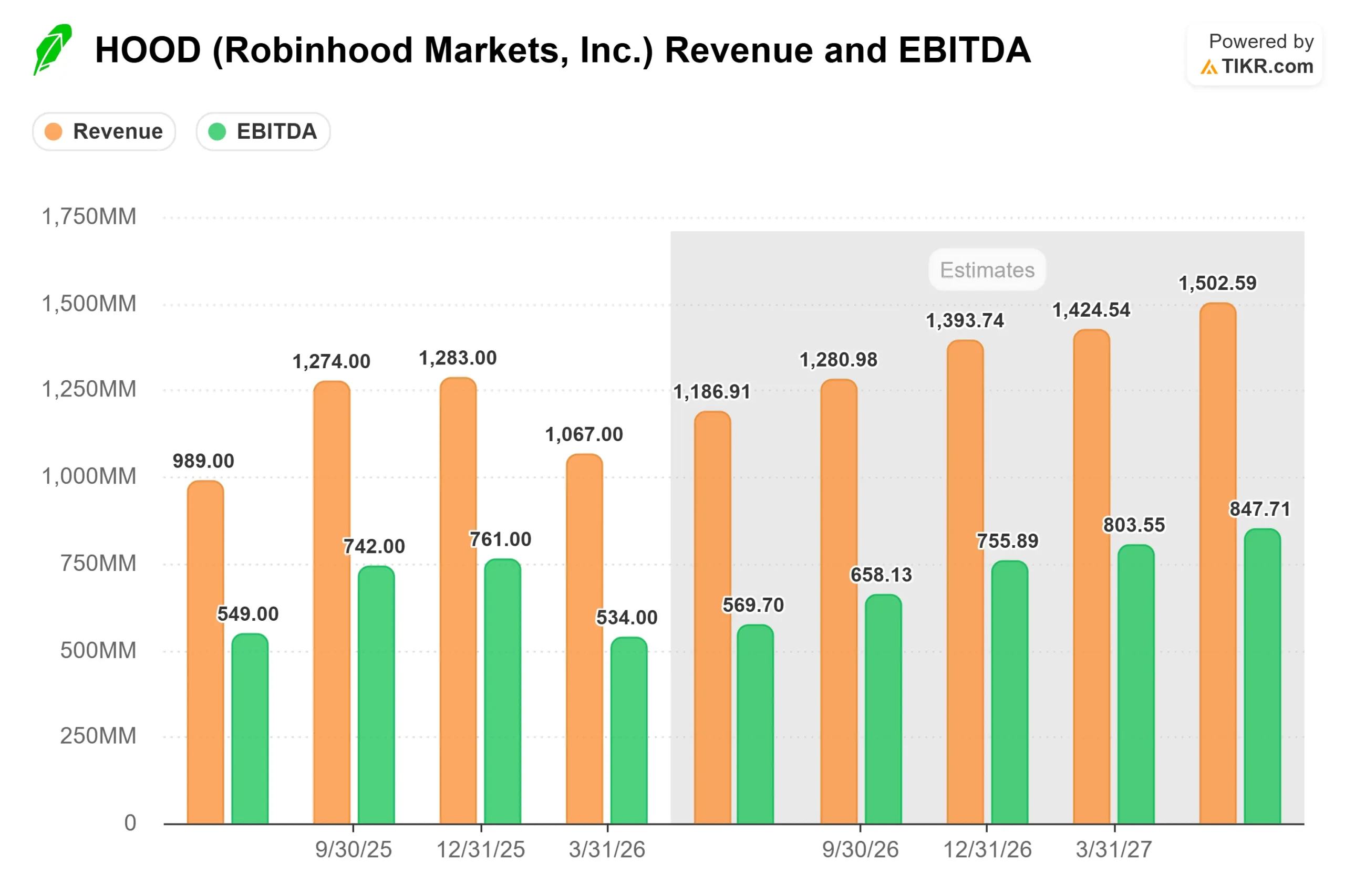
Robinhood reported Q1 2026 revenue of $1.067 billion, up 15% year-over-year but 6.07% below the analyst consensus. Crypto trading revenue fell 47% year-over-year to $134 million. The stock dropped 13.24% the following session.
The miss was real, but the same quarter produced record volumes in prediction markets, futures, and index options. Net interest revenues climbed 24% year-over-year to $359 million as the margin book nearly doubled to $17 billion. Gold subscribers hit a record 4.3 million, up 36%, with a 40% attach rate for new customers. Net deposits reached $18 billion, representing 22% annualized growth and Robinhood’s third-highest quarterly figure on record. CFO Shiv Verma noted April trading volumes were on pace to be the highest month of the year, with net deposits already approximately $5 billion month-to-date. The market focused on the headline miss and moved on.
See historical and forward estimates for Robinhood stock (It’s free!) >>>
Three Things Quirk Said That Change the Calculus
The PDT rule is a re-attraction event
The SEC eliminated the Pattern Day Trader (PDT) rule on April 14, 2026, removing the $25,000 minimum equity requirement that had restricted small-account traders from active intraday trading since 2001. The new framework takes effect June 4, 2026.
The average Robinhood account holds $13,000, well below the old threshold. “This rule is one that materially impacts accounts that are under $25,000,” Quirk said. Robinhood tracked exactly where users went when they left because of PDT restrictions, a data advantage no legacy broker has. Those customers didn’t abandon the platform by choice. They left because the rule forced them out. HOOD surged more than 7% the day the SEC granted accelerated approval. That volume impact hasn’t appeared in a single reported quarter yet.
Rothera shifts the economics of Robinhood’s fastest-growing segment
Prediction markets became Robinhood’s fastest-growing revenue segment in 2025. The company traded 8.8 billion event contracts in Q1 2026 alone, a record. Until now, Robinhood routed those contracts through third-party exchanges, primarily Kalshi, absorbing distribution costs without capturing exchange-level economics.
That changes with Rothera, a joint venture with Susquehanna International Group, one of the dominant market makers in event contracts. Robinhood and Susquehanna each hold 45% of the venture, with MIAX retaining a 10% stake. The exchange carries full CFTC licensing, meaning Robinhood will list, clear, and settle contracts in-house. Quirk put it plainly at the conference: “By coming together and creating our own exchange, it gives us the freedom to drive product development, to drive who liquidity providers are and to drive the economics and the experience for our customers.” Rothera is expected to launch in Q2 2026.
Wealth management is 2.5x the self-directed market, and Robinhood hasn’t touched it
Quirk said the wealth management opportunity is 2.5 times larger than the self-directed investing market, and “we haven’t really touched that yet.” The entry point is Portfolio Overview, launched at Robinhood’s Take Flight event in March 2026. The feature connects Robinhood accounts to external accounts at legacy brokers and banks, letting customers view their full financial picture in one place. From there, Robinhood surfaces where it has better pricing or capabilities.
The specific wedge is cash yields. Legacy brokers pay low rates on customer cash balances while Robinhood’s Cash Sweep pays substantially more. “The reason why it’s the Achilles heel,” Quirk said, “is we have $345 billion in assets and they have trillions. So there’s a lot to attack there.” According to Robinhood’s own Investor Day estimates, the company’s addressable market across brokerage, crypto, banking, and wealth management exceeds $600 billion in total revenue opportunity. Wealth management is the largest piece and the least penetrated.

The Competitor Picture
According to the TIKR Competitors page, Robinhood trades at 32.42x NTM P/E and 26.13x NTM market cap to free cash flow as of May 22, 2026. Coinbase (COIN) trades at 71.24x NTM P/E, a premium that reflects its pure-play crypto positioning. Interactive Brokers (IBKR) trades at 31.62x NTM P/E, representing a more stable but slower-growing platform. Robinhood sits between those two. The discount to Coinbase makes sense given its revenue diversification. The near-parity with IBKR is more debatable: IBKR’s revenue is considerably more stable, but Robinhood’s consensus revenue CAGR through 2030 runs around 14% annually, well above IBKR’s growth profile. If wealth management, Rothera, and international expansion deliver as management expects, a premium to IBKR becomes a more reasonable outcome.
See how Robinhood performs against its peers in TIKR (It’s free!) >>>
TIKR Advanced Model Analysis
- Current Price: $73.64
- Target Price (Mid): ~$161
- Potential Total Return: ~119%
- Annualized IRR: ~19% / year

See analysts’ growth forecasts and price targets for Robinhood stock (It’s free!) >>>
The TIKR mid-case model projects revenue growing at around 14% annually, reaching approximately $8.7 billion by December 2030. Two things drive that growth. First, Gold subscription expansion: Gold subscribers hit 4.3 million in Q1 2026 with a 40% attach rate for new customers, well below saturation across Robinhood’s 27.4 million funded accounts. Second, net interest income from the margin lending book, which nearly doubled to $17 billion in Q1, generated $359 million in net interest revenue in a single quarter.
On margins, EBITDA reached 56.4% in fiscal 2025, and the consensus model holds above 50% through December 2030, reflecting a cost structure that is roughly 85% to 90% fixed. That operating leverage is the margin driver. In the downside scenario, persistent crypto weakness and interest rate compression push net income margins toward 38% and limit annual returns to around 10% through the forecast period.
Of 27 analysts covering HOOD, 15 rate it Buy, 4 Outperform, 5 Hold, 1 Underperform, and 2 Sell, with a mean price target of $98.40 as of May 22. That Street target implies roughly 34% upside from current levels and still falls well short of what the TIKR model suggests at the 2030 horizon.
Conclusion
The Q2 2026 earnings call, expected on July 29, is the first real test of the conference thesis. Watch transaction-based revenue: a figure above $700 million (versus $623 million in Q1) would signal the PDT re-attraction effect is real and scaling. Below $600 million would suggest crypto weakness is offsetting the regulatory tailwind and would put the 2026 consensus EBITDA estimate of around $2.59 billion under pressure.
The Rothera launch is the second signal. Management guided Q2, ending June 30. A confirmed live launch before earnings would give analysts their first data point on exchange-level margins, shifting the prediction markets story from future potential to reported economics.
See what stocks billionaire investors are buying so you can follow the smart money with TIKR.
Should You Invest in Robinhood?
The only way to really know is to look at the numbers yourself. TIKR gives you free access to the same institutional-quality financial data that professional analysts use to answer exactly that question.
Pull up Robinhood, and you’ll see years of historical financials, what Wall Street analysts expect for revenue and earnings in the quarters ahead, how valuation multiples have moved over time, and whether price targets are trending up or down.
You can build a free watchlist to track Robinhood alongside every other stock on your radar. No credit card required. Just the data you need to decide for yourself.
Analyze Robinhood on TIKR Free →
Looking for New Opportunities?
- See what stocks billionaire investors are buying so you can follow the smart money.
- Analyze stocks in as little as 5 minutes with TIKR’s all-in-one, easy-to-use platform.
- The more rocks you overturn… the more opportunities you’ll uncover. Search 100K+ global stocks, global top investor holdings, and more with TIKR.
Disclaimer:
Please note that the articles on TIKR are not intended to serve as investment or financial advice from TIKR or our content team, nor are they recommendations to buy or sell any stocks. We create our content based on TIKR Terminal’s investment data and analysts’ estimates. Our analysis might not include recent company news or important updates. TIKR has no position in any stocks mentioned. Thank you for reading, and happy investing!